
We read your photo as:
For the equation x2 + (2k+2)x + 2k+5 = 0, find the value(s) of k for which the roots are equal. If k>0, find the roots of the new equation whose roots are 2 extalpha + extalpha extbeta and 2 extbeta +
ScanSolve AI Answer
Step-by-step solution
6 steps2. (i) (a)
Identify the coefficients of the quadratic equation .
The coefficients are , , and .
Apply the condition for equal roots.
For the roots and to be equal (), the discriminant () of the quadratic equation must be zero.
Solve the equation for .
Divide the entire equation by 4:
Expand the square:
2. (i) (b)
Use the condition to select the value of .
From part (a), the positive value for is .
Substitute into the original quadratic equation to find its roots:This equation can be factored as .
So, the roots are and .Calculate the new roots.
The new roots are given as and .
Using and :
First, calculate .The new roots are 3 and 3.
Form the new quadratic equation.
A quadratic equation with roots and is given by $x^2 - (r
Still stuck on this one?
Ask a follow-up, and the answer starts from this question.
More Mathematics Questions
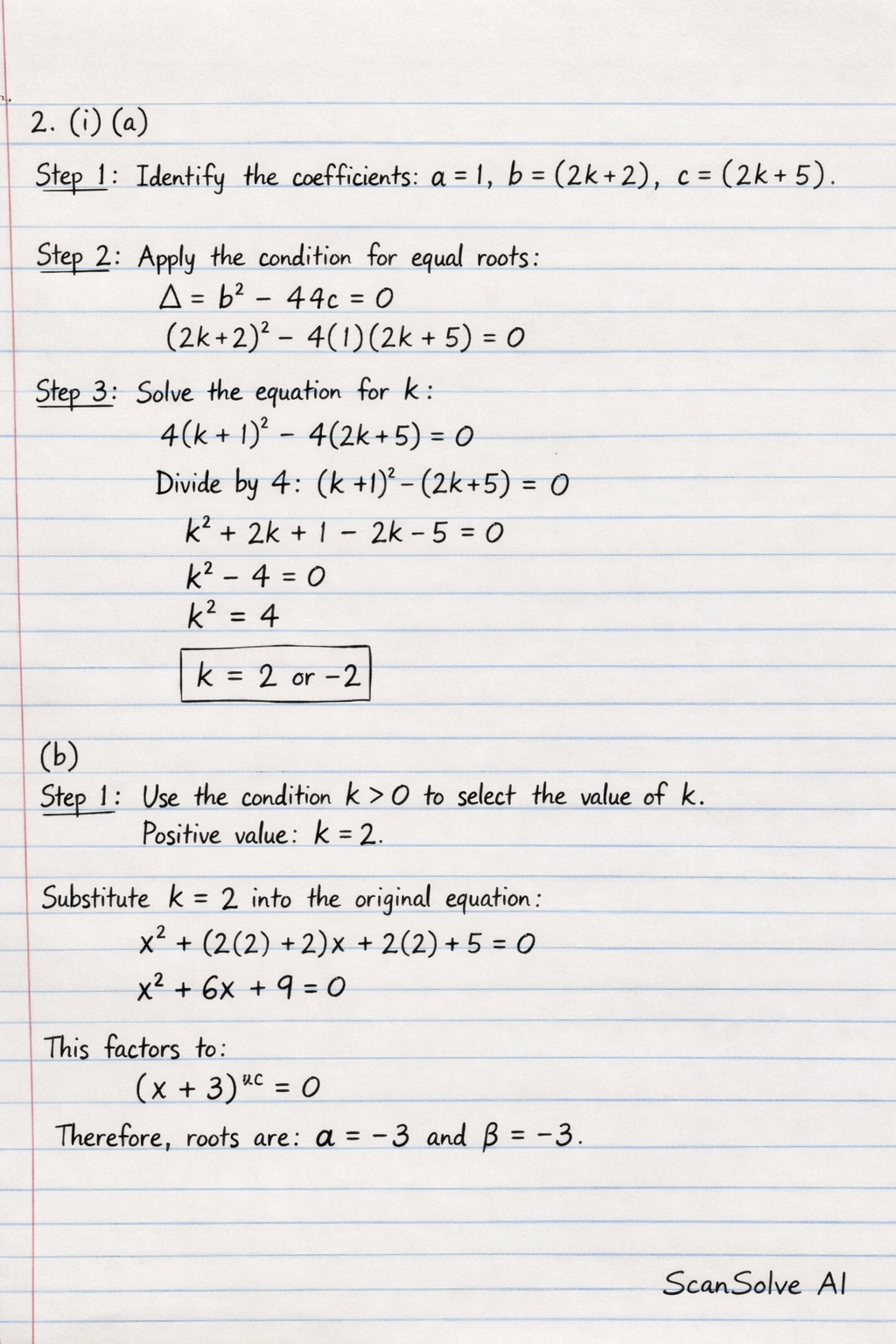
Handwritten Step-by-Step Solution
Get this as a handwritten image on WhatsApp — like a tutor wrote it for you.
Try on WhatsApp