
We read your photo as:
Form a quadratic equation where roots are 3/4 and 1/3, giving your answer in the form ax2 + bx + c = 0, whereas a, b, and c are integers.
Mathematics
ScanSolve AI Answer
Answer
Step-by-step solution
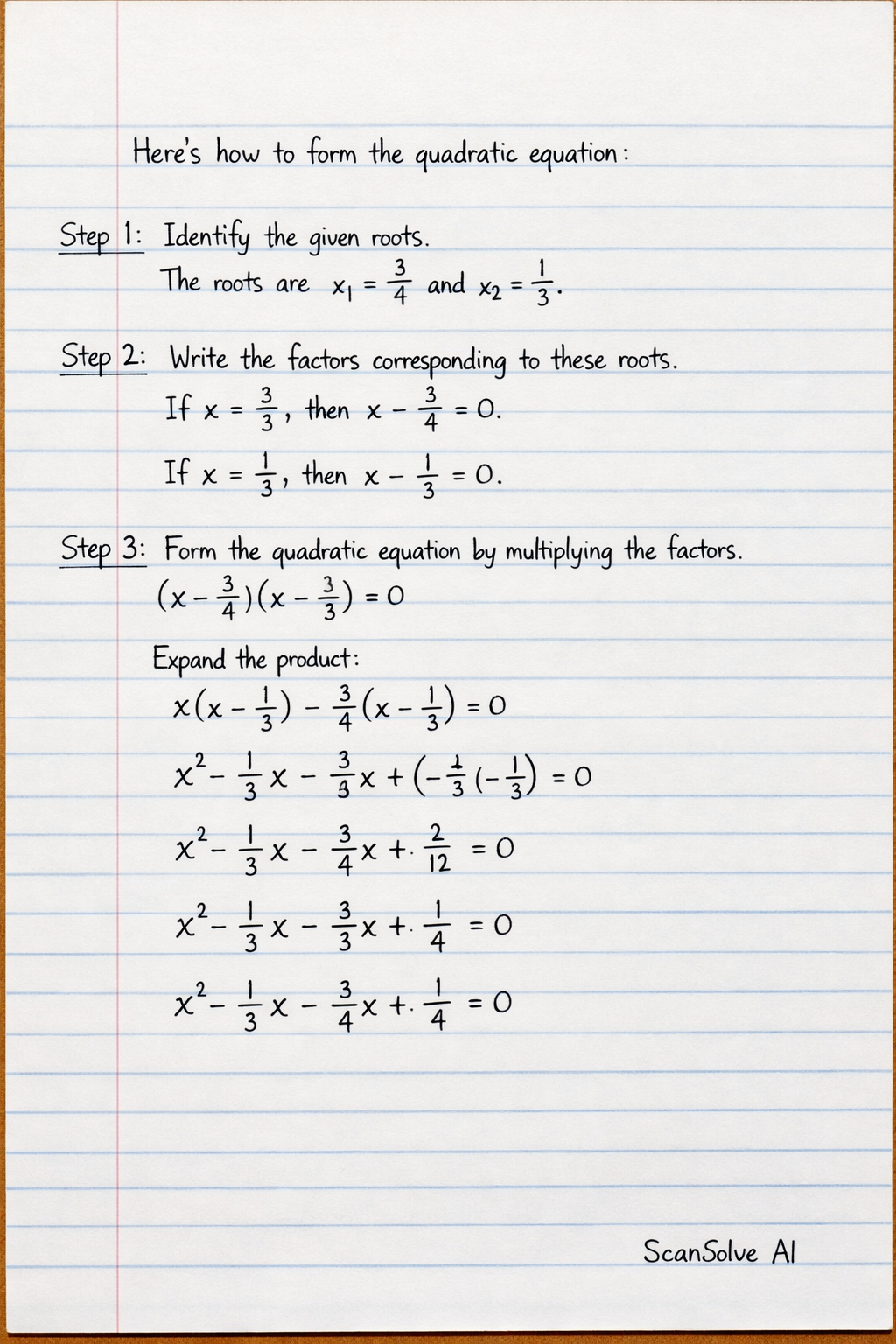
4 stepsHere's how to form the quadratic equation:
22) Form a quadratic equation where roots are and giving your answer in the form , whereas , and are integers.
Identify the given roots.
The roots are and .
Write the factors corresponding to these roots.
If , then .
If , then .Form the quadratic equation by multiplying the factors.
Expand the product:
Combine the terms and clear the denominators to get integer coefficients.
Find a common denominator for the fractions and , which is 12.
To eliminate the fractions, multiply the entire equation by the least common multiple of the denominators (12 and 4), which is 12.
Was this helpful?
Try one yourself
A new problem that tests the same skill.
Still stuck on this one?
Ask a follow-up, and the answer starts from this question.
Got a different question?Ask your own question
More Mathematics Questions
QForm the quadratic equation whose roots are 3 and 2/3.QForm a quadratic equation with roots 2/3 and −1. Which of the following options matches?QForm a quadratic equation with integer coefficients given its roots are −2.5 and 3.QThe roots of a quadratic equation are −2/3 and −1/4. Find the equation.QFind the quadratic equation with roots 2/3 and −1, and choose the correct option.
Browse by topic:Algebra
Handwritten Step-by-Step Solution
Get this as a handwritten image on WhatsApp — like a tutor wrote it for you.
Try on WhatsApp