
We read your photo as:
Given A(3, 4), B(-7, 2), and C(1, -2), find the coordinates of the mid-points K of AB and P of AC, and then find the equation of the perpendicular bisector of the line KP.
ScanSolve AI Answer
Answers
2 partsStep-by-step solution
6 stepsHere's the solution to the problem.
Part a· 2 steps
Find the coordinates of the mid-points K of AB and P of AC.
Find the coordinates of K, the midpoint of AB.
The midpoint formula for two points and is .
Given A and B:Find the coordinates of P, the midpoint of AC.
Given A and C:
The coordinates are .
Part b
Find the equation of the perpendicular bisector of the line KP.
Find the midpoint of the line segment KP.
Let M be the midpoint of KP. Given K and P:
Find the gradient of the line segment KP.
The gradient formula for two points and is .
Find the gradient of the perpendicular bisector.
The product of the gradients of two perpendicular lines is .
Let be the gradient of the perpendicular bisector.Find the equation of the perpendicular bisector.
Using the point-slope form with midpoint M and gradient :
The equation of the perpendicular bisector is .
Try one yourself
A new problem that tests the same skill.
Still stuck on this one?
Ask a follow-up, and the answer starts from this question.
More Mathematics Questions
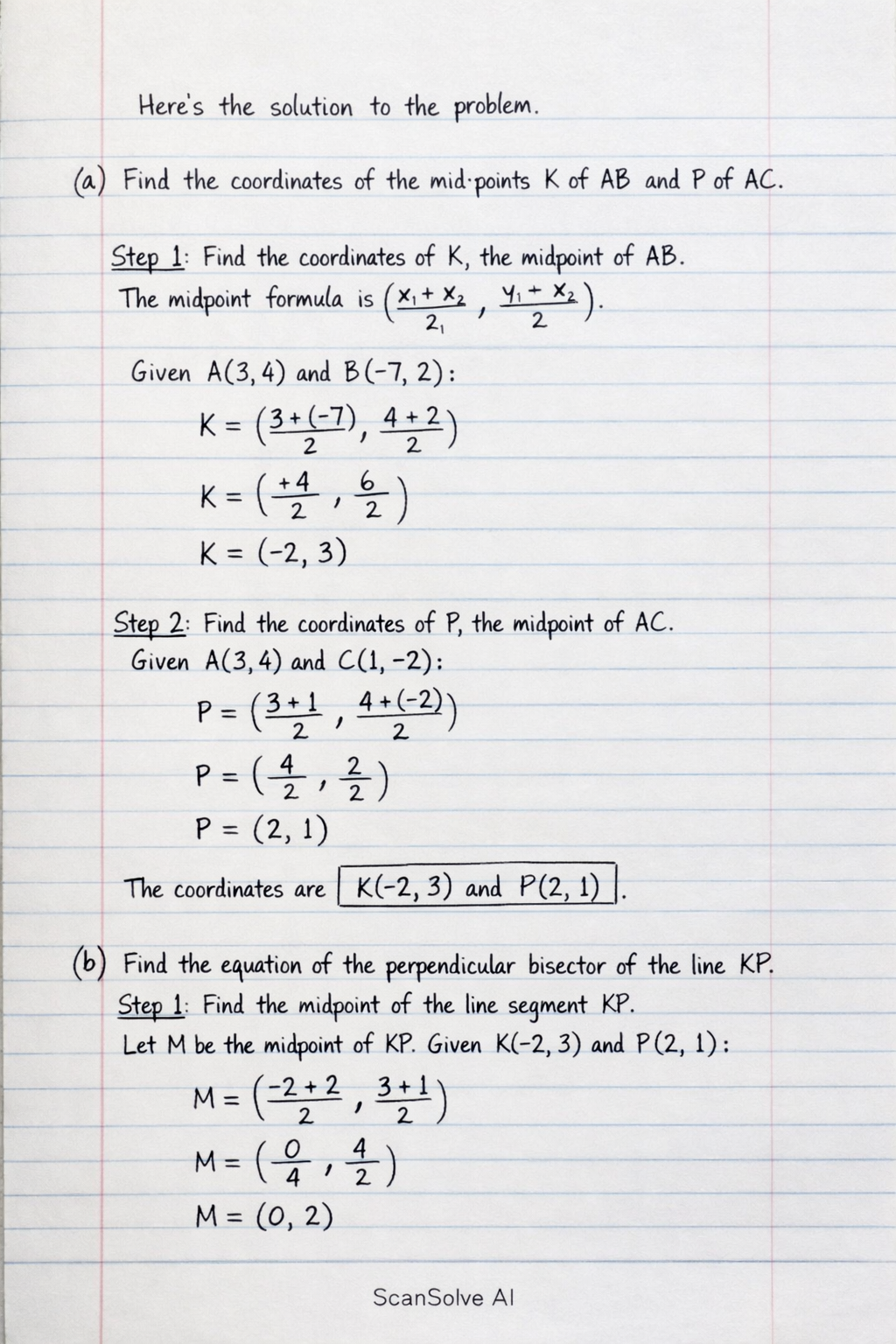
Handwritten Step-by-Step Solution
Get this as a handwritten image on WhatsApp — like a tutor wrote it for you.
Try on WhatsApp