
We read your photo as:
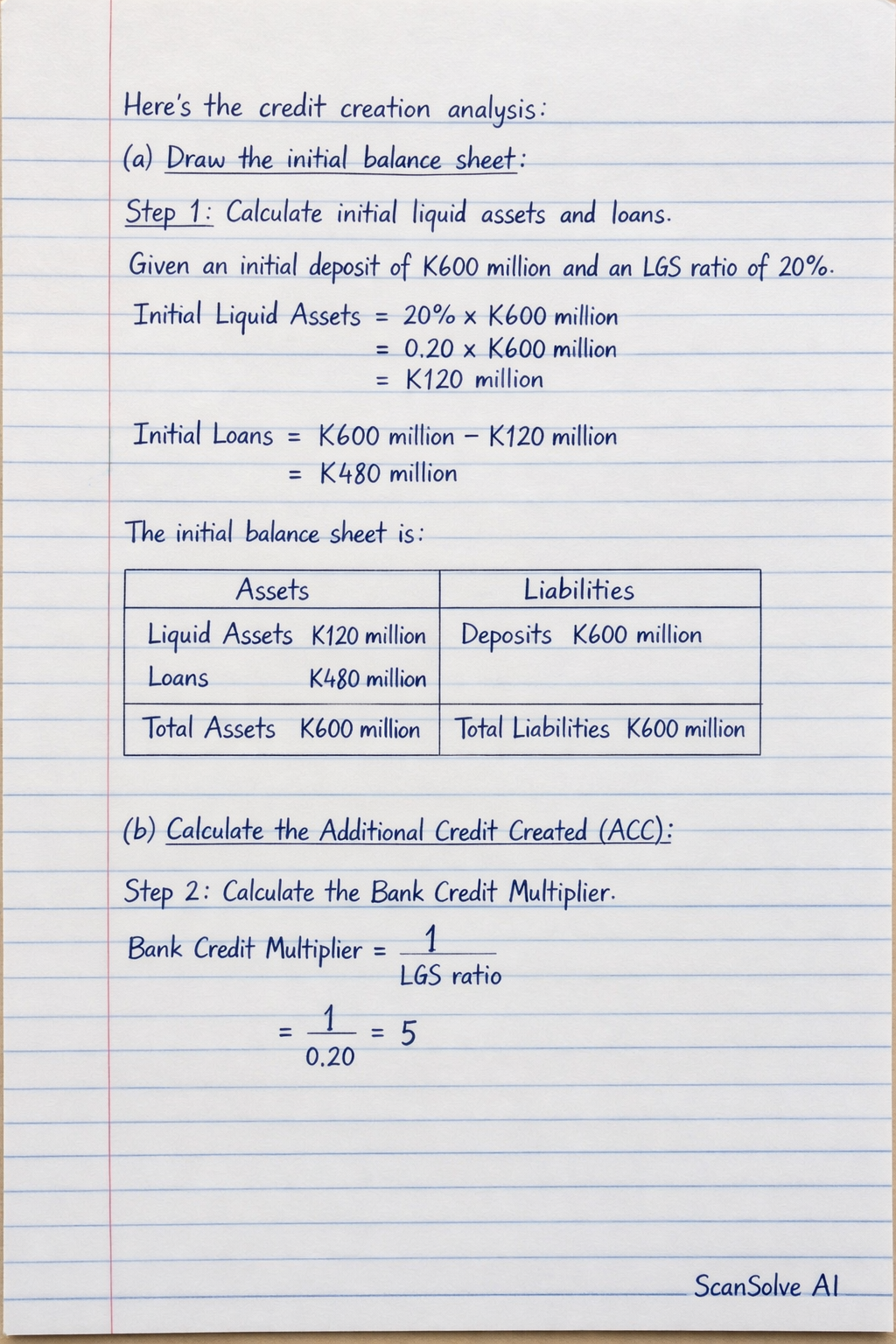
Given an initial deposit of K600 million and an LGS ratio of 20%.
ScanSolve AI Answer
Answers
3 partsStep-by-step solution
7 stepsHere's the credit creation analysis:
Part a· 1 step
Draw the initial balance sheet
Calculate initial liquid assets and loans.
Given an initial deposit of K600 million and an LGS ratio of 20%.
Initial Liquid Assets =
Initial Loans =The initial balance sheet is:
Part b
Calculate the Additional Credit Created (ACC)
Calculate the Bank Credit Multiplier.
Calculate the initial excess reserves from the new deposit.
New Deposit = K40 million
Required Reserves =
Initial Excess Reserves =Calculate the Additional Credit Created (ACC).
The ACC represents the total new loans created by the banking system.
Part c
Calculate the Bank Credit Multiplier
Calculate the Bank Credit Multiplier.
Part d
Calculate the Multiplier Effect
Calculate the Multiplier Effect.
The Multiplier Effect is the total increase in deposits in the banking system due to the new deposit.
Part e· 1 step
Draw the final balance sheet showing the multiplier effect
Calculate the final total deposits, liquid assets, and loans.
Final Total Deposits = Initial Deposits + Multiplier Effect = K600 million + K200 million = K800 million
Final Liquid Assets =
Final Loans =The final balance sheet is:
Still stuck on this one?
Ask a follow-up, and the answer starts from this question.
More Mathematics Questions
Handwritten Step-by-Step Solution
Get this as a handwritten image on WhatsApp — like a tutor wrote it for you.
Try on WhatsApp