
This mathematics problem involves applying core mathematical principles and formulas. Below you will find a complete step-by-step solution with detailed explanations for each step, helping you understand not just the answer but the method behind it.
ScanSolve AI Answer
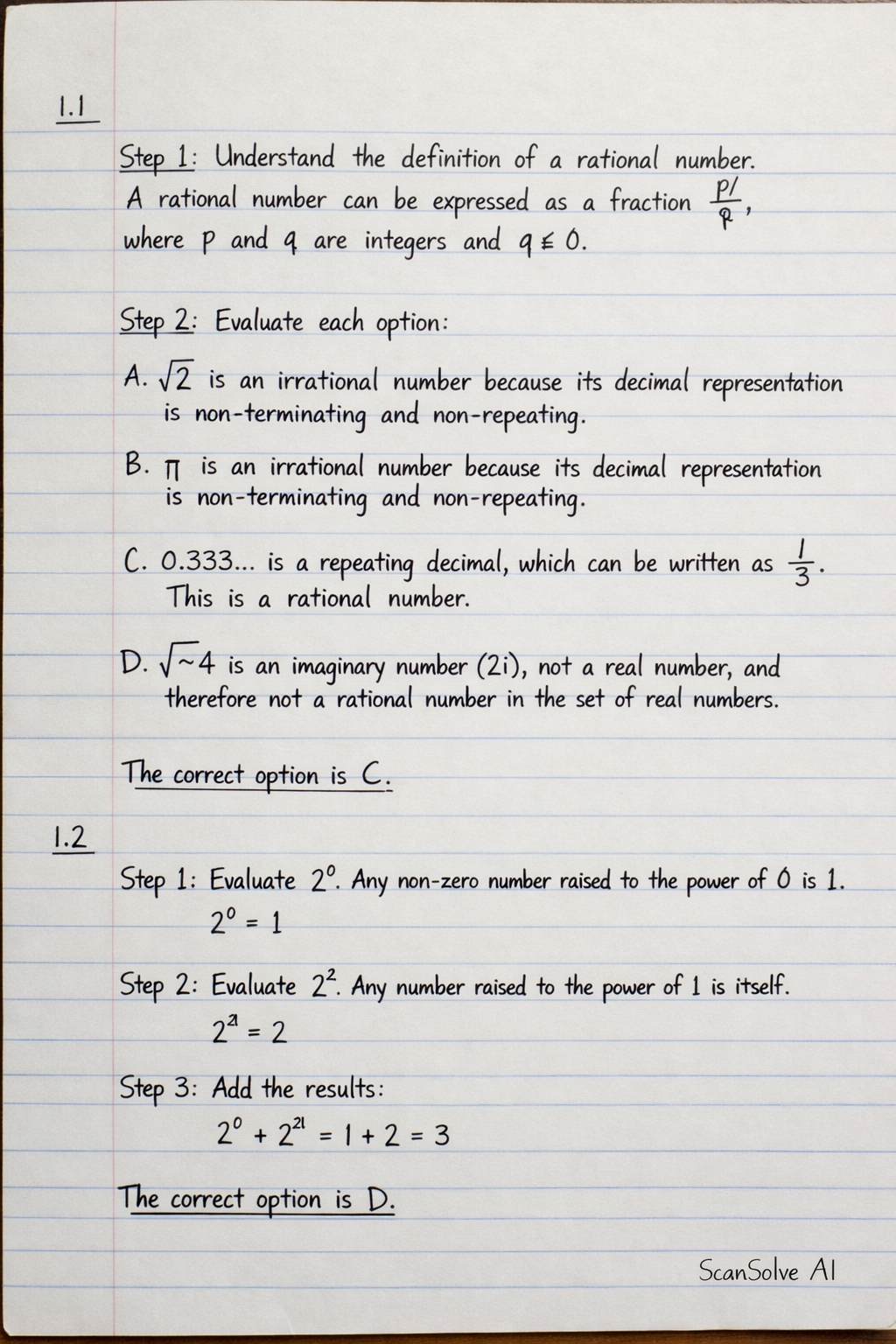
1.1 Step 1: Understand the definition of a rational number. A rational number can be expressed as a fraction (p)/(q), where p and q are integers and q ≠ 0. Step 2: Evaluate each option. A. sqrt(2) is an irrational number because its decimal representation is non-terminating and non-repeating. B. is an irrational number because its decimal representation is non-terminating and non-repeating. C. 0,333... is a repeating decimal, which can be written as (1)/(3). This is a rational number. D. sqrt(-4) is an imaginary number (2i), not a real number, and therefore not a rational number in the set of real numbers. The correct option is C. 1.2 Step 1: Evaluate 2^0. Any non-zero number raised to the power of 0 is 1. 2^0 = 1 Step 2: Evaluate 2^1. Any number raised to the power of 1 is itself. 2^1 = 2 Step 3: Add the results. 2^0 + 2^1 = 1 + 2 = 3 The correct option is D. 1.3 Step 1: List the multiples of 6. Multiples of 6: 6, 12, 18, 24, 30, ... Step 2: List the multiples of 8. Multiples of 8: 8, 16, 24, 32, 40, ... Step 3: Identify the lowest common multiple (LCM) from the lists. The smallest number that appears in both lists is 24. The correct option is B. 1.4 Step 1: Calculate the square root of 16. sqrt(16) = 4 Step 2: Calculate the square root of 9. sqrt(9) = 3 Step 3: Add the results. sqrt(16) + sqrt(9) = 4 + 3 = 7 The correct option is B. 1.5 Step 1: Analyze the given sequence: 1; 4; 9; 16; ... Step 2: Identify the pattern. 1 = 1^2 4 = 2^2 9 = 3^2 16 = 4^2 The sequence consists of perfect squares of consecutive natural numbers. Step 3: Determine the next term in the sequence. The next number in the sequence of bases is 5. The next term is 5^2 = 25. The correct option is B. 1.6 Step 1: Recognize the form of the expression x^2 - 4. This is a difference of two squares, which follows the formula a^2 - b^2 = (a-b)(a+b). Step 2: Identify a and b in the given expression. Here, a^2 = x^2, so a = x. And b^2 = 4, so b = sqrt(4) = 2. Step 3: Apply the difference of squares formula. x^2 - 4 = (x-2)(x+2) The correct option is C. 1.7 Step 1: Write the given equation. 2x - 1 = 5 Step 2: Add 1 to both sides of the equation to isolate the term with x. 2x - 1 + 1 = 5 + 1 2x = 6 Step 3: Divide both sides by 2 to solve for x. (2x)/(2) = (6)/(2) x = 3 The correct option is B. 1.8 Step 1: Substitute the given value of x = -1 into the expression x^2 - 2x + 1. (-1)^2 - 2(-1) + 1 Step 2: Evaluate each term. (-1)^2 = (-1) × (-1) = 1 -2(-1) = 2 Step 3: Add the results. 1 + 2 + 1 = 4 The correct option is C. 1.9 Step 1: Recall the slope-intercept form of a linear equation, which is y = mx + c. In this form, m represents the gradient (slope) of the line, and c represents the y-intercept. Step 2: Compare the given equation y = 2x - 3 with the slope-intercept form. By comparison, the coefficient of x is 2. Therefore, the gradient m = 2. The correct option is A. 1.10 Step 1: Understand that a line passing through the origin (0; 0) has a y-intercept of 0. Its equation is of the form y = mx. Step 2: Use the given point (1; 2) to find the gradient m. Substitute x=1 and y=2 into the equation y = mx. 2 = m(1) m = 2 Step 3: Write the equation of the line using the calculated gradient. y = 2x The correct option is B. Drop the next question.