
We read your photo as:
Find the gradient and angle of inclination of the line PR, given P(9, 2) and R(-4, -4). Also, find the angle alpha between the y-axis and PR.
ScanSolve AI Answer
Answer
Step-by-step solution
4 stepsDetermine the gradient of PR (Question 1.1).
The coordinates of P are and R are .
The formula for the gradient between two points and is:Let and .
The gradient of PR is .
Find the angle of inclination of PR with the positive x-axis.
Let be the angle of inclination of line PR with the positive x-axis. We know that .
Relate to and explain why is used.
The angle is defined as the angle between the y-axis and the line PR. The x-axis and y-axis are perpendicular, meaning they form a angle.
If is the angle the line PR makes with the positive x-axis, then the acute angle it makes with the y-axis is the complement of .
Therefore, . This is because the sum of the angles in the right-angled triangle formed by the line PR, the x-axis, and a vertical line from a point on PR to the x-axis, or by the line PR, the y-axis, and a horizontal line from a point on PR to the y-axis, must be . Since the angle between the axes is , the other two acute angles must sum to .Calculate the size of (Question 1.2).
Rounding to one decimal place:
The size of is .
Try one yourself
A new problem that tests the same skill.
Still stuck on this one?
Ask a follow-up, and the answer starts from this question.
More Mathematics Questions
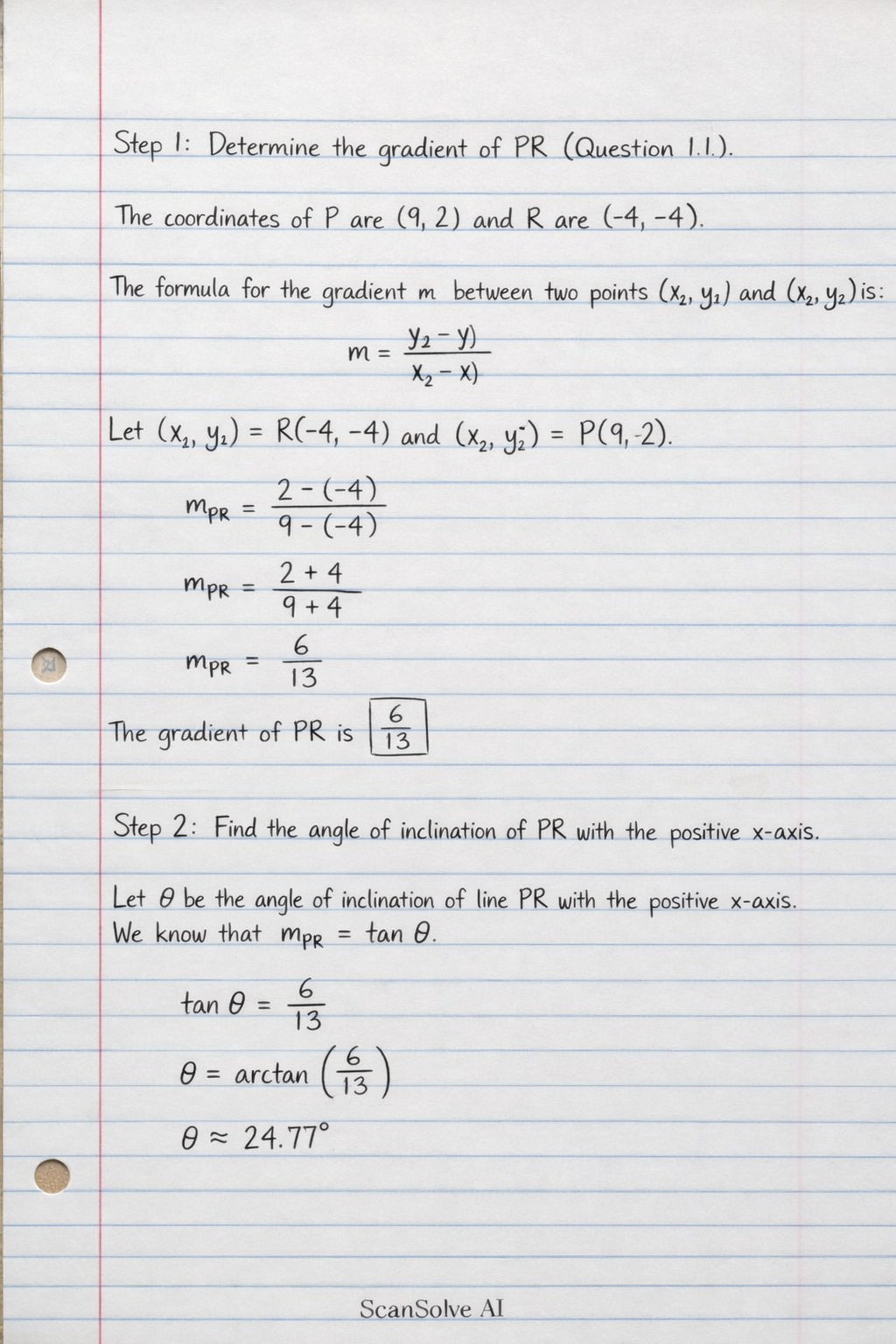
Handwritten Step-by-Step Solution
Get this as a handwritten image on WhatsApp — like a tutor wrote it for you.
Try on WhatsApp