

This mathematics problem involves applying core mathematical principles and formulas. Below you will find a complete step-by-step solution with detailed explanations for each step, helping you understand not just the answer but the method behind it.
ScanSolve AI Answer
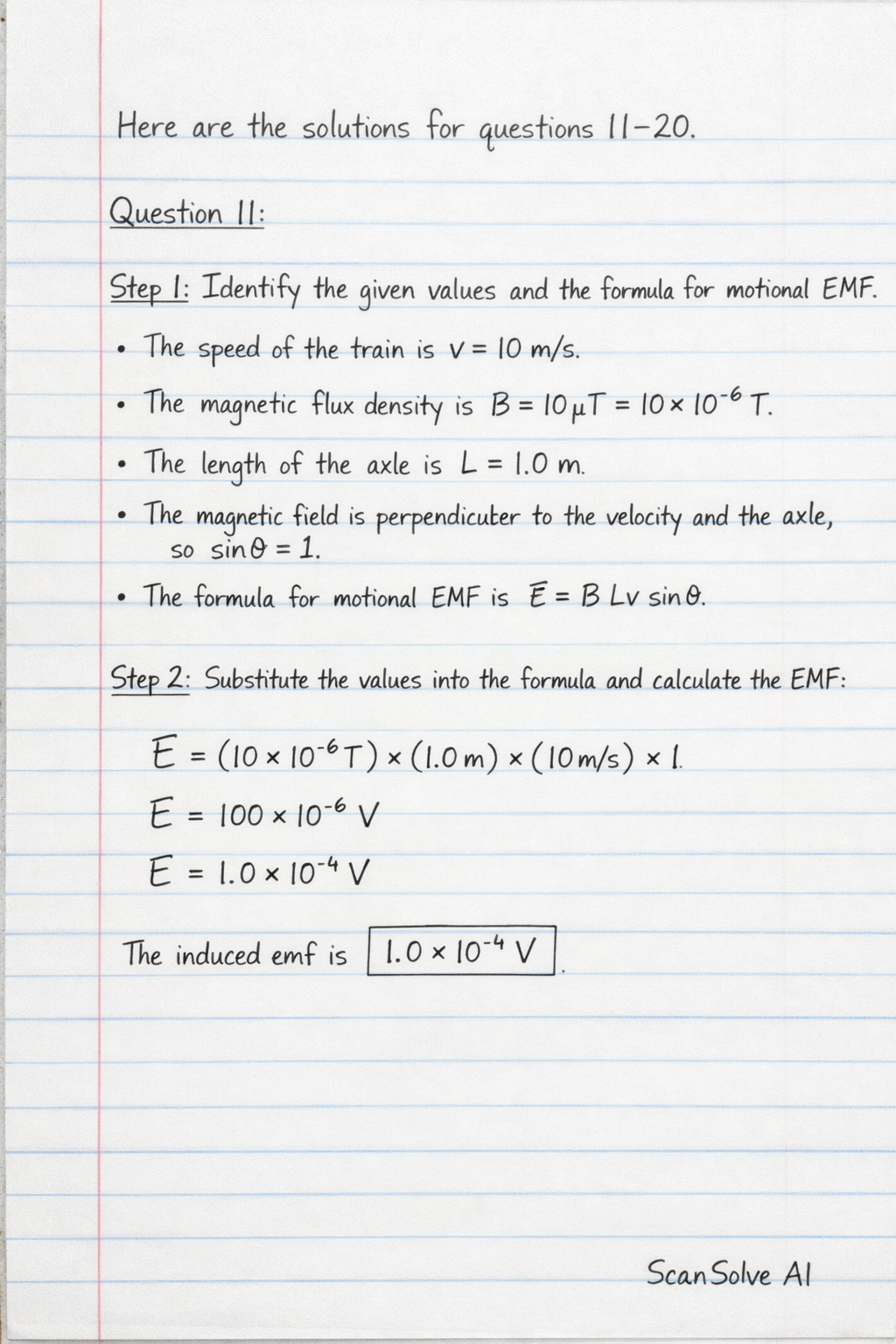
Here are the solutions for questions 11-20. Question 11: Step 1: Identify the given values and the formula for motional EMF. The speed of the train is v = 10 m/s. The magnetic flux density is B = 10 μT = 10 × 10^-6 T. The length of the axle is L = 1.0 m. The magnetic field is perpendicular to the velocity and the axle, so = 1. The formula for motional EMF is E = B L v . Step 2: Substitute the values into the formula and calculate the EMF. E = (10 × 10^-6 T) × (1.0 m) × (10 m/s) × 1 E = 100 × 10^-6 V E = 1.0 × 10^-4 V The induced emf is 1.0 × 10^-4 V. Question 12: Step 1: Identify the given values and the formula for induced EMF by Faraday's Law. Number of turns N = 5. Initial magnetic flux _1 = 1.0 mWb = 1.0 × 10^-3 Wb. Final magnetic flux _2 = 2.0 mWb = 2.0 × 10^-3 Wb. Time interval t = 1.0 s. The magnitude of the induced EMF is given by |E| = N (||)/(| t|). Step 2: Calculate the change in magnetic flux. = _2 - _1 = (2.0 × 10^-3 Wb) - (1.0 × 10^-3 Wb) = 1.0 × 10^-3 Wb Step 3: Substitute the values into the EMF formula and calculate. |E| = 5 × 1.0 × 10^-3 Wb1.0 s |E| = 5.0 × 10^-3 V The magnitude of the induced emf is 5.0 × 10^-3 V. Question 13: Step 1: Identify the given values and the formula for motional EMF. Wing span L = 10 m. Speed of the aircraft v = 100 m/s. Vertical component of Earth's magnetic field B = 10 μT = 10 × 10^-6 T. The wing span is perpendicular to both the velocity and the vertical magnetic field, so = 1. The formula for motional EMF is E = B L v . Step 2: Substitute the values into the formula and calculate the EMF. E = (10 × 10^-6 T) × (10 m) × (100 m/s) × 1 E = 10000 × 10^-6 V E = 1.0 × 10^-2 V The induced emf is 1.0 × 10^-2 V. Question 14: Step 1: Identify the given values and the formula for induced EMF by Faraday's Law. Number of turns N = 100. Initial magnetic flux _1 = 2 mWb = 2 × 10^-3 Wb. Final magnetic flux _2 = 0 Wb. Time interval t = 1.0 s. The magnitude of the average induced EMF is given by |E| = N (||)/(| t|). Step 2: Calculate the change in magnetic flux. = _2 - _1 = 0 Wb - (2 × 10^-3 Wb) = -2 × 10^-3 Wb Step 3: Substitute the values into the EMF formula and calculate. |E| = 100 × |-2 × 10^-3 Wb|1.0 s |E| = 100 × (2 × 10^-3 V) |E| = 0.2 V The average induced emf is 0.2 V. Question 15: Step 1: Compare the given equation with the general form of alternating EMF. The given equation for emf is E = 20 (100 t). The general form for alternating emf is E = E_0 ( t), where E_0 is the peak emf and is the angular frequency. Step 2: Identify the peak value from the equation. By comparing the two equations, the peak value E_0 is the coefficient of the sine function. E_0 = 20 V The peak value E_0 is 20 V. Question 16: Step 1: Identify the given RMS voltage and the relationship between RMS and peak voltage. The RMS voltage of the main supply is V_rms = 230 V. The relationship between RMS voltage (V_rms) and peak voltage (V_peak) for an AC supply is V_rms = V_peaksqrt(2). Step 2: Rearrange the formula to solve for peak voltage and substitute the value. V_peak = V_rms × sqrt(2) V_peak = 230 V × sqrt(2) V_peak ≈ 230 V × 1.414 V_peak ≈ 325.22 V The peak voltage is 325 V. Question 17: Step 1: Identify the given current equation and resistance, and the formulas for mean power. The alternating current is I = 3 (50t). From this, the peak current is I_peak = 3 A. The resistive load is R = 10 Ω. The mean power dissipated in a resistive load is P_mean = I_rms^2 R. Step 2: Calculate the RMS current from the peak current. The relationship between RMS current (I_rms) and peak current (I_peak) is I_rms = I_peaksqrt(2). I_rms = 3 Asqrt(2) Step 3: Substitute the RMS current and resistance into the mean power formula. P_mean = ((3)/(sqrt(2)))^2 × 10 Ω P_mean = (9)/(2) × 10 W P_mean = 4.5 × 10 W P_mean = 45 W The mean power dissipated is 45 W. Question 18: Step 1: Identify the given power and RMS voltage, and the formulas for power and peak current. Power of the heater P = 4.0 kW = 4000 W. RMS voltage of the supply V_rms = 240 V. The power in an AC circuit is P = V_rms I_rms. The relationship between RMS current and peak current is I_peak = I_rms sqrt(2). Step 2: Calculate the RMS current. I_rms = (P)/(V_rms) I_rms = 4000 W240 V I_rms = (400)/(24) A = (50)/(3) A ≈ 16.67 A Step 3: Calculate the peak current. I_peak = I_rms sqrt(2) I_peak = (50)/(3) A × sqrt(2) I_peak ≈ 16.67 A × 1.414 I_peak ≈ 23.57 A The peak current drawn is 23.6 A. Question 19: Step 1: Identify the given voltages and secondary turns, and the transformer turns ratio formula. Primary voltage V_p = 220 V. Secondary voltage V_s = 7.5 V. Number of turns on the secondary coil N_s = 140 turns. For an ideal transformer, the ratio of voltages is equal to the ratio of turns: (V_p)/(V_s) = (N_p)/(N_s). Step 2: Rearrange the formula to solve for the number of turns on the primary coil (N_p) and substitute the values. N_p = N_s × (V_p)/(V_s) N_p = 140 turns × 220 V7.5 V N_p = 140 × 29.333... N_p ≈ 4106.67 Since the number of turns must be an integer, we round to the nearest whole number. The number of turns on the primary coil is 4107 turns. Question 20: Step 1: Identify the given voltages and secondary current, and the power conservation formula for an ideal transformer. Primary voltage V_p = 240 V. Secondary voltage V_s = 15 V. Secondary current I_s = 2.0 A. For an ideal transformer, the power in the primary coil equals the power in the secondary coil: P_p = P_s. This can be written as V_p I_p = V_s I_s. Step 2: Rearrange the formula to solve for the primary current (I_p) and substitute the values. I_p = (V_s I_s)/(V_p) I_p = (15 V) × (2.0 A)240 V I_p = 30 W240 V I_p = (1)/(8) A I_p = 0.125 A The current drawn from the primary coil is 0.125 A.