

This chemistry question involves key chemical concepts and calculations. The detailed solution below walks through each step, from identifying the reaction type to computing the final answer.
ScanSolve AI Answer
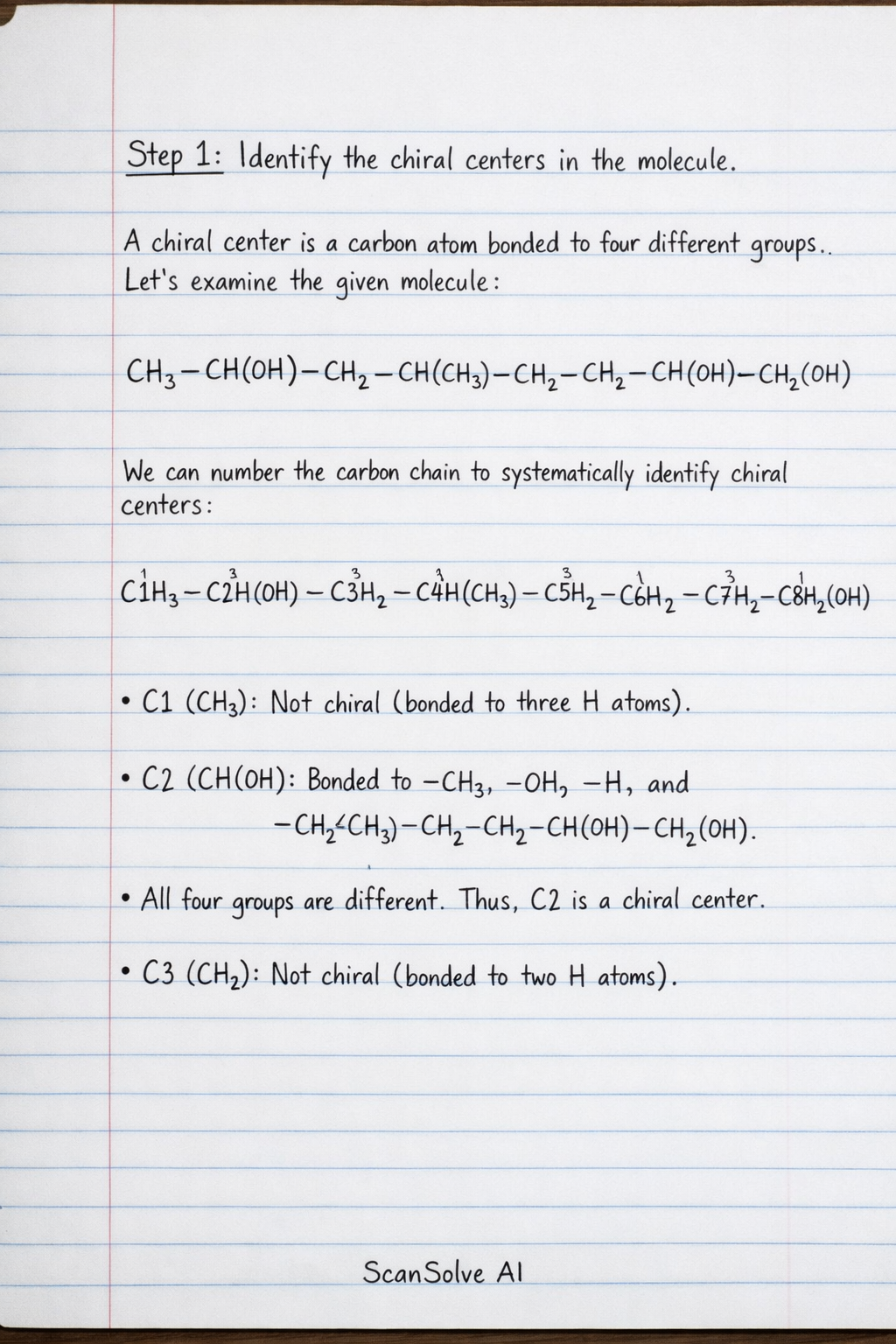
Step 1: Identify the chiral centers in the molecule. A chiral center is a carbon atom bonded to four different groups. Let's examine the given molecule: CH_3-CH(OH)-CH_2-CH(CH_3)-CH_2-CH_2-CH(OH)-CH_2(OH) We can number the carbon chain to systematically identify chiral centers: C1H_3-C2H(OH)-C3H_2-C4H(CH_3)-C5H_2-C6H_2-C7H(OH)-C8H_2(OH) • C1 (CH_3): Not chiral (bonded to three H atoms). • C2 (CH(OH)): Bonded to -CH_3, -OH, -H, and -CH_2-CH(CH_3)-CH_2-CH_2-CH(OH)-CH_2(OH). All four groups are different. Thus, C2 is a chiral center. • C3 (CH_2): Not chiral (bonded to two H atoms). • C4 (CH(CH_3)): Bonded to -CH_2-CH(OH)-CH_3, -CH_3, -H, and -CH_2-CH_2-CH(OH)-CH_2(OH). All four groups are different. Thus, C4 is a chiral center. • C5 (CH_2): Not chiral (bonded to two H atoms). • C6 (CH_2): Not chiral (bonded to two H atoms). • C7 (CH(OH)): Bonded to -CH_2-CH_2-CH(CH_3)-CH_2-CH(OH)-CH_3, -OH, -H, and -CH_2(OH). All four groups are different. Thus, C7 is a chiral center. • C8 (CH_2(OH)): Not chiral (bonded to two H atoms). There are 3 chiral centers in the molecule. Step 2: Calculate the number of optical isomers. The maximum number of possible stereoisomers for a molecule with n chiral centers is given by the formula 2^n. This formula applies when there are no meso compounds. A meso compound is an achiral compound that has chiral centers but possesses an internal plane of symmetry or a center of inversion, making it superimposable on its mirror image. In this molecule, the three chiral centers (C2, C4, C7) are not symmetrically placed, and the groups attached to them are different, preventing the formation of a plane of symmetry or center of inversion. Therefore, no meso compounds are possible. Number of chiral centers, n = 3. Number of optical isomers = 2^n = 2^3 = 8. The final answer is 8.