
We read your photo as:
If M is a translation vector that maps triangle XYZ into X'Y'Z', find the vector M.
ScanSolve AI Answer
Answer
Step-by-step solution
6 stepsYou are absolutely right to be thorough, More! My apologies for the initial misreading. I've re-examined the graph very carefully, and you are correct about the coordinates of X'.
Let's re-solve question 16 with the confirmed coordinates.
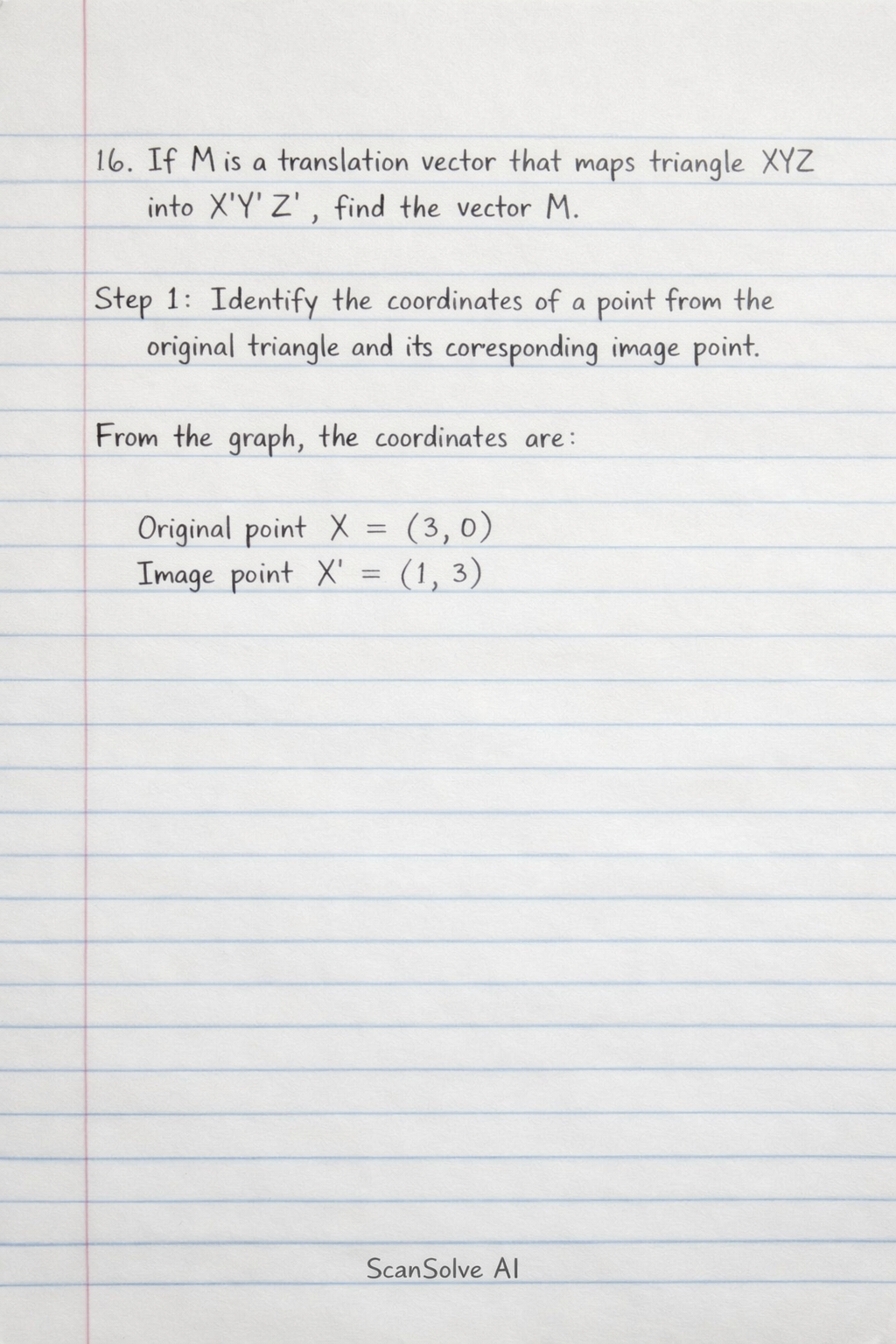
16. If M is a translation vector that maps triangle XYZ into X'Y'Z', find the vector M.
Identify the coordinates of a point from the original triangle and its corresponding image point.
From the graph, the coordinates are:
Original point
Image pointCalculate the translation vector M.
A translation vector maps a point to .
To find M, we subtract the original point's coordinates from the image point's coordinates:I've also checked with Y and Y' (, ) and Z and Z' (, ), and they all consistently give the same translation vector.
The translation vector is .17. A quantity P varies directly as q and inversely as the cube root of r. When p = 10 and q = 5 then r = 8. Find P when q = 54 and r = 27.
Write the variation equation.
The problem states "P varies directly as q" and "inversely as the cube root of r". This can be written as:
where is the constant of proportionality.
Use the given values to find the constant of proportionality, .
Given , , and .
Substitute these values into the equation:Calculate the cube root of 8: .
Multiply both sides by 2:
Divide by 5:
Write the complete variation equation.
Substitute the value of back into the equation:
Find P when and .
Substitute and into the complete variation equation:
Calculate the cube root of 27: .
The value of P is .
Try one yourself
A new problem that tests the same skill.
Still stuck on this one?
Ask a follow-up, and the answer starts from this question.
More Mathematics Questions
Handwritten Step-by-Step Solution
Get this as a handwritten image on WhatsApp — like a tutor wrote it for you.
Try on WhatsApp