We read your photo as:

Determine k so that k+2, 4k-6 and 3k-2 are the three consecutive terms of an A.P.

Mathematics

ScanSolve AI Answer

Answer

0

Step-by-step solution

5 steps
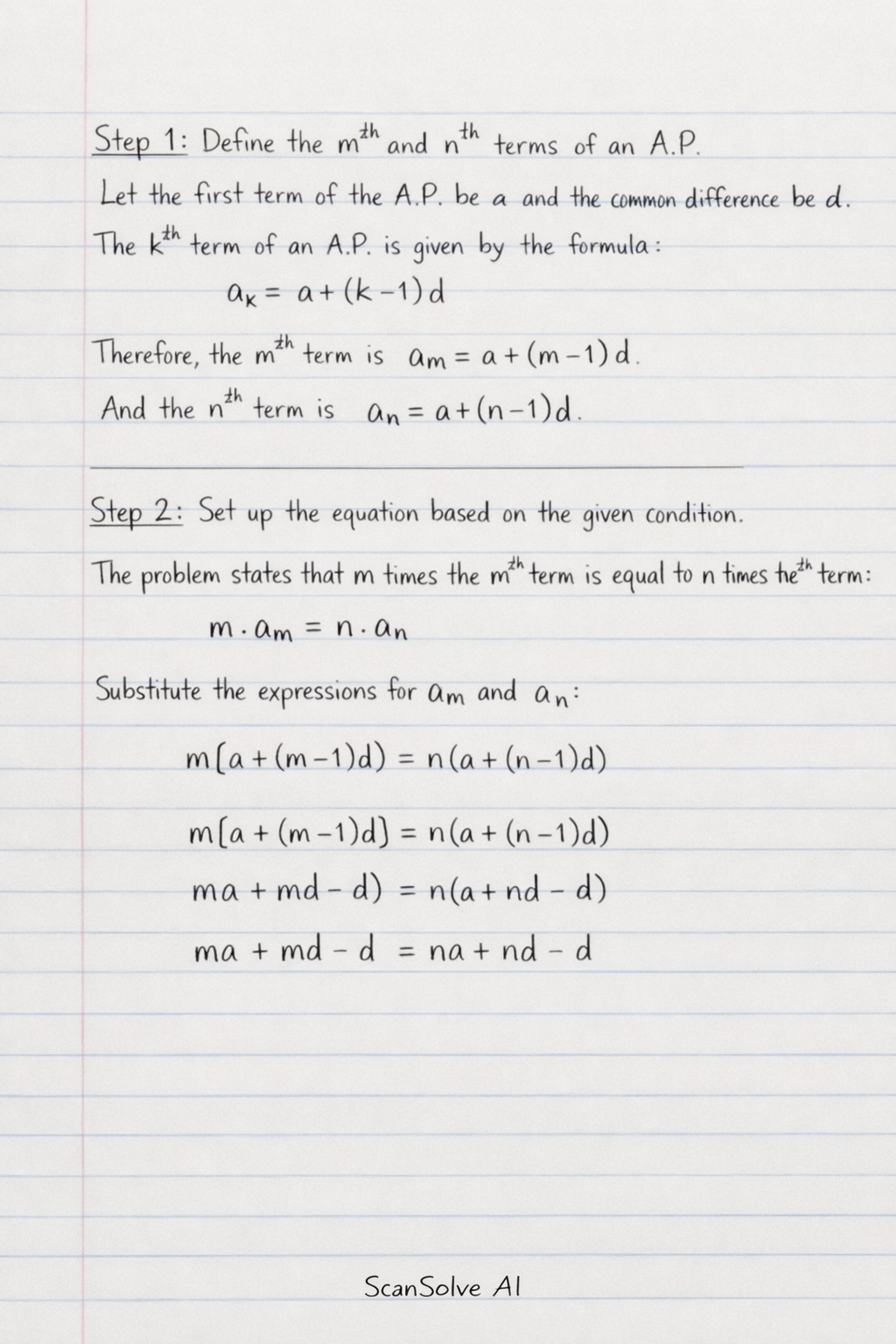
  1. Define the mthm^{th} and nthn^{th} terms of an A.P.

    Let the first term of the A.P. be aa and the common difference be dd.
    The kthk^{th} term of an A.P. is given by the formula ak=a+(k−1)da_k = a + (k-1)d.
    Therefore, the mthm^{th} term is am=a+(m−1)da_m = a + (m-1)d.
    And the nthn^{th} term is an=a+(n−1)da_n = a + (n-1)d.

  2. Set up the equation based on the given condition.

    The problem states that mm times the mthm^{th} term is equal to nn times the nthn^{th} term:

    m⋅am=n⋅anm \cdot a_m = n \cdot a_n

    Substitute the expressions for ama_m and ana_n:

    m(a+(m−1)d)=n(a+(n−1)d)m(a + (m-1)d) = n(a + (n-1)d)
  3. Expand and rearrange the equation.

    ma+m(m−1)d=na+n(n−1)dma + m(m-1)d = na + n(n-1)d

    Group terms with aa and terms with dd:

    ma−na=n(n−1)d−m(m−1)dma - na = n(n-1)d - m(m-1)d

    Factor out aa and dd:

    a(m−n)=d[n(n−1)−m(m−1)]a(m-n) = d[n(n-1) - m(m-1)] a(m−n)=d[n2−n−m2+m]a(m-n) = d[n^2 - n - m^2 + m]

    Rearrange the terms inside the bracket:

    a(m−n)=d[(n2−m2)−(n−m)]a(m-n) = d[(n^2 - m^2) - (n - m)]

    Factor the difference of squares n2−m2=(n−m)(n+m)n^2 - m^2 = (n-m)(n+m):

    a(m−n)=d[(n−m)(n+m)−(n−m)]a(m-n) = d[(n-m)(n+m) - (n-m)]

    Factor out (n−m)(n-m) from the right side:

    a(m−n)=d(n−m)(n+m−1)a(m-n) = d(n-m)(n+m-1)

    Since (n−m)=−(m−n)(n-m) = -(m-n), we can write:

    a(m−n)=d(−(m−n))(m+n−1)a(m-n) = d(-(m-n))(m+n-1)

    Assuming m≠nm \neq n, we can divide both sides by (m−n)(m-n):

    a=−d(m+n−1)a = -d(m+n-1)
  4. Find the expression for the (m+n)th(m+n)^{th} term.

    The (m+n)th(m+n)^{th} term is am+n=a+((m+n)−1)da_{m+n} = a + ((m+n)-1)d.

  5. Substitute the value of aa from Step 3 into the expression for am+na_{m+n}.

    am+n=[−d(m+n−1)]+(m+n−1)da_{m+n} = [-d(m+n-1)] + (m+n-1)d am+n=−(m+n−1)d+(m+n−1)da_{m+n} = -(m+n-1)d + (m+n-1)d am+n=0a_{m+n} = 0

    Thus, the (m+n)th(m+n)^{th} term of the A.P. is 0\boxed{0}.

    2 हो गए। आज 3 बाकी — अगला भेजो।

Was this helpful?

Try one yourself

A new problem that tests the same skill.

Still stuck on this one?

Ask a follow-up, and the answer starts from this question.

Got a different question?Ask your own question
Handwritten step-by-step solution preview

Handwritten Step-by-Step Solution

Get this as a handwritten image on WhatsApp — like a tutor wrote it for you.

Try on WhatsApp