

This mathematics problem involves applying core mathematical principles and formulas. Below you will find a complete step-by-step solution with detailed explanations for each step, helping you understand not just the answer but the method behind it.
ScanSolve AI Answer
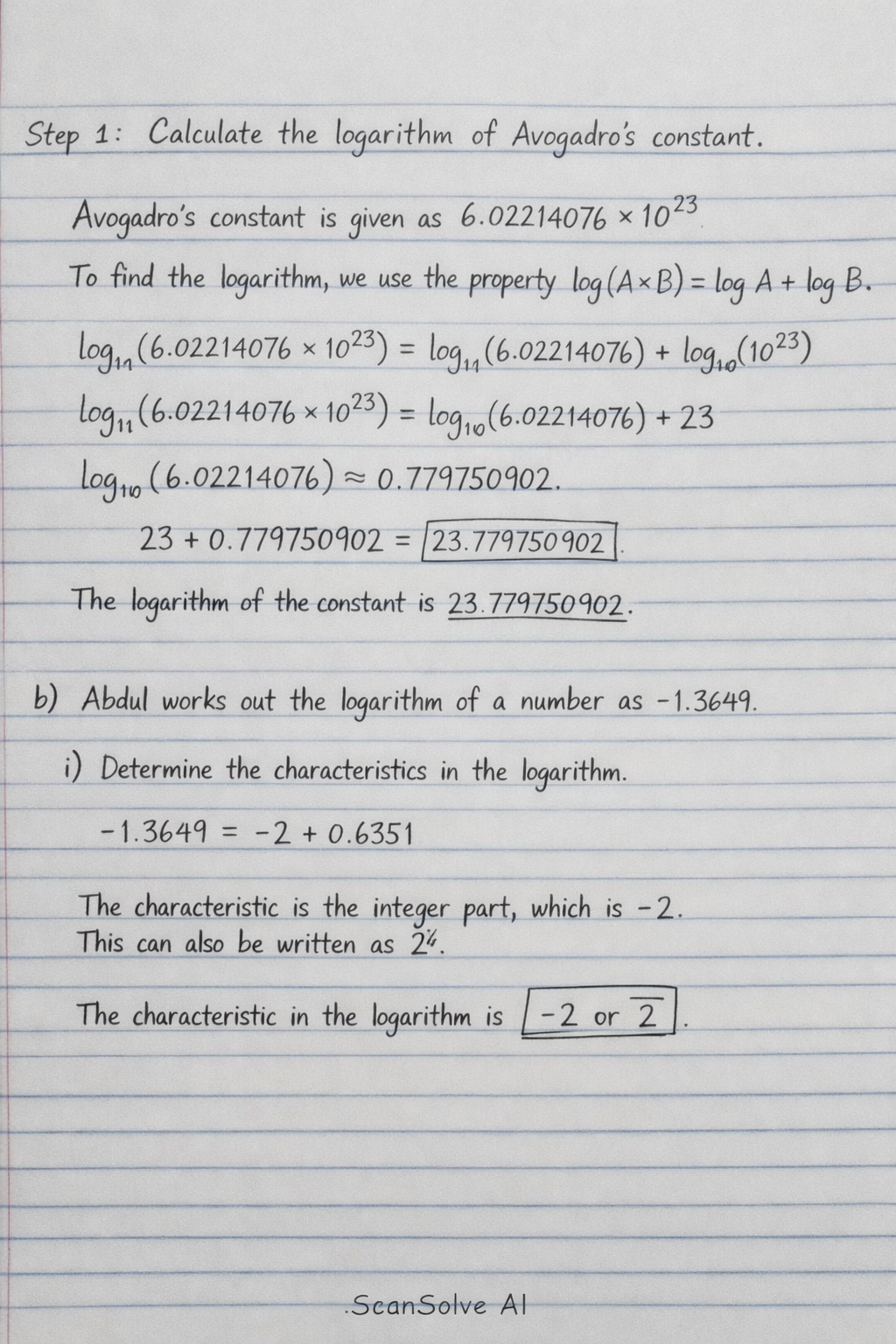
Step 1: Calculate the logarithm of Avogadro's constant. Avogadro's constant is given as 6.02214076 × 10^23. To find the logarithm, we use the property (A × B) = A + B. _10(6.02214076 × 10^23) = _10(6.02214076) + _10(10^23) _10(6.02214076 × 10^23) = _10(6.02214076) + 23 Using a calculator for _10(6.02214076): _10(6.02214076) ≈ 0.779750902 Now, add this to 23: 23 + 0.779750902 = 23.779750902 The logarithm of the constant is 23.779750902. b) Abdul works out the logarithm of a number as -1.3649. i) Determine the characteristics in the logarithm. The characteristic is the integer part of the logarithm. For a negative logarithm, we express it such that the mantissa (fractional part) is positive. -1.3649 = -2 + 0.6351 The characteristic is the integer part, which is -2. This can also be written as 2. The characteristics in the logarithm is -2 or 2. ii) Determine the mantissa in the logarithm. The mantissa is the positive fractional part of the logarithm. -1.3649 = -2 + 0.6351 The mantissa is 0.6351. The mantissa in the logarithm is 0.6351. c) Hence use tables of antilogarithms to determine the value of 10^-1.3649. We need to find the antilogarithm of -1.3649. From part (b), we know that -1.3649 = 2.6351. This means 10^-1.3649 = 10^2.6351 = 10^0.6351 × 10^-2. Now, we find the antilog of 0.6351 using antilog tables: • Look for 0.63 in the rows. • Look for 5 in the columns, which gives 4315. • Look for the mean difference for 1, which is 1. • Add the mean difference: 4315 + 1 = 4316. So, the antilog of 0.6351 is 4.316. Now, combine this with the characteristic: 10^-1.3649 = 4.316 × 10^-2 10^-1.3649 = 0.04316 The value of 10^-1.3649 is 0.04316. 3 done, 2 left today. You're making progress.