
![Pin(ac) = [(Ip)/(2)]2 x [RD + RL]](/_next/image?url=https%3A%2F%2Fohijasnjvprzodcmxltt.supabase.co%2Fstorage%2Fv1%2Fobject%2Fpublic%2Fwhatsapp-images%2F1775414755613-4d27722a5d0bac44.png&w=3840&q=75)
This mathematics problem involves applying core mathematical principles and formulas. Below you will find a complete step-by-step solution with detailed explanations for each step, helping you understand not just the answer but the method behind it.
ScanSolve AI Answer
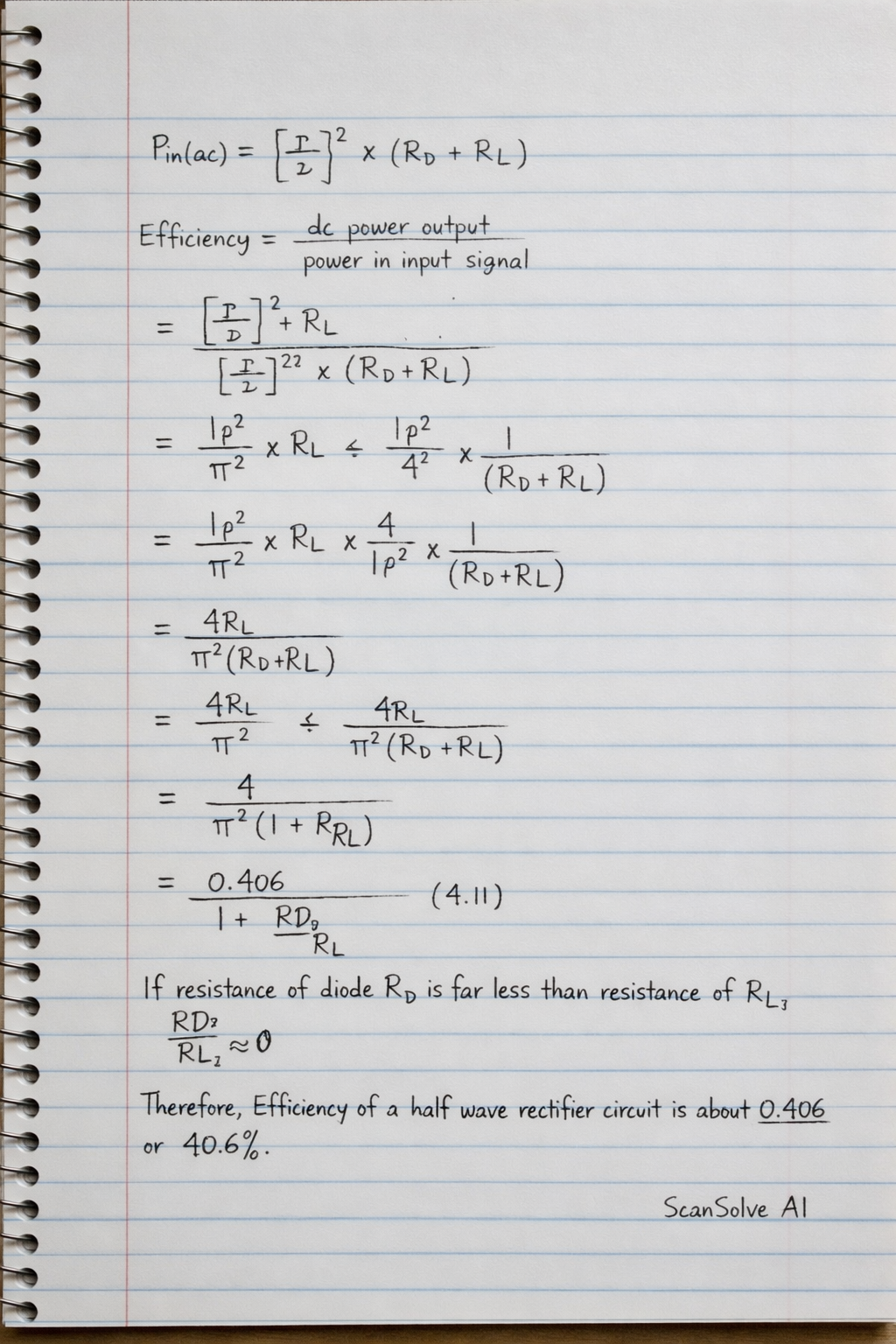
Here is the transcription of the provided image: P_in(ac) = [(I_p)/(2)]^2 × [R_D + R_L] Efficiency = dc power outputpower in input signal = ([I_p)/()]^2 × R_L[(I_p)/(2)]^2 × [R_D + R_L] = (I_p^2)/(^2) × R_L ÷ (I_p^2)/(4) × (1)/([R_D + R_L]) = (I_p^2)/(^2) × R_L × (4)/(I_p^2) × (1)/([R_D + R_L]) = (4 R_L)/(^2 [R_D + R_L]) = (4 R_L)/(^2 (R_D + R_L)) = (4 R_L)/(R_L)^2 ((R_D + R_L))/(R_L) = (4)/(^2 (1 + R_D)R_L) = (0.406)/(1 + R_D)R_L (4.11) If resistance of diode R_D is far less than resistance of R_L, (R_D)/(R_L) ≈ 0 Therefore, Efficiency of a half wave rectifier circuit is about 0.406 or 40.6%. This means that a half wave rectifier circuit can only rectify about 40.6% of a full cycle of an input signal. Note that 50% (half cycle) of the input signal is not rectified but blocked by the diode. This means, about 9.4% of the input signal is lost during the process of rectification. 4.4. PEAK INVERSE VOLTAGE (PIV) OF DIODE IN HALF WAVE RECTIFIER CIRCUIT During the negative half cycle of the input signal, the diode in a half wave rectifier circuit does not allow electric current to flow through it. See Figure 4.4. If electric current do not flow through the diode, it means that the voltage across the Electronics for Beginners