We read your photo as:

Represent the following complex numbers on an Argand diagram and evaluate the following square roots of negative numbers.

Mathematics

ScanSolve AI Answer

Step-by-step solution

23 steps

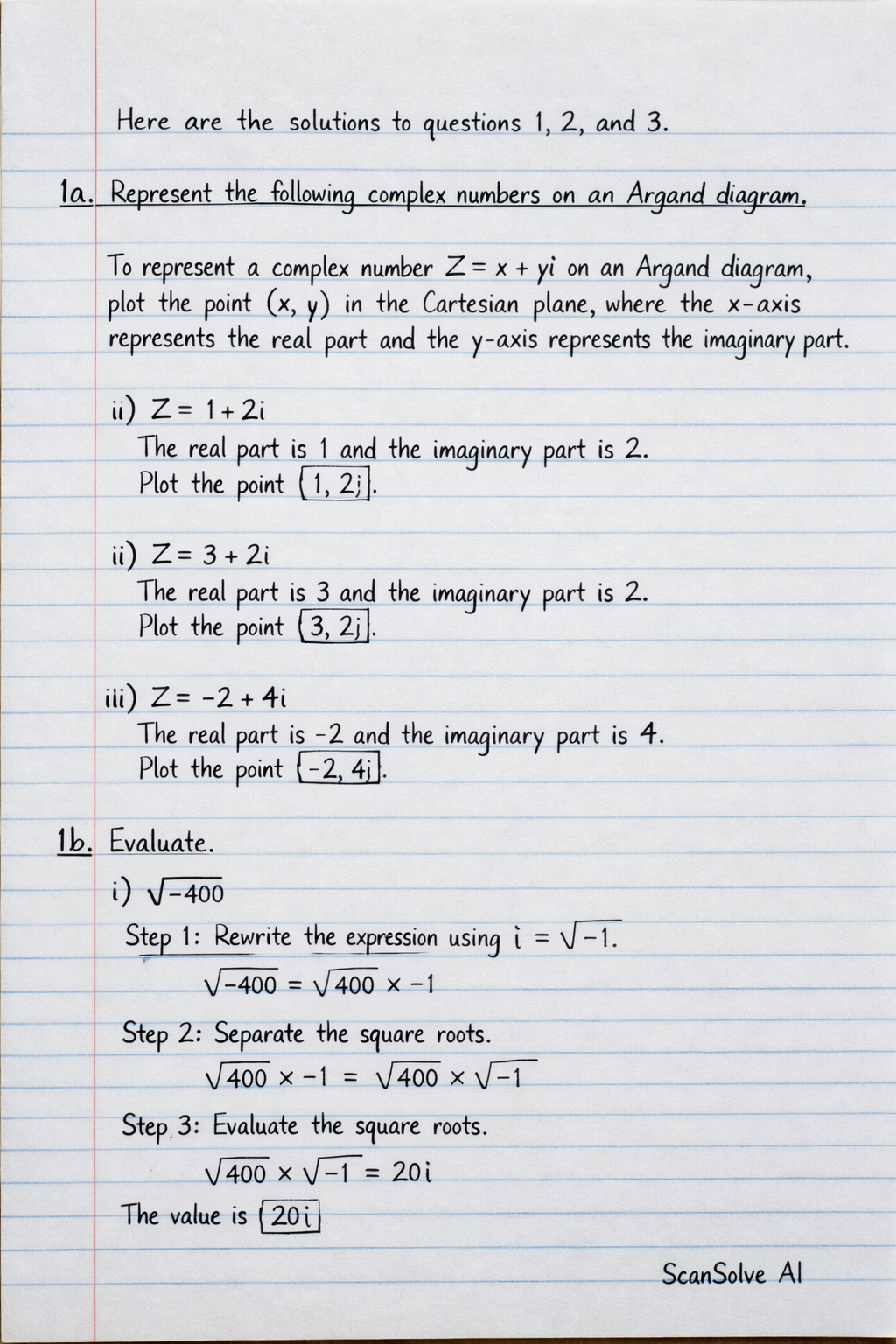
Here are the solutions to questions 1, 2, and 3.

1a. Represent the following complex numbers on an Argand diagram.

To represent a complex number Z=x+yiZ = x + yi on an Argand diagram, plot the point (x,y)(x, y) in the Cartesian plane, where the x-axis represents the real part and the y-axis represents the imaginary part.

i) Z=1+2iZ = 1 + 2i
The real part is 1 and the imaginary part is 2.
Plot the point (1,2)\boxed{(1, 2)}.

ii) Z=3+2iZ = 3 + 2i
The real part is 3 and the imaginary part is 2.
Plot the point (3,2)\boxed{(3, 2)}.

iii) Z=−2+4iZ = -2 + 4i
The real part is -2 and the imaginary part is 4.
Plot the point (−2,4)\boxed{(-2, 4)}.

1b. Evaluate

i) −400\sqrt{-400}

  1. Rewrite the expression using i=−1i = \sqrt{-1}.

    −400=400×−1\sqrt{-400} = \sqrt{400 \times -1}
  2. Separate the square roots.

    400×−1=400×−1\sqrt{400 \times -1} = \sqrt{400} \times \sqrt{-1}
  3. Evaluate the square roots.

    400×−1=20i\sqrt{400} \times \sqrt{-1} = 20i

    The value is 20i\boxed{20i}.

    ii) −81\sqrt{-81}

  4. Rewrite the expression using i=−1i = \sqrt{-1}.

    −81=81×−1\sqrt{-81} = \sqrt{81 \times -1}
  5. Separate the square roots.

    81×−1=81×−1\sqrt{81 \times -1} = \sqrt{81} \times \sqrt{-1}
  6. Evaluate the square roots.

    81×−1=9i\sqrt{81} \times \sqrt{-1} = 9i

    The value is 9i\boxed{9i}.

    iii) −225\sqrt{-225}

  7. Rewrite the expression using i=−1i = \sqrt{-1}.

    −225=225×−1\sqrt{-225} = \sqrt{225 \times -1}
  8. Separate the square roots.

    225×−1=225×−1\sqrt{225 \times -1} = \sqrt{225} \times \sqrt{-1}
  9. Evaluate the square roots.

    225×−1=15i\sqrt{225} \times \sqrt{-1} = 15i

    The value is 15i\boxed{15i}.

    2. Find the Product and Division of the following complex numbers.

    i) Z1=1−2iZ_1 = 1 - 2i and Z2=1+2iZ_2 = 1 + 2i

    Product:

  10. Multiply the complex numbers.

    Z1Z2=(1−2i)(1+2i)Z_1 Z_2 = (1 - 2i)(1 + 2i)
  11. Use the difference of squares formula (a−b)(a+b)=a2−b2(a-b)(a+b) = a^2 - b^2.

    (1−2i)(1+2i)=12−(2i)2(1 - 2i)(1 + 2i) = 1^2 - (2i)^2
  12. Simplify using i2=−1i^2 = -1.

    12−(2i)2=1−4i2=1−4(−1)=1+4=51^2 - (2i)^2 = 1 - 4i^2 = 1 - 4(-1) = 1 + 4 = 5

    The product is 5\boxed{5}.

    Division:

  13. Write the division as a fraction.

    Z1Z2=1−2i1+2i\frac{Z_1}{Z_2} = \frac{1 - 2i}{1 + 2i}
  14. Multiply the numerator and denominator by the conjugate of the denominator, which is 1−2i1 - 2i.

    1−2i1+2i=(1−2i)(1−2i)(1+2i)(1−2i)\frac{1 - 2i}{1 + 2i} = \frac{(1 - 2i)(1 - 2i)}{(1 + 2i)(1 - 2i)}
  15. Expand the numerator and denominator.

    Numerator: (1−2i)(1−2i)=1−2i−2i+4i2=1−4i−4=−3−4i(1 - 2i)(1 - 2i) = 1 - 2i - 2i + 4i^2 = 1 - 4i - 4 = -3 - 4i
    Denominator: (1+2i)(1−2i)=12−(2i)2=1−4i2=1−4(−1)=1+4=5(1 + 2i)(1 - 2i) = 1^2 - (2i)^2 = 1 - 4i^2 = 1 - 4(-1) = 1 + 4 = 5

  16. Combine the results.

    −3−4i5=−35−45i\frac{-3 - 4i}{5} = -\frac{3}{5} - \frac{4}{5}i

    The division is −35−45i\boxed{-\frac{3}{5} - \frac{4}{5}i}.

    ii) Z1=1+iZ_1 = 1 + i and Z2=2+4iZ_2 = 2 + 4i

    Product:

  17. Multiply the complex numbers.

    Z1Z2=(1+i)(2+4i)Z_1 Z_2 = (1 + i)(2 + 4i)
  18. Expand the product.

    (1+i)(2+4i)=1(2)+1(4i)+i(2)+i(4i)(1 + i)(2 + 4i) = 1(2) + 1(4i) + i(2) + i(4i) =2+4i+2i+4i2= 2 + 4i + 2i + 4i^2
  19. Simplify using i2=−1i^2 = -1.

    2+6i+4(−1)=2+6i−4=−2+6i2 + 6i + 4(-1) = 2 + 6i - 4 = -2 + 6i

    The product is −2+6i\boxed{-2 + 6i}.

    Division:

  20. Write the division as a fraction.

    Z1Z2=1+i2+4i\frac{Z_1}{Z_2} = \frac{1 + i}{2 + 4i}
  21. Multiply the numerator and denominator by the conjugate of the denominator, which is 2−4i2 - 4i.

    1+i2+4i=(1+i)(2−4i)(2+4i)(2−4i)\frac{1 + i}{2 + 4i} = \frac{(1 + i)(2 - 4i)}{(2 + 4i)(2 - 4i)}
  22. Expand the numerator and denominator.

    Numerator: (1+i)(2−4i)=1(2)+1(−4i)+i(2)+i(−4i)=2−4i+2i−4i2=2−2i−4(−1)=2−2i+4=6−2i(1 + i)(2 - 4i) = 1(2) + 1(-4i) + i(2) + i(-4i) = 2 - 4i + 2i - 4i^2 = 2 - 2i - 4(-1) = 2 - 2i + 4 = 6 - 2i
    Denominator: (2+4i)(2−4i)=22−(4i)2=4−16i2=4−16(−1)=4+16=20(2 + 4i)(2 - 4i) = 2^2 - (4i)^2 = 4 - 16i^2 = 4 - 16(-1) = 4 + 16 = 20

  23. Combine the results and simplify.

    6−2i20=620−220i=310−110i\frac{6 - 2i}{20} = \frac{6}{20} - \frac{2}{20}i = \frac{3}{10} - \frac{1}{10}i

    The division is 310−110i\boxed{\frac{3}{10} - \frac{1}{10}i}.

    3. Determine the Real and Imaginary parts of:

    For a complex number Z=x+yiZ = x + yi, the real part is Re(Z)=x\text{Re}(Z) = x and the imaginary part is Im(Z)=y\text{Im}(Z) = y.

    i) Z=5+2iZ = 5 + 2i
    Real part: 5\boxed{5}
    Imaginary part: 2\boxed{2}

    ii) Z=2iZ = 2i
    This can be written as Z=0+2iZ = 0 + 2i.
    Real part: 0\boxed{0}
    Imaginary part: 2\boxed{2}

    iii) Z=12Z = 12
    This can be written as Z=12+0iZ = 12 + 0i.
    Real part: 12\boxed{12}
    Imaginary part: 0\boxed{0}

    iv) Z=−cos⁡θ+isin⁡θZ = -\cos\theta + i\sin\theta
    Real part: −cos⁡θ\boxed{-\cos\theta}
    Imaginary part: sin⁡θ\boxed{\sin\theta}

    v) Z=−9+(−i)Z = -9 + (-i)
    This can be written as Z=−9−iZ = -9 - i.
    Real part: −9\boxed{-9}
    Imaginary part: −1\boxed{-1}

Was this helpful?

Still stuck on this one?

Ask a follow-up, and the answer starts from this question.

Got a different question?Ask your own question
Handwritten step-by-step solution preview

Handwritten Step-by-Step Solution

Get this as a handwritten image on WhatsApp — like a tutor wrote it for you.

Try on WhatsApp