Soit les points A(1, 3), B(-2, 1), C(5, -3). 1) Donner les composantes des vecteurs AB, AC et BC. 2) Montrer que le triangle ABC est rectangle en A et déterminer le centre et le rayon du cercle (C) ci
|Mathematics
Soit les points A(1, 3), B(-2, 1), C(5, -3). 1) Donner les composantes des vecteurs AB, AC et BC. 2) Montrer que le triangle ABC est rectangle en A et déterminer le centre et le rayon du cercle (C) ci
ScanSolve AI Answer
Answer
\vec{AB} = (-3, -2)
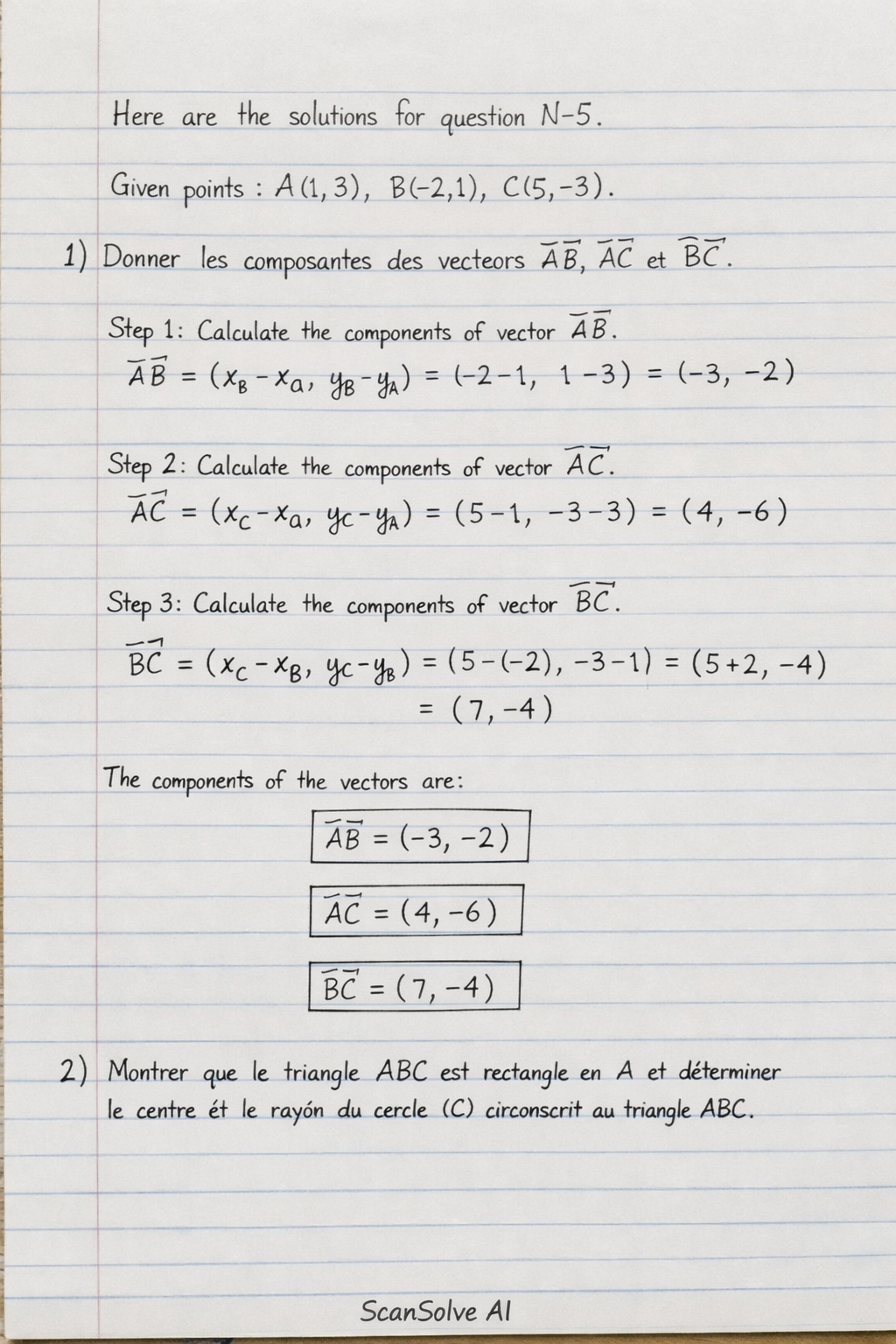
Here are the solutions for question N-5.
Given points: A(1,3), B(−2,1), C(5,−3).
1) Donner les composantes des vecteurs AB, AC et BC.
Step 1: Calculate the components of vector AB.
AB=(xB−xA,yB−yA)=(−2−1,1−3)=(−3,−2)
Step 2: Calculate the components of vector AC.
AC=(xC−xA,yC−yA)=(5−1,−3−3)=(4,−6)
Step 3: Calculate the components of vector BC.
BC=(xC−xB,yC−yB)=(5−(−2),−3−1)=(5+2,−4)=(7,−4)
The components of the vectors are:
AB=(−3,−2)AC=(4,−6)BC=(7,−4)
2) Montrer que le triangle ABC est rectangle en A et déterminer le centre et le rayon du cercle (C) circonscrit au triangle ABC.
Step 1: Show that triangle ABC is right-angled at A.
To show that the triangle is right-angled at A, we calculate the dot product of vectors AB and AC. If the dot product is zero, the vectors are orthogonal, and the angle at A is 90∘.
AB⋅AC=(−3)(4)+(−2)(−6)AB⋅AC=−12+12AB⋅AC=0
Since the dot product is 0, the vectors AB and AC are orthogonal. Therefore, triangle ABC is right-angled at A.
Step 2: Determine the center of the circumscribed circle.
For a right-angled triangle, the hypotenuse is the diameter of the circumscribed circle. The center of the circumscribed circle is the midpoint of the hypotenuse. In this case, BC is the hypotenuse.
Let M be the center of the circle.
M=(2xB+xC,2yB+yC)M=(2−2+5,21+(−3))M=(23,2−2)M=(23,−1)
The center of the circumscribed circle is M(23,−1).
Step 3: Determine the radius of the circumscribed circle.
The radius R is half the length of the hypotenuse BC.
First, calculate the length of BC:
∣BC∣=(xC−xB)2+(yC−yB)2=72+(−4)2∣BC∣=49+16=65
Now, calculate the radius:
R=21∣BC∣=265
The radius of the circumscribed circle is R=265.
3) Trouver les coordonnées du point S tel que AS=43AB+34BC.
Step 1: Calculate the vector 43AB.
We found AB=(−3,−2).
43AB=43(−3,−2)=(−49,−46)=(−49,−23)
Step 2: Calculate the vector 34BC.
We found BC=(7,−4).
34BC=34(7,−4)=(328,−316)
Step 3: Calculate the sum 43AB+34BC.
AS=(−49+328,−23−316)
For the x-component:
−49+328=12−9×3+1228×4=12−27+112=1285
For the y-component:
−23−316=6−3×3−616×2=6−9−32=−641
So, AS=(1285,−641).
Step 4: Find the coordinates of point S.
Let S(xS,yS). We know A(1,3).
AS=(xS−xA,yS−yA)=(xS−1,yS−3)
Equating the components of AS:
xS−1=1285xS=1+1285=1212+1285=1297yS−3=−641yS=3−641=618−641=−623
The coordinates of point S are S(1297,−623).
Was this helpful?
Need help with your own homework?
Get instant step-by-step solutions to any question. Free to start.
A(1, 3), B(-2, 1), C(5, -3). 1) Donner les composantes des vecteurs AB, AC et BC.
Soit les points A(1, 3), B(-2, 1), C(5, -3). 1) Donner les composantes des vecteurs AB, AC et BC. 2) Montrer que le triangle ABC est rectangle en A et déterminer le centre et le rayon du cercle (C) ci
This mathematics problem involves applying core mathematical principles and formulas. Below you will find a complete step-by-step solution with detailed explanations for each step, helping you understand not just the answer but the method behind it.
ScanSolve AI Answer
Here are the solutions for question N-5. Given points: A(1, 3), B(-2, 1), C(5, -3). 1) Donner les composantes des vecteurs AB, AC et BC. Step 1: Calculate the components of vector AB. AB = (x_B - x_A, y_B - y_A) = (-2 - 1, 1 - 3) = (-3, -2) Step 2: Calculate the components of vector AC. AC = (x_C - x_A, y_C - y_A) = (5 - 1, -3 - 3) = (4, -6) Step 3: Calculate the components of vector BC. BC = (x_C - x_B, y_C - y_B) = (5 - (-2), -3 - 1) = (5 + 2, -4) = (7, -4) The components of the vectors are: AB = (-3, -2) AC = (4, -6) BC = (7, -4) 2) Montrer que le triangle ABC est rectangle en A et déterminer le centre et le rayon du cercle (C) circonscrit au triangle ABC. Step 1: Show that triangle ABC is right-angled at A. To show that the triangle is right-angled at A, we calculate the dot product of vectors AB and AC. If the dot product is zero, the vectors are orthogonal, and the angle at A is 90^. AB · AC = (-3)(4) + (-2)(-6) AB · AC = -12 + 12 AB · AC = 0 Since the dot product is 0, the vectors AB and AC are orthogonal. Therefore, triangle ABC is right-angled at A. Step 2: Determine the center of the circumscribed circle. For a right-angled triangle, the hypotenuse is the diameter of the circumscribed circle. The center of the circumscribed circle is the midpoint of the hypotenuse. In this case, BC is the hypotenuse. Let M be the center of the circle. M = ((x_B + x_C)/(2), (y_B + y_C)/(2)) M = ((-2 + 5)/(2), (1 + (-3))/(2)) M = ((3)/(2), (-2)/(2)) M = ((3)/(2), -1) The center of the circumscribed circle is M((3)/(2), -1). Step 3: Determine the radius of the circumscribed circle. The radius R is half the length of the hypotenuse BC. First, calculate the length of BC: |BC| = sqrt((x_C - x_B)^2 + (y_C - y_B)^2) = sqrt(7^2 + (-4)^2) |BC| = sqrt(49 + 16) = sqrt(65) Now, calculate the radius: R = (1)/(2) |BC| = sqrt(65)2 The radius of the circumscribed circle is R = sqrt(65)2. 3) Trouver les coordonnées du point S tel que AS = (3)/(4)AB + (4)/(3)BC. Step 1: Calculate the vector (3)/(4)AB. We found AB = (-3, -2). (3)/(4)AB = (3)/(4)(-3, -2) = (-(9)/(4), -(6)/(4)) = (-(9)/(4), -(3)/(2)) Step 2: Calculate the vector (4)/(3)BC. We found BC = (7, -4). (4)/(3)BC = (4)/(3)(7, -4) = ((28)/(3), -(16)/(3)) Step 3: Calculate the sum (3)/(4)AB + (4)/(3)BC. AS = (-(9)/(4) + (28)/(3), -(3)/(2) - (16)/(3)) For the x-component: -(9)/(4) + (28)/(3) = (-9 × 3)/(12) + (28 × 4)/(12) = (-27 + 112)/(12) = (85)/(12) For the y-component: -(3)/(2) - (16)/(3) = (-3 × 3)/(6) - (16 × 2)/(6) = (-9 - 32)/(6) = -(41)/(6) So, AS = ((85)/(12), -(41)/(6)). Step 4: Find the coordinates of point S. Let S(x_S, y_S). We know A(1, 3). AS = (x_S - x_A, y_S - y_A) = (x_S - 1, y_S - 3) Equating the components of AS: x_S - 1 = (85)/(12) x_S = 1 + (85)/(12) = (12)/(12) + (85)/(12) = (97)/(12) y_S - 3 = -(41)/(6) y_S = 3 - (41)/(6) = (18)/(6) - (41)/(6) = -(23)/(6) The coordinates of point S are S((97)/(12), -(23)/(6)).