

This mathematics problem involves applying core mathematical principles and formulas. Below you will find a complete step-by-step solution with detailed explanations for each step, helping you understand not just the answer but the method behind it.
ScanSolve AI Answer
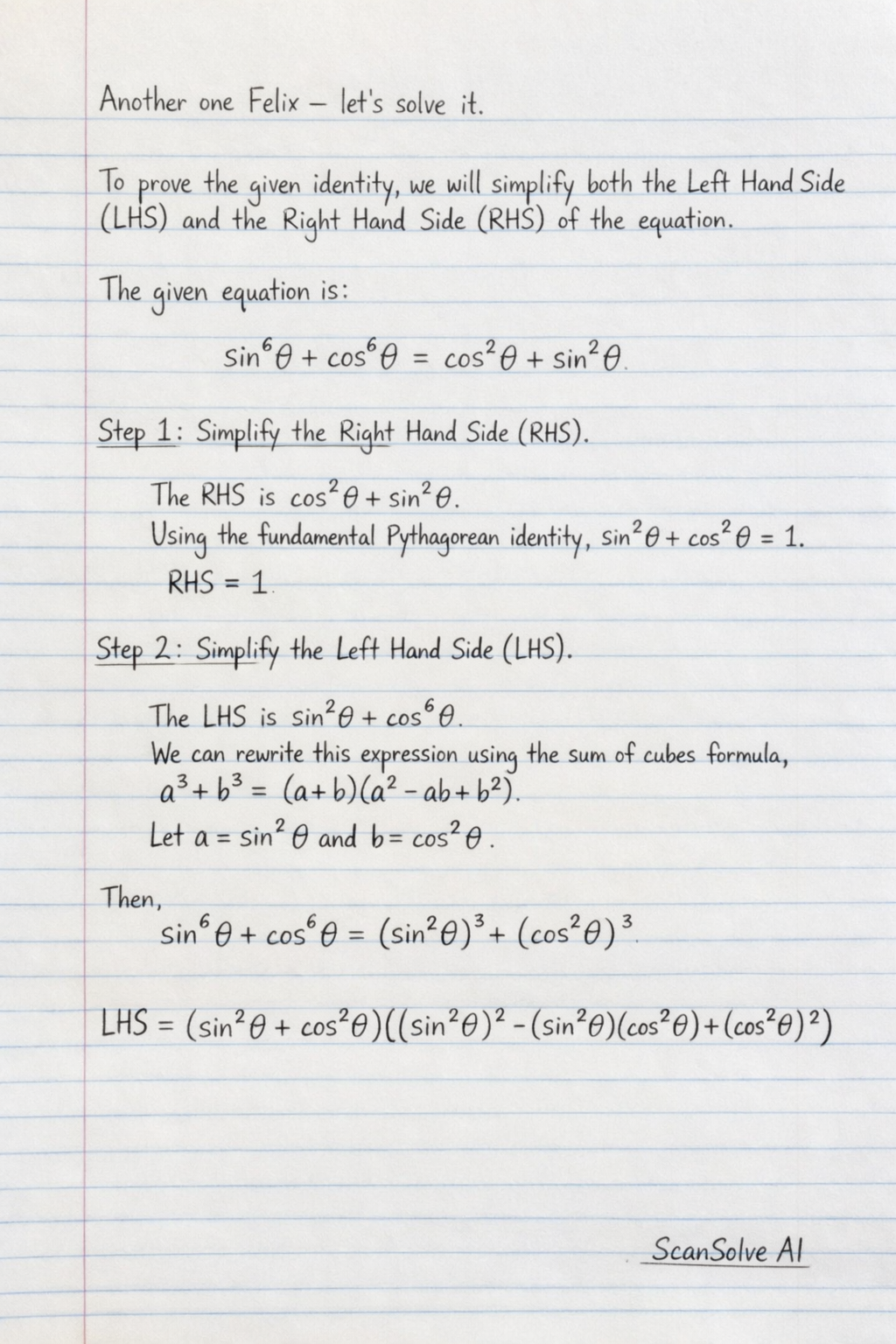
To prove the given identity, we will simplify both the Left Hand Side (LHS) and the Right Hand Side (RHS) of the equation. The given equation is: ^6 + ^6 = ^2 + ^2 Step 1: Simplify the Right Hand Side (RHS). The RHS is ^2 + ^2 . Using the fundamental Pythagorean identity, ^2 + ^2 = 1. RHS = 1 Step 2: Simplify the Left Hand Side (LHS). The LHS is ^6 + ^6 . We can rewrite this expression using the sum of cubes formula, a^3 + b^3 = (a+b)(a^2 - ab + b^2). Let a = ^2 and b = ^2 . Then, ^6 + ^6 = (^2 )^3 + (^2 )^3. LHS = (^2 + ^2 )((^2 )^2 - (^2 )(^2 ) + (^2 )^2) Step 3: Apply the Pythagorean identity ^2 + ^2 = 1 to the first factor. LHS = (1)(^4 - ^2 ^2 + ^4 ) LHS = ^4 + ^4 - ^2 ^2 Step 4: Express ^4 + ^4 in terms of ^2 ^2 . We know that (^2 + ^2 )^2 = 1^2. Expanding the left side: ^4 + 2^2 ^2 + ^4 = 1 Rearranging this, we get: ^4 + ^4 = 1 - 2^2 ^2 Step 5: Substitute this back into the expression for the LHS. LHS = (1 - 2^2 ^2 ) - ^2 ^2 LHS = 1 - 3^2 ^2 Step 6: Compare the simplified LHS and RHS. We have LHS = 1 - 3^2 ^2 and RHS = 1. For the given equation to be true, we would need: 1 - 3^2 ^2 = 1 Subtracting 1 from both sides: -3^2 ^2 = 0 ^2 ^2 = 0 This condition is only met when = 0 or = 0. This is not true for all values of (for example, if = ()/(4), then = sqrt(2)2 and = sqrt(2)2, so ^2 ^2 = (1)/(4) ≠ 0). Therefore, the given statement is not a trigonometric identity and cannot be proven as generally true. The statement is not a general identity. What's next?