
We read your photo as:
The 13th term of an arithmetic progression is 10 and the 25th term is 20. Calculate: i) the common difference ii) the first term. iii) the 17th term.
Mathematics
ScanSolve AI Answer
Answers
3 partsStep-by-step solution
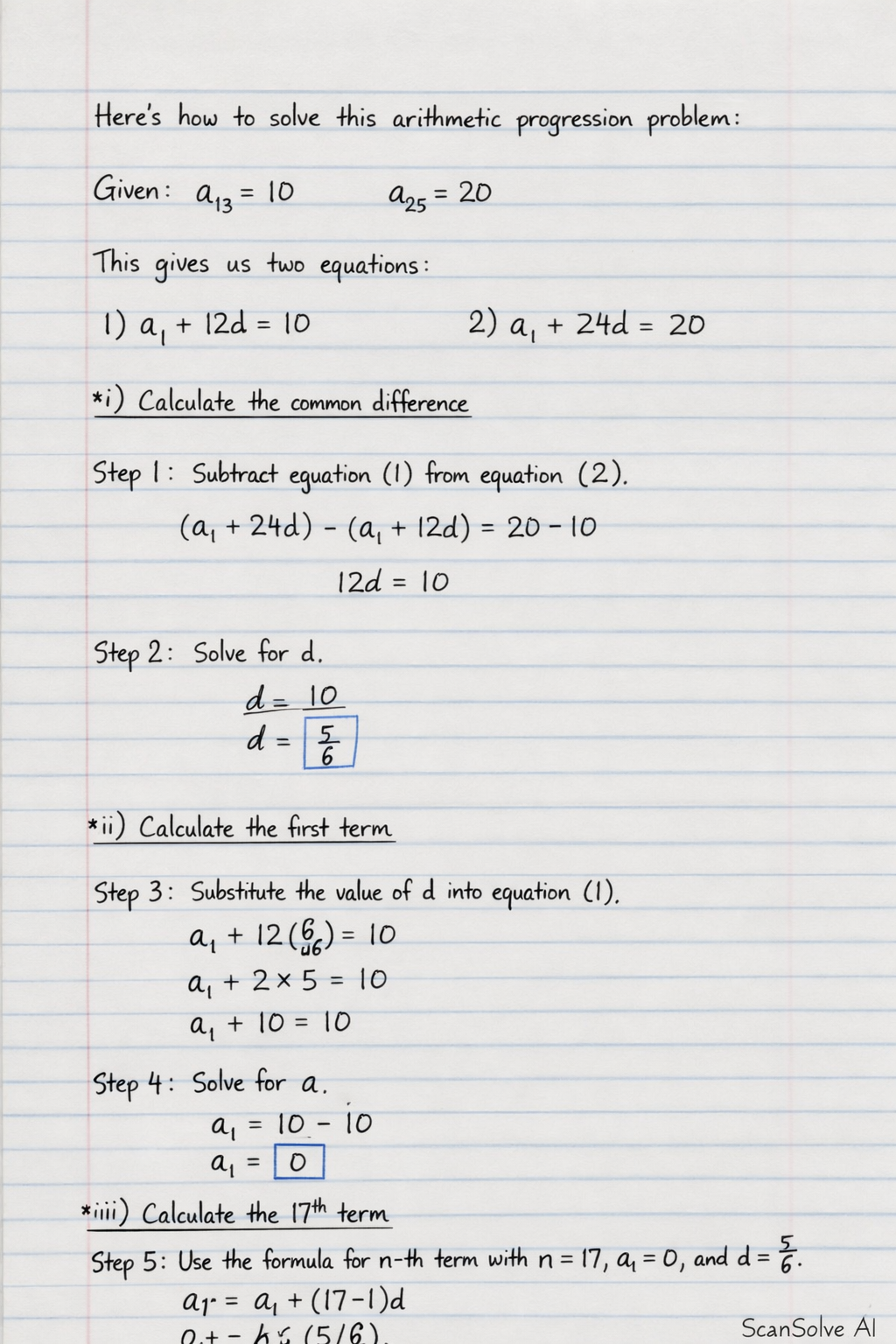
6 stepsHere's how to solve this arithmetic progression problem:
The formula for the -th term of an arithmetic progression is , where is the first term and is the common difference.
Given:
This gives us two equations:
Part i· 2 steps
Calculate the common difference
Subtract equation (1) from equation (2).
Solve for .
Part ii0
Calculate the first term
Substitute the value of into equation (1).
Solve for .
Part iii
Calculate the 17th term
Use the formula for the -th term with , , and .
Simplify the expression.
Was this helpful?
Try one yourself
A new problem that tests the same skill.
Still stuck on this one?
Ask a follow-up, and the answer starts from this question.
Got a different question?Ask your own question
More Mathematics Questions
QAn arithmetic progression has its 12th term equal to 7 and its 15th term equal to 9. Find the first…QThe first and last terms of an arithmetic progression are 7 and 43 respectively. The sum of the…QThe first term of an Arithmetic Progression is 20. If the fifth term is four-fifth of the third…QThe first term of an arithmetic progression is 4 and the last term is 20. The sum of the terms is…QAn arithmetic progression has its 5th term equal to 60 and its 10th term equal to 45. Find (a) the…
Browse by topic:Pre-Calculus
Handwritten Step-by-Step Solution
Get this as a handwritten image on WhatsApp — like a tutor wrote it for you.
Try on WhatsApp