

This mathematics problem involves applying core mathematical principles and formulas. Below you will find a complete step-by-step solution with detailed explanations for each step, helping you understand not just the answer but the method behind it.
ScanSolve AI Answer
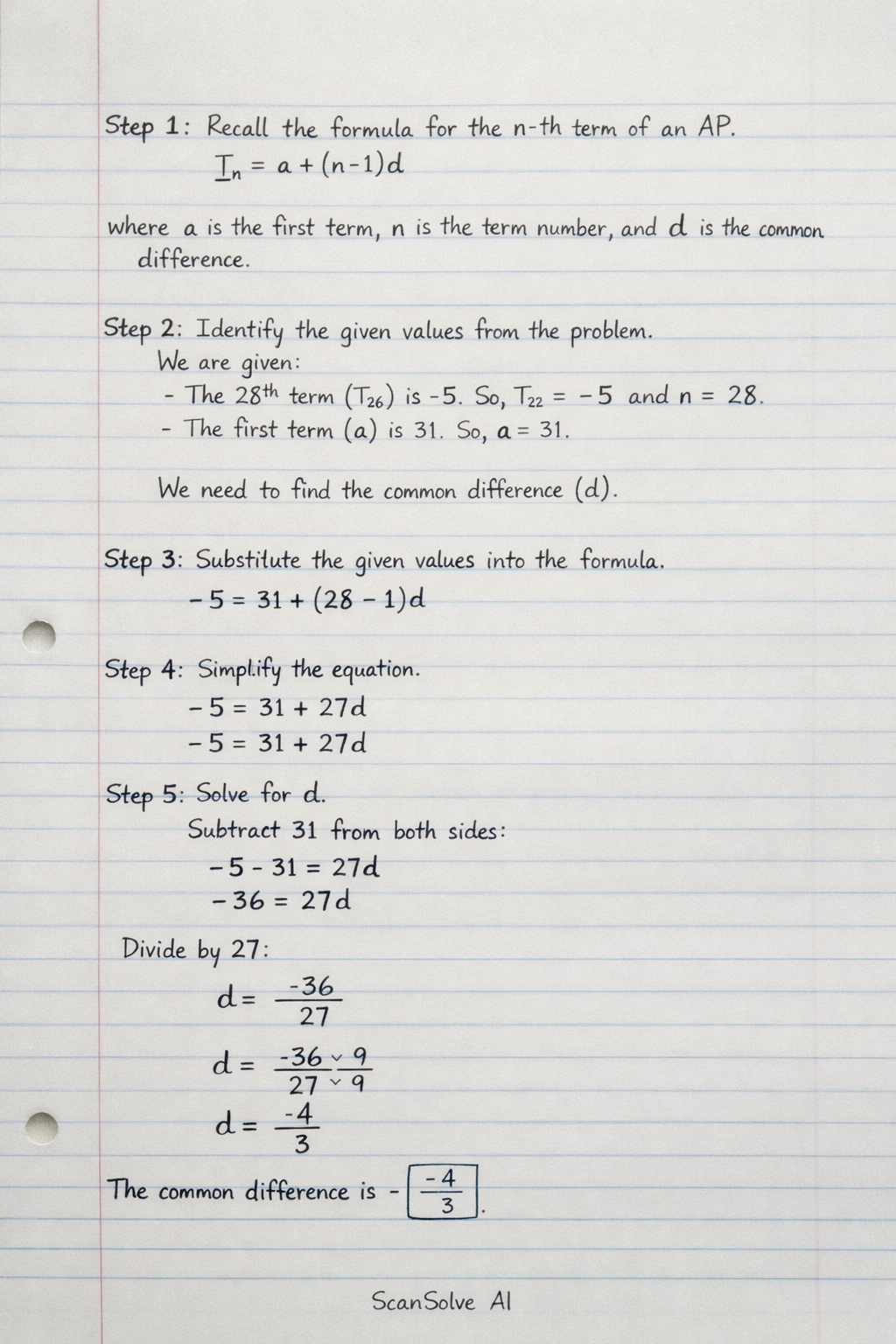
Step 1: Recall the formula for the n-th term of an Arithmetic Progression (AP). The formula for the n-th term (T_n) of an AP is: T_n = a + (n-1)d where a is the first term, n is the term number, and d is the common difference. Step 2: Identify the given values from the problem. We are given: • The 28th term (T_28) is -5. So, T_n = -5 and n = 28. • The first term (a) is 31. So, a = 31. We need to find the common difference (d). Step 3: Substitute the given values into the formula. -5 = 31 + (28-1)d Step 4: Simplify the equation. -5 = 31 + (27)d -5 = 31 + 27d Step 5: Solve for d. Subtract 31 from both sides: -5 - 31 = 27d -36 = 27d Divide by 27: d = (-36)/(27) Simplify the fraction by dividing both numerator and denominator by their greatest common divisor, which is 9: d = (-36 ÷ 9)/(27 ÷ 9) d = (-4)/(3) The common difference is -(4)/(3). -(4)/(3) That's 2 down. 3 left today — send the next one.