
We read your photo as:
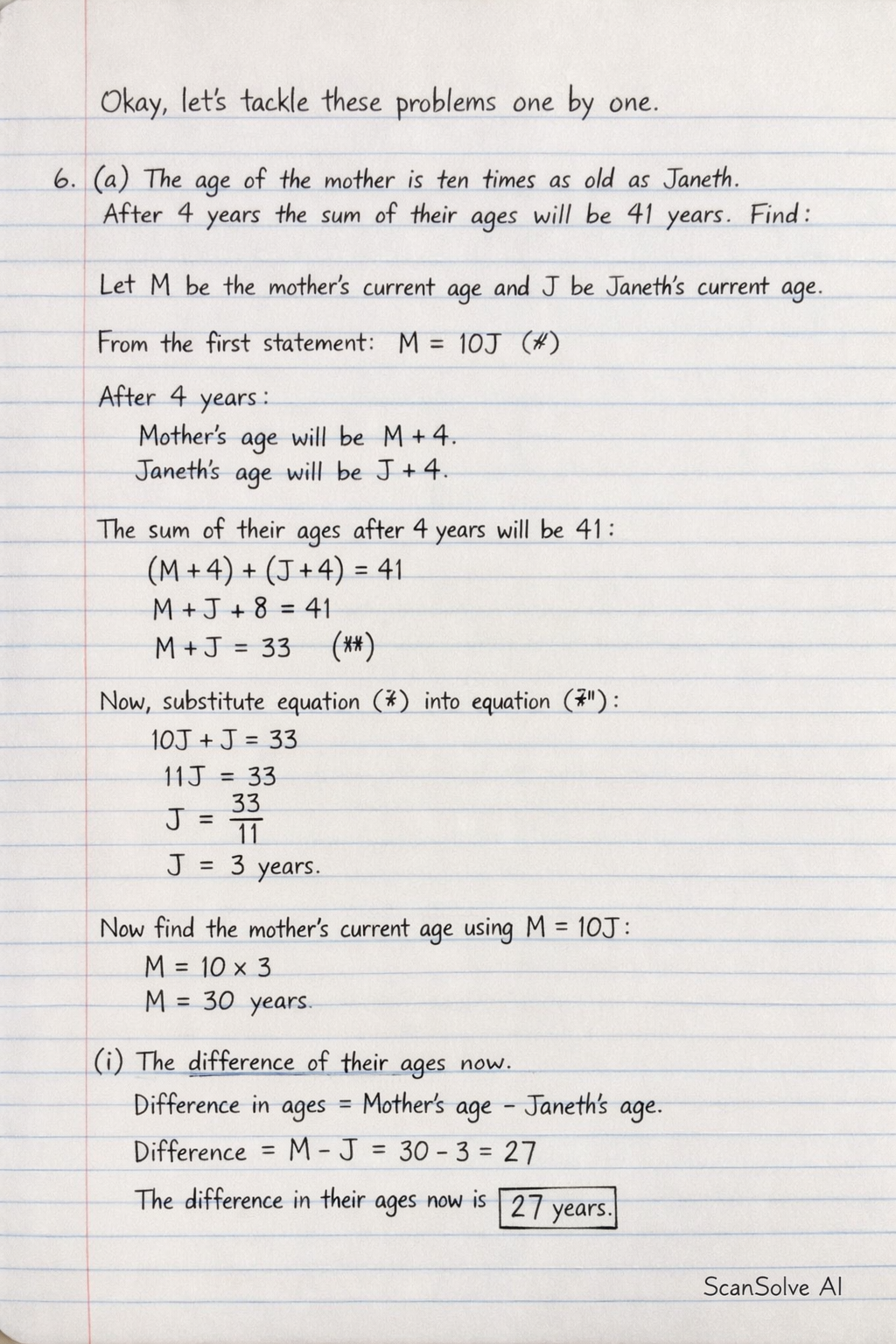
The age of the mother is ten times as old as Janeth. After 4 years the sum of their ages will be 41 years. Find the difference in their ages now and the sum of their ages 5 years ago.
ScanSolve AI Answer
This answer stops before the end.
It was cut off when it was first written. Ask ScanSolve this question again for the full working.
Okay, let's tackle these problems one by one.
6. (a) The age of the mother is ten times as old as Janeth. After 4 years the sum of their ages will be 41 years. Find:
Let be the mother's current age and be Janeth's current age.
From the first statement:
After 4 years:
Mother's age will be .
Janeth's age will be .
The sum of their ages after 4 years will be 41:
Now, substitute equation into equation :
Now find the mother's current age using :
(i) The different of their ages now.
Difference in ages = Mother's age - Janeth's age
The difference in their ages now is .
(ii) The sum of their ages 5 years ago (Comment for your result)
Janeth's age 5 years ago = years.
Mother's age 5 years ago = years.
Sum of their ages 5 years ago = years.
The sum of their ages 5 years ago is .
Comment: Janeth's age 5 years ago would be -2 years, which is not possible. This indicates that Janeth was not yet born 5 years ago. The problem implies that both individuals existed 5 years ago, which is not true for Janeth.
(b) The sum of two consecutive integers is at least negative fifteen. What are the smallest values of the consecutive integers that will make it true?
Let the first integer be .
The next consecutive integer is .
The sum of the two consecutive integers is .
"At least negative fifteen" means greater than or equal to -15.
Step 1: Subtract 1 from both sides.
Step 2: Divide by 2.
The smallest integer that satisfies this condition is .
So, the first integer is .
The second consecutive integer is .
The smallest values of the consecutive integers are .
7. (a) Express each of the following statements in symbolic form:
(i) "x is greater than 7"
(ii) "y is not equal to 10"
(b) Find the solution of the following equation.
For an absolute value equation , we have two cases: or .
Case 1:
Step 1: Subtract 2 from both sides.
Step 2: Divide by -5.
Case 2:
Step 1: Subtract 2 from both sides.
Step 2: Divide by -5.
The solutions are .
8. If one side of a triangle is one-fourth of the perimeter, the second side is 7cm and the third side is two-fifth of the perimeter.
Let the perimeter of the triangle be .
Let the three sides be , , and .
Given:
First side,
Second side,
Third side,
We know that the perimeter is the sum of the lengths of its sides:
Step 1: Substitute the expressions for , , and into the perimeter equation.
Step 2: Collect terms involving on one side.
Step 3: Find a common denominator for the fractions (which is 20).
Step 4: Solve for .
(b) Find the perimeter of the triangle.
The perimeter of the triangle is .
(c) Write down the length of the unknown sides.
Now that we have , we can find the lengths of sides and .
First side,
Third side,
The lengths of the unknown sides are .
(a) Construct a triangle using the information given.
The sides of the triangle are , , and .
To construct the triangle:
- Draw a line segment of length 7 cm (side ).
- From one endpoint of the 7 cm segment, draw an arc with a radius of 5 cm (side ).
- From the other endpoint of the 7 cm segment, draw an arc with a radius of 8 cm (side ).
- The intersection of the two arcs is the third vertex of the triangle. Connect the endpoints of the 7 cm segment to this intersection point to form the triangle.
9. (a) The average of two numbers and is 7 and three times subtract from is 18. Find the numbers.
From the first statement: "The average of two numbers and is 7."
From the second statement: "three times subtract from is 18."
This means .
We have a system of two linear equations:
Step 1: Subtract equation (2) from equation (1) to eliminate .
Step 2: Substitute the value of into equation (1) to find .
The numbers are .
(b) A piece of wire is 1.5m long. When it is cut into 6 pieces of the same length, what cm will be the Length of each piece?
Step 1: Convert the total length from meters to centimeters.
We know that .
Step 2: Divide the total length by the number of pieces.
Length of each piece = Total length / Number of pieces
The length of each piece will be .
10. (a) Frank planted trees on each side of the road to his house. The road is km long and the trees are 10m apart. How many trees are there?
Step 1: Convert the length of the road from kilometers to meters.
Step 2: Calculate the number of intervals along one side of the road.
Number of intervals = Total length / Distance between trees
Step 3: If trees are planted at both ends of the road, the number of trees on one side is one more than the number of intervals.
Number of trees on one side = Number of intervals + 1
Step 4: Since trees are planted on each side of the road, multiply the number of trees on one side by 2.
Total number of trees = Number of trees on one side
There are trees.
(b) Solve for q where .
Step 1: Convert mixed numbers to improper fractions.
The equation becomes:
Step 2: Collect terms with on one side and constant terms on the other side.
Step 3: Simplify the constant terms.
Step 4: Simplify the terms with . Find a common denominator for 6 and 3, which is 6.
Still stuck on this one?
Ask a follow-up, and the answer starts from this question.
More Mathematics Questions
Handwritten Step-by-Step Solution
Get this as a handwritten image on WhatsApp — like a tutor wrote it for you.
Try on WhatsApp