

This mathematics problem involves applying core mathematical principles and formulas. Below you will find a complete step-by-step solution with detailed explanations for each step, helping you understand not just the answer but the method behind it.
ScanSolve AI Answer
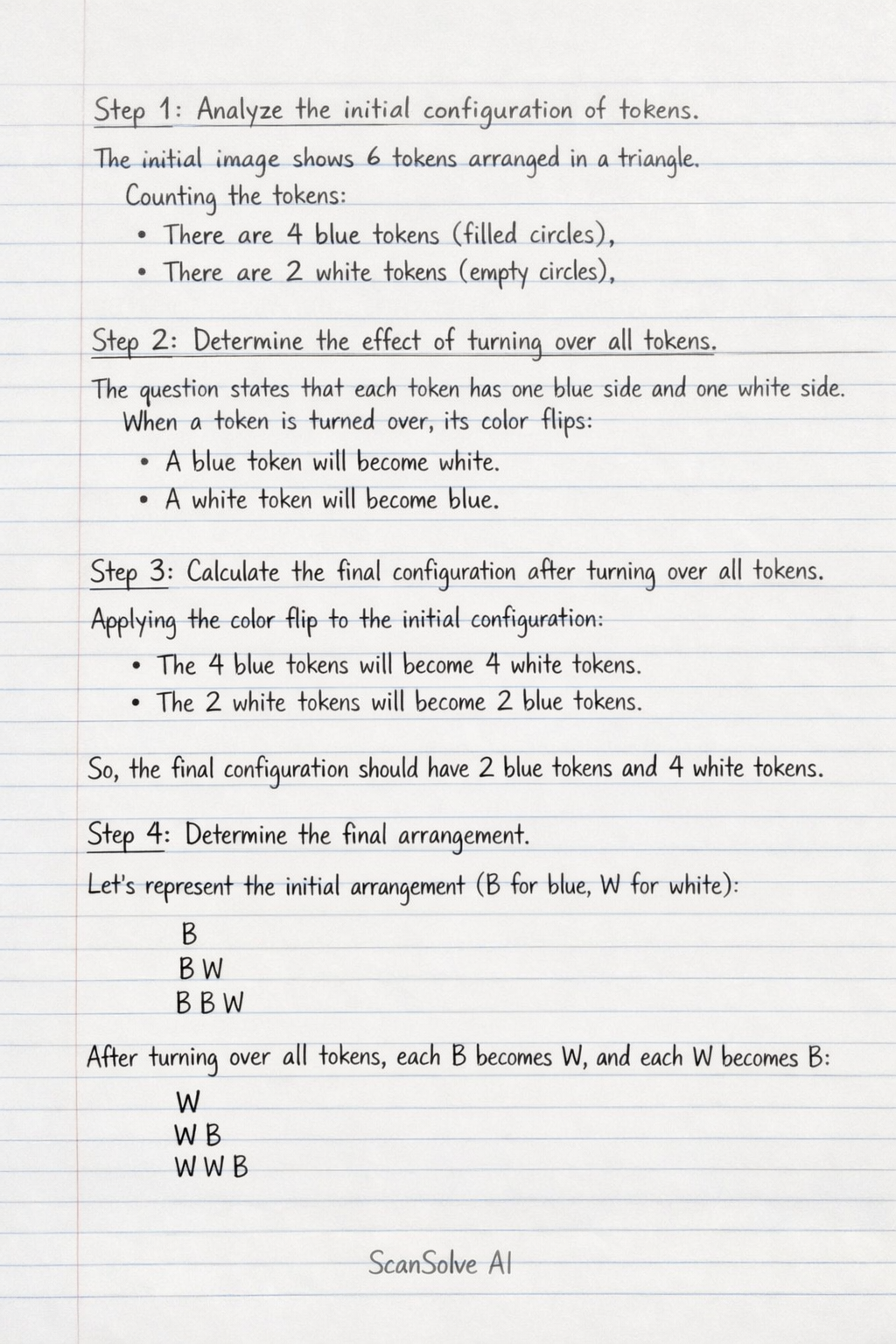
Step 1: Analyze the initial configuration of tokens. The initial image shows 6 tokens arranged in a triangle. Counting the tokens: • There are 4 blue tokens (filled circles). • There are 2 white tokens (empty circles). Step 2: Determine the effect of turning over all tokens. The question states that each token has one blue side and one white side. When a token is turned over, its color flips. • A blue token will become white. • A white token will become blue. Step 3: Calculate the final configuration after turning over all tokens. Applying the color flip to the initial configuration: • The 4 blue tokens will become 4 white tokens. • The 2 white tokens will become 2 blue tokens. So, the final configuration should have 2 blue tokens and 4 white tokens. Step 4: Determine the final arrangement. Let's represent the initial arrangement (B for blue, W for white): B B W B B W After turning over all tokens, each B becomes W, and each W becomes B: W W B W W B Step 5: Compare the final configuration and arrangement with the given options. • Option (A) shows 4 blue and 2 white tokens, which is the initial state. Incorrect. • Option (B) shows 2 blue and 4 white tokens, arranged as: W W B W W B This matches our calculated final configuration and arrangement. Correct. • Option (C) shows 3 blue and 3 white tokens. Incorrect. • Option (D) shows 2 blue and 4 white tokens, arranged as: W W B W W B This is identical to option (B) and also matches our calculated final configuration and arrangement. Correct. • Option (E) shows 4 blue and 2 white tokens, which is the initial state. Incorrect. Since both (B) and (D) are identical and correct, we select one of them. The final answer is B. That's 2 down. 3 left today — send the next one.