
We read your photo as:
The nth term of a geometric progression (G.P.) is given by T_n = 5 imes 22-n. Write down the first four terms and calculate the sum of the first six terms.
ScanSolve AI Answer
Answers
2 partsStep-by-step solution
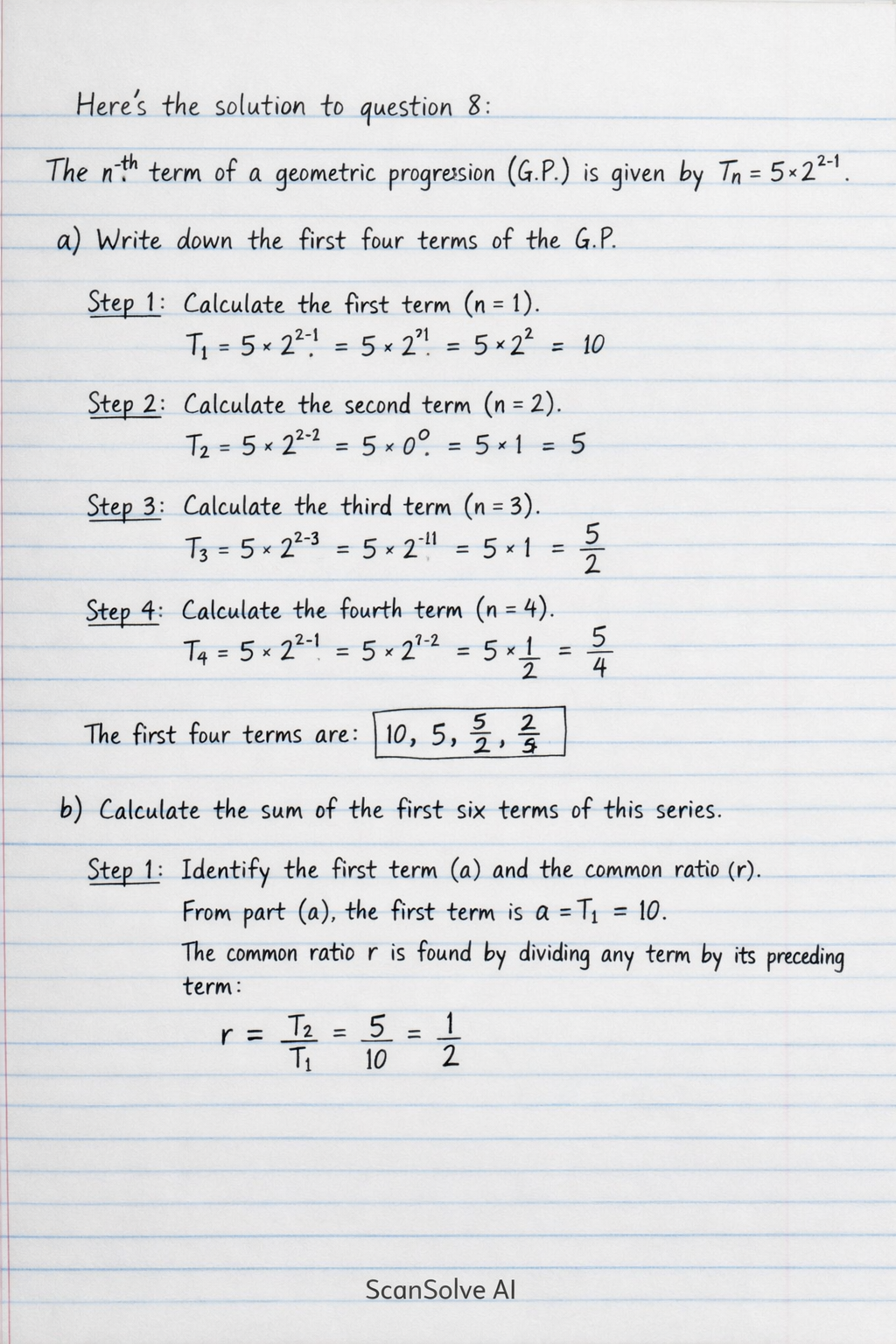
8 stepsHere's the solution to question 8:
The th term of a geometric progression (G.P.) is given by .
Part a· 4 steps
Write down the first four terms of the G.P.
Calculate the first term ().
Calculate the second term ().
Calculate the third term ().
Calculate the fourth term ().
The first four terms are:
Part b
Calculate the sum of the first six terms of this series.
Identify the first term () and the common ratio ().
From part (a), the first term is .
The common ratio is found by dividing any term by its preceding term:Use the formula for the sum of the first terms of a G.P.
The formula for the sum of the first terms is .
We need to find the sum of the first six terms, so , , and .Calculate .
Substitute the value and simplify.
The sum of the first six terms is:
Try one yourself
A new problem that tests the same skill.
Still stuck on this one?
Ask a follow-up, and the answer starts from this question.
More Mathematics Questions
Handwritten Step-by-Step Solution
Get this as a handwritten image on WhatsApp — like a tutor wrote it for you.
Try on WhatsApp