
We read your photo as:
The opposite angles of a cyclic quadrilateral are x and 3x. Find the angles.
ScanSolve AI Answer
Answers
2 partsStep-by-step solution
6 stepsHere is the solution to question 12:
Part a
The sum of the opposite angles of a cyclic quadrilateral is .
Part b
Identify the relationship between opposite angles in a cyclic quadrilateral.
In a cyclic quadrilateral, the sum of opposite angles is .
Given and .Set up the equation and solve for .
The value of is .
Part c
This is an experimental task and cannot be performed by an AI.
The theorem states that the angle subtended by an arc at the center is double the angle subtended by it at any point on the remaining part of the circle. Therefore, the central angle is twice the circumference angle .
Part d
Use the value of found in part (b) to determine .
From part (b), .
So, .Identify properties of triangles formed by radii.
Since O is the center of the circle, OW, OY, and OZ are radii.
In , (radii of the same circle). Therefore, is an isosceles triangle, and its base angles are equal:In , (radii of the same circle). Therefore, is an isosceles triangle, and its base angles are equal:
Express in terms of the angles from the isosceles triangles.
The angle of the cyclic quadrilateral is the sum of and .
Substitute known values and relationships to prove the statement.
We know .
So, .
Substitute with (since ) and with (since ).Hence, it is proven that .
Try one yourself
A new problem that tests the same skill.
Still stuck on this one?
Ask a follow-up, and the answer starts from this question.
More Mathematics Questions
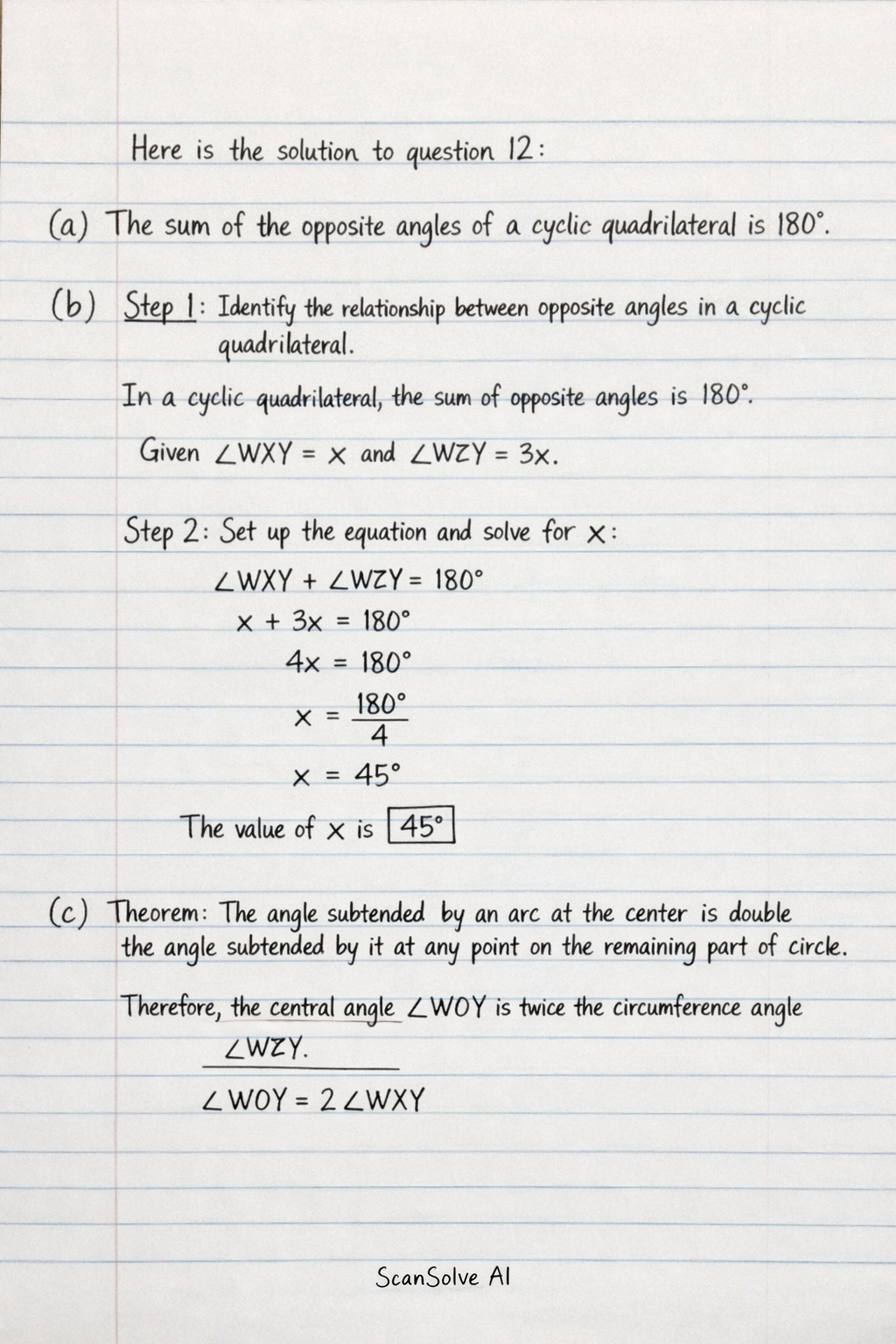
Handwritten Step-by-Step Solution
Get this as a handwritten image on WhatsApp — like a tutor wrote it for you.
Try on WhatsApp