

This mathematics problem involves applying core mathematical principles and formulas. Below you will find a complete step-by-step solution with detailed explanations for each step, helping you understand not just the answer but the method behind it.
ScanSolve AI Answer
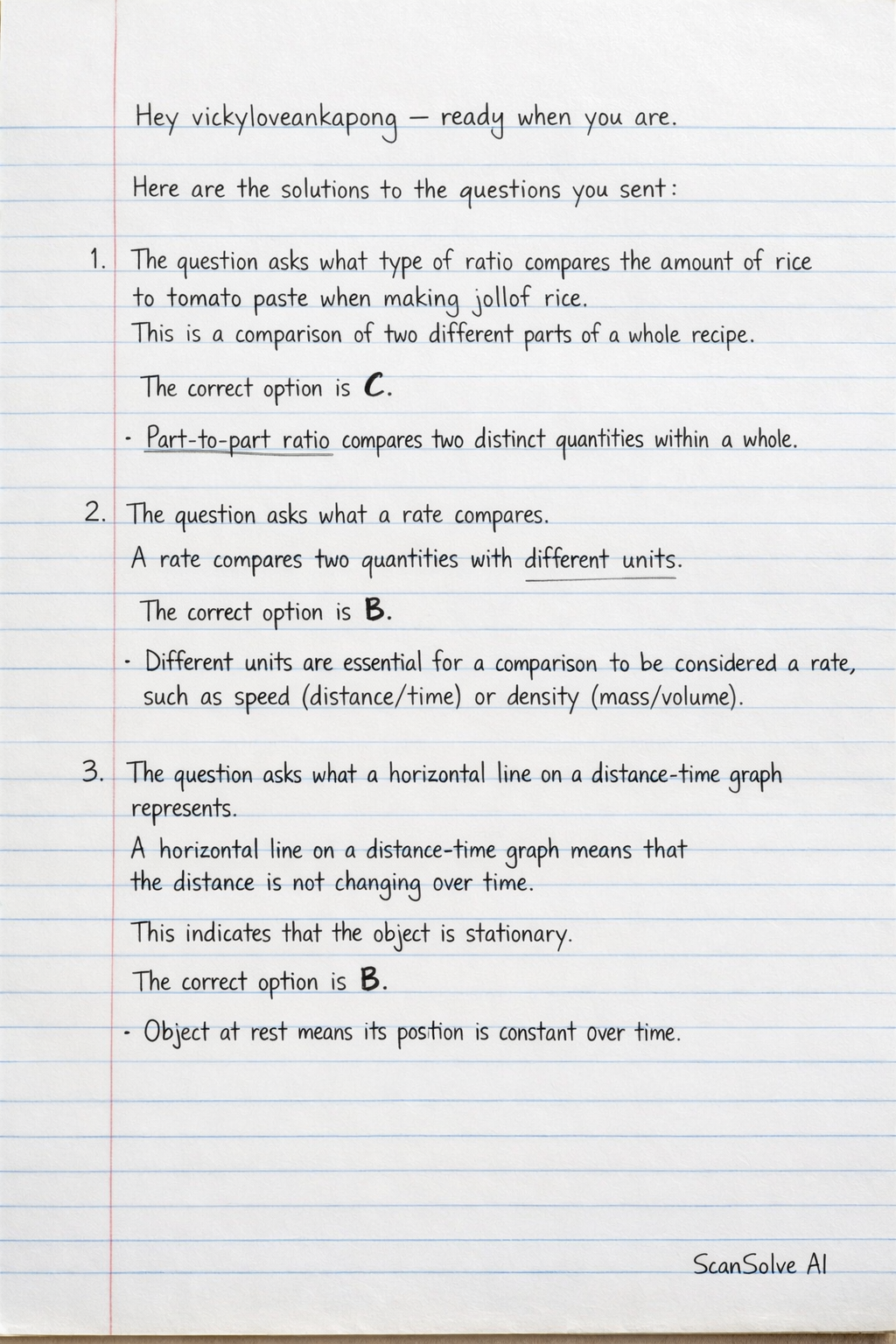
Hey vickyloveankapong — ready when you are. Here are the solutions to the questions you sent: 1. The question asks what type of ratio compares the amount of rice to tomato paste when making jollof rice. This is a comparison of two different parts of a whole recipe. The correct option is C. • Part-to-part ratio compares two distinct quantities within a whole. 2. The question asks what a rate compares. A rate compares two quantities with different units. The correct option is B. • Different units are essential for a comparison to be considered a rate, such as speed (distance/time) or density (mass/volume). 3. The question asks what a horizontal line on a distance-time graph represents. A horizontal line on a distance-time graph means that the distance is not changing over time. This indicates that the object is stationary. The correct option is B. • Object at rest means its position is constant over time. 4. The question asks what the gradient of the line in a distance-time graph represents. The gradient of a distance-time graph is calculated as change in distancechange in time, which is the definition of speed. The correct option is C. • Speed is the rate of change of distance with respect to time. 5. The question asks what a sequence where the difference between consecutive terms is constant is called. This is the definition of an arithmetic progression. The correct option is C. • An arithmetic progression is a sequence of numbers such that the difference between the consecutive terms is constant. 6. The general term of an arithmetic progression is given by U_n = a + (n-1)d, where a is the first term, n is the term number, and d is the common difference. The correct option is B. • U_n = a + (n-1)d is the standard formula for the n-th term of an arithmetic progression. 7. The general term of a geometric progression is given by U_n = ar^n-1, where a is the first term, n is the term number, and r is the common ratio. The correct option is C. • U_n = ar^n-1 is the standard formula for the n-th term of a geometric progression. 8. The sum of the first n terms of an arithmetic progression is given by S_n = (n)/(2)[2a + (n-1)d]. The correct option is A. • S_n = (n)/(2)[2a + (n-1)d] is the standard formula for the sum of the first n terms of an arithmetic progression. 9. The surface area of a cuboid with length l, width w, and height h is given by the sum of the areas of its six faces: 2(lw + lh + wh). The correct option is B. • The formula 2(lw + lh + wh) accounts for the area of all six rectangular faces of the cuboid. 10. The volume of a cylinder with radius r and height h is given by the formula r^2 h. The correct option is A. • The formula r^2 h is derived from the area of the circular base ( r^2) multiplied by the height (h). 11. The question asks how many feet are in 1 meter. 1 meter ≈ 3.281 feet The correct option is B. • This is a standard conversion factor. 12. The question asks how many square centimeters are in 1 square meter. We know that 1 meter = 100 centimeters. Therefore, 1 square meter = (1 meter) × (1 meter) = (100 cm) × (100 cm) = 10,000 cm^2. The correct option is C. • 1 m^2 = (100 cm)^2 = 100^2 cm^2 = 10,000 cm^2. Drop the next question. 📸