
We read your photo as:
Write the unit digit in the cube of the following numbers: 19, 201, 164, 1307, 510, 35, 716.
ScanSolve AI Answer
Step-by-step solution
51 stepsHere are the solutions to the problems.
1. Write the unit digit in the cube of the following numbers:
To find the unit digit of a cube, we only need to cube the unit digit of the original number and find its unit digit.
- a) 19
The unit digit of 19 is 9.
Cube the unit digit
.
The unit digit of 729 is 9.
The unit digit is $\boxed{9}$.- b) 201
The unit digit of 201 is 1.
Cube the unit digit
.
The unit digit of 1 is 1.
The unit digit is $\boxed{1}$.- c) 164
The unit digit of 164 is 4.
Cube the unit digit
.
The unit digit of 64 is 4.
The unit digit is $\boxed{4}$.- d) 1307
The unit digit of 1307 is 7.
Cube the unit digit
.
The unit digit of 343 is 3.
The unit digit is $\boxed{3}$.- e) 510
The unit digit of 510 is 0.
Cube the unit digit
.
The unit digit of 0 is 0.
The unit digit is $\boxed{0}$.- f) 35
The unit digit of 35 is 5.
Cube the unit digit
.
The unit digit of 125 is 5.
The unit digit is $\boxed{5}$.- g) 716
The unit digit of 716 is 6.
Cube the unit digit
.
The unit digit of 216 is 6.
The unit digit is $\boxed{6}$.- h) 1718
The unit digit of 1718 is 8.
Cube the unit digit
.
The unit digit of 512 is 2.
The unit digit is $\boxed{2}$.2. State which of the following numbers are perfect cubes:
A number is a perfect cube if it can be expressed as for some integer .- a) 1000
Find the cube root of 1000.
$$ \sqrt[3]{1000} = 10 $$Since 1000 is the cube of an integer (10), it is a perfect cube.
$\boxed{\text{Perfect cube}}$- b)
Use the property .
$$ 5^3 \times 7^3 = (5 \times 7)^3 = 35^3 $$Since the number can be expressed as the cube of an integer (35), it is a perfect cube.
$\boxed{\text{Perfect cube}}$- c) 100000
Count the number of zeros.
There are 5 zeros.
For a number ending in zeros to be a perfect cube, the number of zeros must be a multiple of 3.
Since 5 is not a multiple of 3, 100000 is not a perfect cube.
- d)
Simplify the expression.
$$ (100)^2 \times 10 = 10000 \times 10 = 100000 $$As determined in part (c), 100000 is not a perfect cube.
$\boxed{\text{Not a perfect cube}}$- e)
Simplify the expression.
$$ (1000)^2 = 1000 \times 1000 = 1000000 $$Find the cube root of 1000000.
$$ \sqrt[3]{1000000} = 100 $$Since 1000000 is the cube of an integer (100), it is a perfect cube.
$\boxed{\text{Perfect cube}}$3. Find the cube of the following numbers:
- a) 21
Calculate .
$$ 21^3 = 21 \times 21 \times 21 = 441 \times 21 = 9261 $$ The cube of 21 is $\boxed{9261}$.- b) 100
Calculate .
$$ 100^3 = 100 \times 100 \times 100 = 1000000 $$ The cube of 100 is $\boxed{1000000}$.- c) 17
Calculate .
$$ 17^3 = 17 \times 17 \times 17 = 289 \times 17 = 4913 $$ The cube of 17 is $\boxed{4913}$.- d)
Calculate .
$$ 11^3 = 11 \times 11 \times 11 = 121 \times 11 = 1331 $$ The cube of 11 is $\boxed{1331}$.4. Find the sum of consecutive odd numbers to obtain the following cubes:
The sum of consecutive odd numbers starting from equals .- a)
Identify .
Here .
Find the first odd number in the sequence
.
Write the sum of 4 consecutive odd numbers starting from 13.
$$ 4^3 = 13 + 15 + 17 + 19 = 64 $$ The sum is $\boxed{13 + 15 + 17 + 19}$.- b)
Identify .
Here .
Find the first odd number in the sequence
.
Write the sum of 7 consecutive odd numbers starting from 43.
$$ 7^3 = 43 + 45 + 47 + 49 + 51 + 53 + 55 = 343 $$ The sum is $\boxed{43 + 45 + 47 + 49 + 51 + 53 + 55}$.- c)
Identify .
Here .
Find the first odd number in the sequence
.
Write the sum of 8 consecutive odd numbers starting from 57.
$$ 8^3 = 57 + 59 + 61 + 63 + 65 + 67 + 69 + 71 = 512 $$ The sum is $\boxed{57 + 59 + 61 + 63 + 65 + 67 + 69 + 71}$.- d)
Identify .
Here .
Find the first odd number in the sequence
.
Write the sum of 11 consecutive odd numbers starting from 111.
$$
11^3 = 111 + 113 + 115 + 117 + 119 + 121 + 123 + 125 + 127 + 129 + 131 = 1331
$$
The sum is $\boxed{111 + 113 + 115 + 117 + 119 + 121 + 123 + 125 + 127 + 129 + 131}$.
Still stuck on this one?
Ask a follow-up, and the answer starts from this question.
More Mathematics Questions
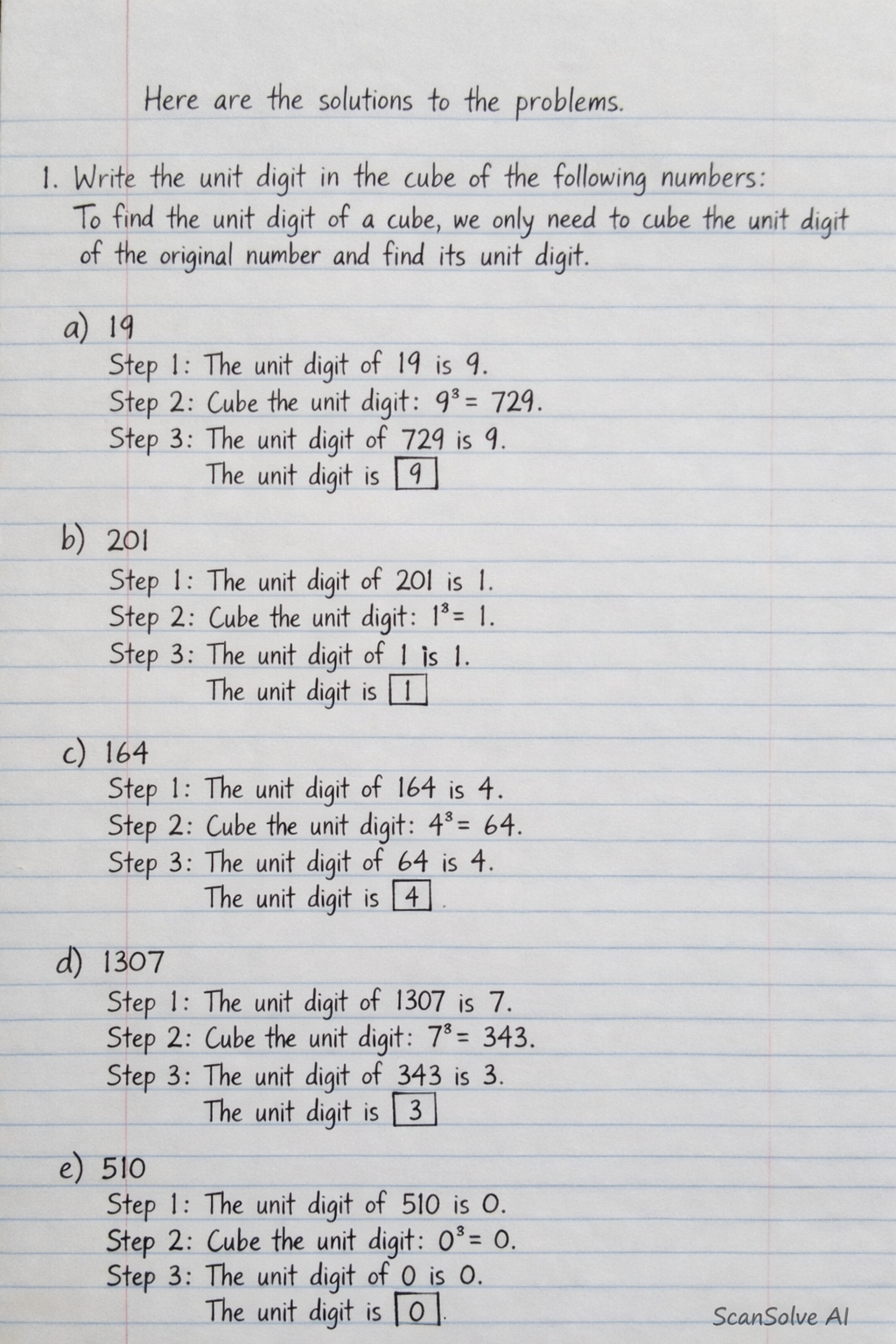
Handwritten Step-by-Step Solution
Get this as a handwritten image on WhatsApp — like a tutor wrote it for you.
Try on WhatsApp