
We read your photo as:
Use this for an instance to solve the equation I gave earlier show each points
Mathematics
ScanSolve AI Answer
Step-by-step solution
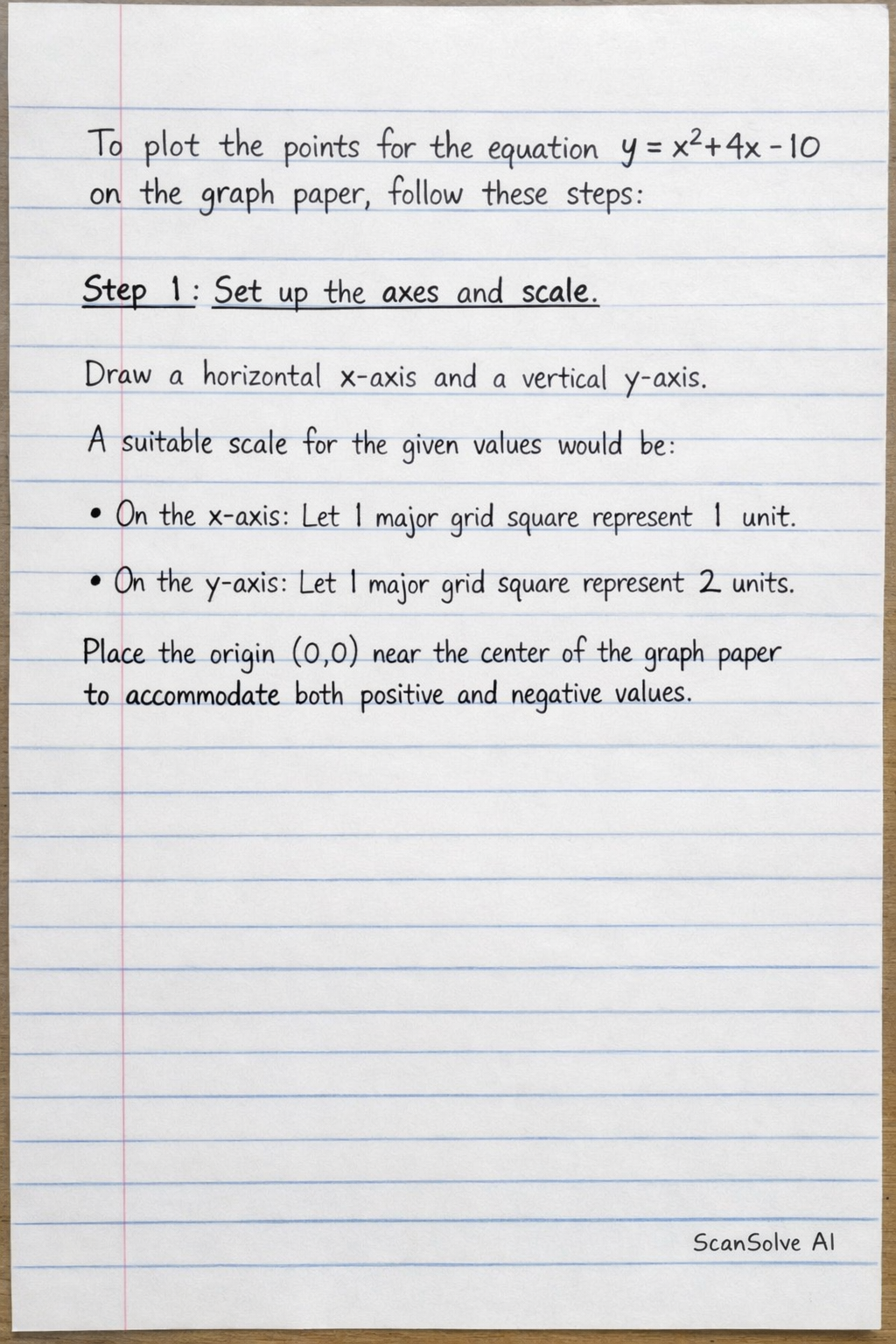
3 stepsTo plot the points for the equation on the graph paper, follow these steps:
Set up the axes and scale.
Draw a horizontal x-axis and a vertical y-axis. A suitable scale for the given values would be:
- On the x-axis: Let 1 major grid square represent 1 unit.
- On the y-axis: Let 1 major grid square represent 2 units. Place the origin $(0,0)$ near the center of the graph paper to accommodate both positive and negative values.
Plot each point using the chosen scale.
Locate each coordinate pair on the graph paper:
- For : Move 4 major squares left from the origin, then 5 major squares down (since ).
- For : Move 3 major squares left from the origin, then 6.5 major squares down (since ). This is 6 major squares and 5 small squares down.
- For : Move 2 major squares left from the origin, then 7 major squares down (since ).
- For : Move 1 major square left from the origin, then 6.5 major squares down.
- For : Stay on the y-axis, then move 5 major squares down from the origin.
- For : Move 1 major square right from the origin, then 2.5 major squares down (since ). This is 2 major squares and 5 small squares down.
- For : Move 2 major squares right from the origin, then 1 major square up (since ).
- For : Move 3 major squares right from the origin, then 5.5 major squares up (since ). This is 5 major squares and 5 small squares up.
Draw the curve.
Once all points are plotted, draw a smooth curve connecting them. The graph should form a parabola opening upwards.
The points to plot are:
Was this helpful?
Still stuck on this one?
Ask a follow-up, and the answer starts from this question.
Got a different question?Ask your own question
More Mathematics Questions
QShow every point on the graph and the numbers ,for easy to understandQGiven points P(2, 9), Q(6, 3), R(2, −3), and S(−4, 3), and the equation y = 1/2x + 3, plot the…QSolve , show working and plot it on a graphQHow do I graph the equations y = −2x + 3 and x + y = 5 using points?QUse the equations below to determine the values of y. Place points on the Cartesian plane and join…
Handwritten Step-by-Step Solution
Get this as a handwritten image on WhatsApp — like a tutor wrote it for you.
Try on WhatsApp