We read your photo as:

Using the formula for cos(A + B), the exact value of cos 75 degrees is Cos 4a - cos 6a = ? Given that x = sec 2t, y = tan 2t, dy/dx in terms of t is

Mathematics

ScanSolve AI Answer

Answers

3 parts
1

A. 14(6−2)\text{A. } \frac{1}{4}(\sqrt{6} - \sqrt{2})

2

C. 2sin⁡(5α)sin⁡(α)\text{C. } 2\sin(5\alpha)\sin(\alpha)

3

B. csc⁡(2t)\text{B. } \csc(2t)

Graph of y = tan(2t)

Use the left and right arrow keys to trace the curve, up and down to jump between key points, and plus and minus to zoom.

Key points of y = tan(2t)
Pointty
x-intercept−3.140
x-intercept−1.570
x-intercept00
x-intercept1.570
x-intercept3.140

Step-by-step solution

12 steps

Voici les solutions détaillées pour chaque question :

Part 1· 4 steps

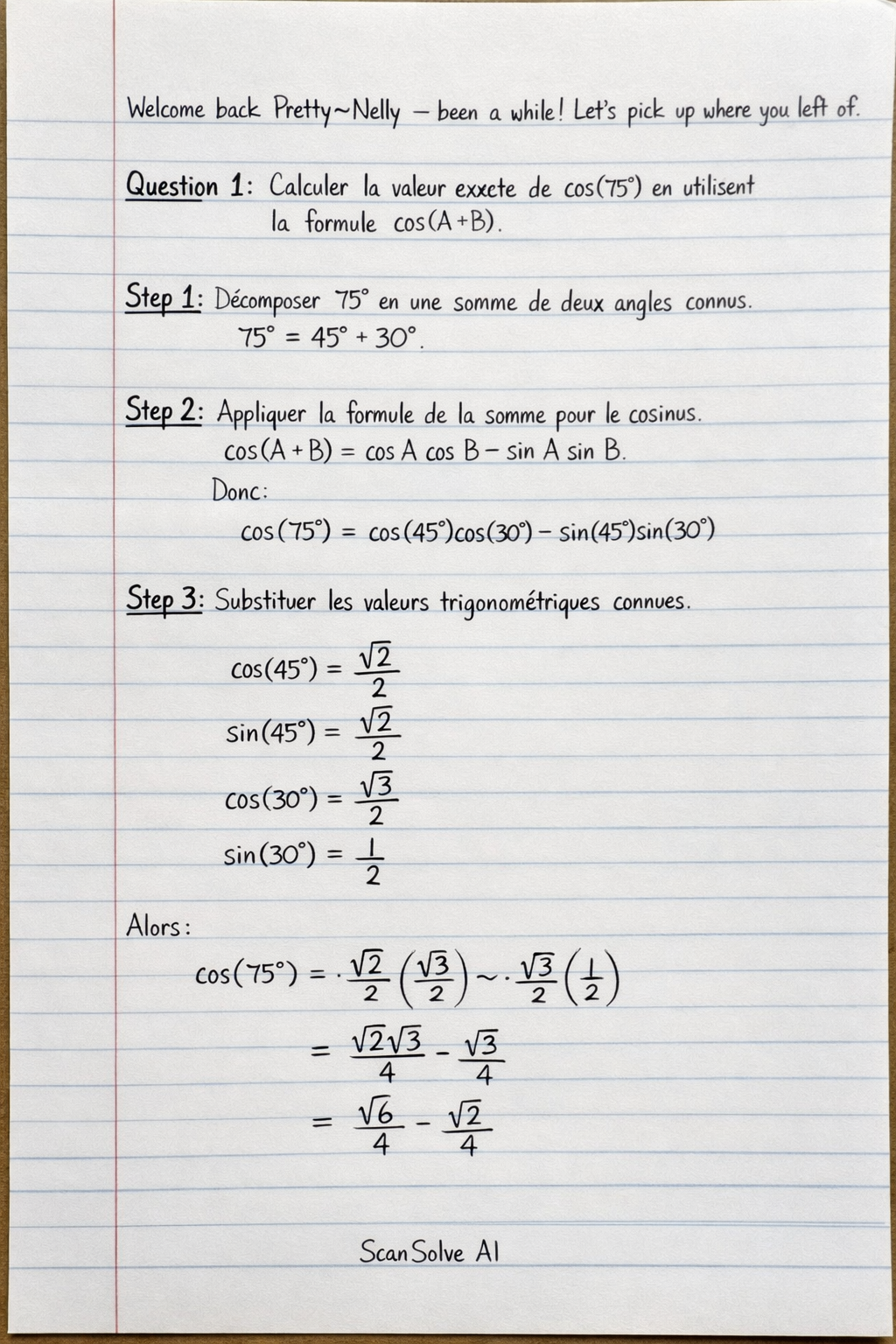
Calculer la valeur exacte de cos⁡(75∘)\cos(75^\circ) en utilisant la formule cos⁡(A+B)\cos(A+B).

  1. Décomposer l'angle 75∘75^\circ en une somme de deux angles dont les valeurs trigonométriques sont connues.

    On peut écrire 75∘=45∘+30∘75^\circ = 45^\circ + 30^\circ.

  2. Appliquer la formule de la somme pour le cosinus.

    La formule est cos⁡(A+B)=cos⁡Acos⁡B−sin⁡Asin⁡B\cos(A+B) = \cos A \cos B - \sin A \sin B.
    En substituant A=45∘A = 45^\circ et B=30∘B = 30^\circ:

    cos⁡(75∘)=cos⁡(45∘)cos⁡(30∘)−sin⁡(45∘)sin⁡(30∘)\cos(75^\circ) = \cos(45^\circ)\cos(30^\circ) - \sin(45^\circ)\sin(30^\circ)
  3. Substituer les valeurs trigonométriques connues.

    On sait que:
    cos⁡(45∘)=22\cos(45^\circ) = \frac{\sqrt{2}}{2}
    sin⁡(45∘)=22\sin(45^\circ) = \frac{\sqrt{2}}{2}
    cos⁡(30∘)=32\cos(30^\circ) = \frac{\sqrt{3}}{2}
    sin⁡(30∘)=12\sin(30^\circ) = \frac{1}{2}
    D'où:

    cos⁡(75∘)=(22)(32)−(22)(12)\cos(75^\circ) = \left(\frac{\sqrt{2}}{2}\right)\left(\frac{\sqrt{3}}{2}\right) - \left(\frac{\sqrt{2}}{2}\right)\left(\frac{1}{2}\right)
  4. Simplifier l'expression.

    cos⁡(75∘)=2⋅34−2⋅14\cos(75^\circ) = \frac{\sqrt{2} \cdot \sqrt{3}}{4} - \frac{\sqrt{2} \cdot 1}{4} cos⁡(75∘)=64−24\cos(75^\circ) = \frac{\sqrt{6}}{4} - \frac{\sqrt{2}}{4} cos⁡(75∘)=6−24\cos(75^\circ) = \frac{\sqrt{6} - \sqrt{2}}{4}

    En comparant avec les options, cela correspond à l'option A.
    La réponse est A. 14(6−2)\boxed{\text{A. } \frac{1}{4}(\sqrt{6} - \sqrt{2})}.

Part 2

C. 2sin⁡(5α)sin⁡(α)\text{C. } 2\sin(5\alpha)\sin(\alpha)

Simplifier cos⁡(4α)−cos⁡(6α)\cos(4\alpha) - \cos(6\alpha).

  1. Utiliser la formule de transformation de somme en produit pour le cosinus.

    La formule est cos⁡A−cos⁡B=−2sin⁡(A+B2)sin⁡(A−B2)\cos A - \cos B = -2 \sin\left(\frac{A+B}{2}\right) \sin\left(\frac{A-B}{2}\right).
    Ici, A=4αA = 4\alpha et B=6αB = 6\alpha.

  2. Calculer les arguments des fonctions sinus.

    A+B2=4α+6α2=10α2=5α\frac{A+B}{2} = \frac{4\alpha + 6\alpha}{2} = \frac{10\alpha}{2} = 5\alpha A−B2=4α−6α2=−2α2=−α\frac{A-B}{2} = \frac{4\alpha - 6\alpha}{2} = \frac{-2\alpha}{2} = -\alpha
  3. Substituer ces arguments dans la formule.

    cos⁡(4α)−cos⁡(6α)=−2sin⁡(5α)sin⁡(−α)\cos(4\alpha) - \cos(6\alpha) = -2 \sin(5\alpha) \sin(-\alpha)
  4. Utiliser la propriété sin⁡(−θ)=−sin⁡(θ)\sin(-\theta) = -\sin(\theta).

    cos⁡(4α)−cos⁡(6α)=−2sin⁡(5α)(−sin⁡(α))\cos(4\alpha) - \cos(6\alpha) = -2 \sin(5\alpha) (-\sin(\alpha)) cos⁡(4α)−cos⁡(6α)=2sin⁡(5α)sin⁡(α)\cos(4\alpha) - \cos(6\alpha) = 2 \sin(5\alpha) \sin(\alpha)

    En comparant avec les options, cela correspond à l'option C.
    La réponse est C. 2sin⁡(5α)sin⁡(α)\boxed{\text{C. } 2\sin(5\alpha)\sin(\alpha)}.

Part 3

B. csc⁡(2t)\text{B. } \csc(2t)

Étant donné x=sec⁡(2t)x = \sec(2t) et y=tan⁡(2t)y = \tan(2t), trouver dydx\frac{dy}{dx} en fonction de tt.

  1. Calculer dxdt\frac{dx}{dt}.

    On a x=sec⁡(2t)x = \sec(2t). La dérivée de sec⁡(u)\sec(u) est sec⁡(u)tan⁡(u)⋅u′\sec(u)\tan(u) \cdot u'.

    dxdt=ddt(sec⁡(2t))=sec⁡(2t)tan⁡(2t)⋅ddt(2t)\frac{dx}{dt} = \frac{d}{dt}(\sec(2t)) = \sec(2t)\tan(2t) \cdot \frac{d}{dt}(2t) dxdt=sec⁡(2t)tan⁡(2t)⋅2=2sec⁡(2t)tan⁡(2t)\frac{dx}{dt} = \sec(2t)\tan(2t) \cdot 2 = 2\sec(2t)\tan(2t)
  2. Calculer dydt\frac{dy}{dt}.

    On a y=tan⁡(2t)y = \tan(2t). La dérivée de tan⁡(u)\tan(u) est sec⁡2(u)⋅u′\sec^2(u) \cdot u'.

    dydt=ddt(tan⁡(2t))=sec⁡2(2t)⋅ddt(2t)\frac{dy}{dt} = \frac{d}{dt}(\tan(2t)) = \sec^2(2t) \cdot \frac{d}{dt}(2t) dydt=sec⁡2(2t)⋅2=2sec⁡2(2t)\frac{dy}{dt} = \sec^2(2t) \cdot 2 = 2\sec^2(2t)
  3. Utiliser la règle de la chaîne pour trouver dydx\frac{dy}{dx}.

    dydx=dy/dtdx/dt\frac{dy}{dx} = \frac{dy/dt}{dx/dt} dydx=2sec⁡2(2t)2sec⁡(2t)tan⁡(2t)\frac{dy}{dx} = \frac{2\sec^2(2t)}{2\sec(2t)\tan(2t)}
  4. Simplifier l'expression.

    On peut annuler 2sec⁡(2t)2\sec(2t) au numérateur et au dénominateur:

    dydx=sec⁡(2t)tan⁡(2t)\frac{dy}{dx} = \frac{\sec(2t)}{\tan(2t)}

    Ensuite, exprimer sec⁡(2t)\sec(2t) et tan⁡(2t)\tan(2t) en termes de sin⁡(2t)\sin(2t) et cos⁡(2t)\cos(2t):

    sec⁡(2t)=1cos⁡(2t)\sec(2t) = \frac{1}{\cos(2t)} tan⁡(2t)=sin⁡(2t)cos⁡(2t)\tan(2t) = \frac{\sin(2t)}{\cos(2t)}

    Donc:

    dydx=1cos⁡(2t)sin⁡(2t)cos⁡(2t)=1cos⁡(2t)⋅cos⁡(2t)sin⁡(2t)=1sin⁡(2t)\frac{dy}{dx} = \frac{\frac{1}{\cos(2t)}}{\frac{\sin(2t)}{\cos(2t)}} = \frac{1}{\cos(2t)} \cdot \frac{\cos(2t)}{\sin(2t)} = \frac{1}{\sin(2t)}

    Enfin, on sait que 1sin⁡(u)=csc⁡(u)\frac{1}{\sin(u)} = \csc(u):

    dydx=csc⁡(2t)\frac{dy}{dx} = \csc(2t)

    En comparant avec les options, cela correspond à l'option B.
    La réponse est B. csc⁡(2t)\boxed{\text{B. } \csc(2t)}.

Was this helpful?

Try one yourself

A new problem that tests the same skill.

Still stuck on this one?

Ask a follow-up, and the answer starts from this question.

Got a different question?Ask your own question
Handwritten step-by-step solution preview

Handwritten Step-by-Step Solution

Get this as a handwritten image on WhatsApp — like a tutor wrote it for you.

Try on WhatsApp