We read your photo as:

Find the value of k for which the line y = -x + k is a tangent to the circle (x+1)2 + (y−1)2 = 1.

Mathematics

ScanSolve AI Answer

Answer

±2\pm\sqrt{2}

Step-by-step solution

3 steps
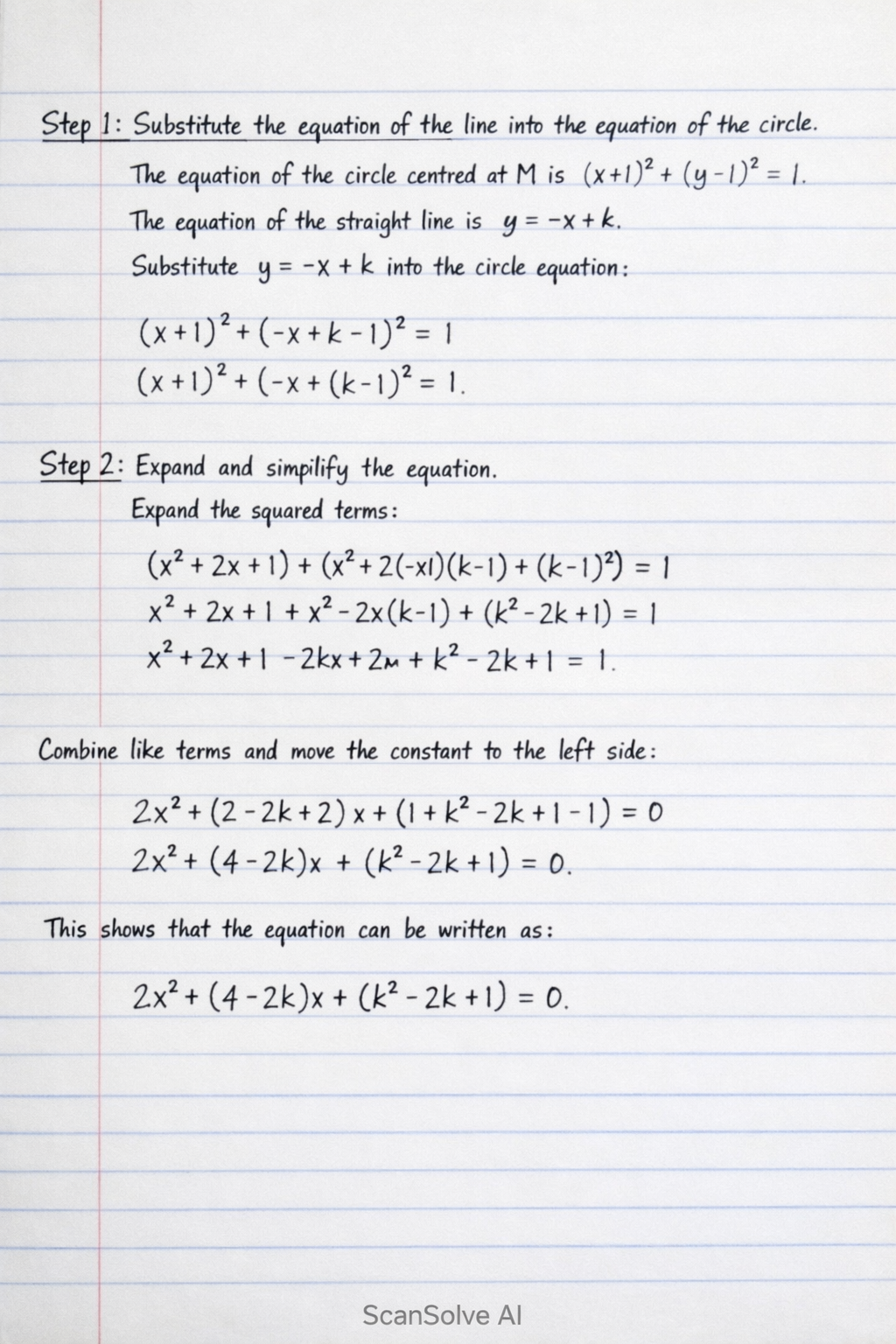
  1. Substitute the equation of the line into the equation of the circle.

    The equation of the circle centred at M is (x+1)2+(y−1)2=1(x+1)^2 + (y-1)^2 = 1.
    The equation of the straight line is y=−x+ky = -x + k.
    Substitute y=−x+ky = -x + k into the circle equation:

    (x+1)2+((−x+k)−1)2=1(x+1)^2 + ((-x+k)-1)^2 = 1 (x+1)2+(−x+(k−1))2=1(x+1)^2 + (-x + (k-1))^2 = 1
  2. Expand and simplify the equation.

    Expand the squared terms:

    (x2+2x+1)+((−x)2+2(−x)(k−1)+(k−1)2)=1(x^2 + 2x + 1) + ((-x)^2 + 2(-x)(k-1) + (k-1)^2) = 1 x2+2x+1+x2−2x(k−1)+(k2−2k+1)=1x^2 + 2x + 1 + x^2 - 2x(k-1) + (k^2 - 2k + 1) = 1 x2+2x+1−2kx+2x+k2−2k+1=1x^2 + 2x + 1 - 2kx + 2x + k^2 - 2k + 1 = 1

    Combine like terms and move the constant to the left side to set the equation to 0:

    2x2+(2−2k+2)x+(1+k2−2k+1−1)=02x^2 + (2 - 2k + 2)x + (1 + k^2 - 2k + 1 - 1) = 0 2x2+(4−2k)x+(k2−2k+1)=02x^2 + (4 - 2k)x + (k^2 - 2k + 1) = 0

    This shows that the equation can be written as 2x2+(4−2k)x+(k2−2k+1)=02x^2 + (4 - 2k)x + (k^2 - 2k + 1) = 0.

  3. Use the condition for tangency to find k.

    For the line to be a tangent to the circle, the quadratic equation 2x2+(4−2k)x+(k2−2k+1)=02x^2 + (4 - 2k)x + (k^2 - 2k + 1) = 0 must have exactly one real solution. This means its discriminant (Δ\Delta) must be equal to zero.
    The discriminant for a quadratic equation ax2+bx+c=0ax^2 + bx + c = 0 is Δ=b2−4ac\Delta = b^2 - 4ac.
    From our equation, we have:
    a=2a = 2
    b=(4−2k)b = (4 - 2k)
    c=(k2−2k+1)c = (k^2 - 2k + 1)

    Set the discriminant to zero:

    Δ=(4−2k)2−4(2)(k2−2k+1)=0\Delta = (4 - 2k)^2 - 4(2)(k^2 - 2k + 1) = 0 (16−16k+4k2)−8(k2−2k+1)=0(16 - 16k + 4k^2) - 8(k^2 - 2k + 1) = 0 16−16k+4k2−8k2+16k−8=016 - 16k + 4k^2 - 8k^2 + 16k - 8 = 0

    Combine like terms:

    (4k2−8k2)+(−16k+16k)+(16−8)=0(4k^2 - 8k^2) + (-16k + 16k) + (16 - 8) = 0 −4k2+8=0-4k^2 + 8 = 0 4k2=84k^2 = 8 k2=84k^2 = \frac{8}{4} k2=2k^2 = 2 k=±2k = \pm\sqrt{2}

    The numerical values of k are ±2\pm\sqrt{2}.

Was this helpful?

Try one yourself

A new problem that tests the same skill.

Still stuck on this one?

Ask a follow-up, and the answer starts from this question.

Got a different question?Ask your own question
Handwritten step-by-step solution preview

Handwritten Step-by-Step Solution

Get this as a handwritten image on WhatsApp — like a tutor wrote it for you.

Try on WhatsApp