
We read your photo as:
Find the value of the constant a and the position vector of the point of intersection of two lines.
ScanSolve AI Answer
Step-by-step solution
8 steps5. (a) The value of the constant
Write the equations of the lines in component form.
Given the equations of the lines:
Equate the components since the lines intersect.
Equating the , , and components:
Solve the system of equations for , , and .
Substitute equation (1) into equation (2):
From equation (4), we can express in terms of :
Substitute this expression for into equation (3):
Add to both sides:
Now substitute back into equation (1) to find :
The value of the constant is .
5. (b) The position vector of the point of intersection
Substitute the value of (or ) into one of the line equations.
Using and in the equation for :
The position vector of the point of intersection is .
5. (c) The cosine of the acute angle between and
Identify the direction vectors of the lines.
The direction vector for is .
The direction vector for is .Calculate the dot product of the direction vectors.
Calculate the magnitudes of the direction vectors.
Use the dot product formula to find the cosine of the angle.
The cosine of the angle between two vectors is given by . For the acute angle, we take the absolute value of the dot product.
Rationalize the denominator:
The cosine of the acute angle between and is .
Still stuck on this one?
Ask a follow-up, and the answer starts from this question.
More Mathematics Questions
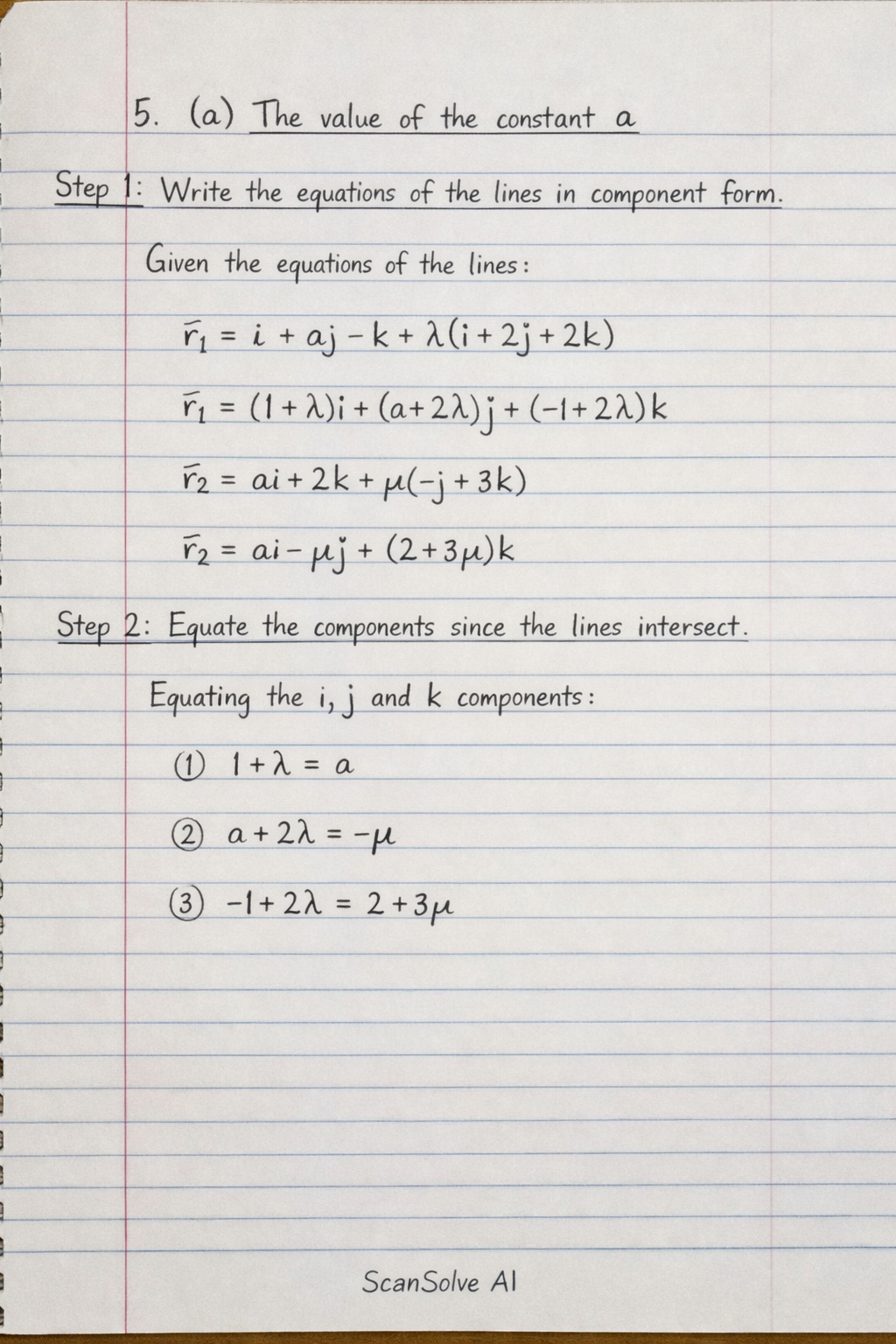
Handwritten Step-by-Step Solution
Get this as a handwritten image on WhatsApp — like a tutor wrote it for you.
Try on WhatsApp