X²−2(1+3k)x+7(2k+3)=0 find k for which the equation has real roots

Mathematics

ScanSolve AI Answer

Answer

k≤−109 or k≥2k \le -\frac{10}{9} \text{ or } k \ge 2

Step-by-step solution

5 steps

To find the values of kk for which the equation has real roots, we need to ensure that the discriminant of the quadratic equation is greater than or equal to zero.

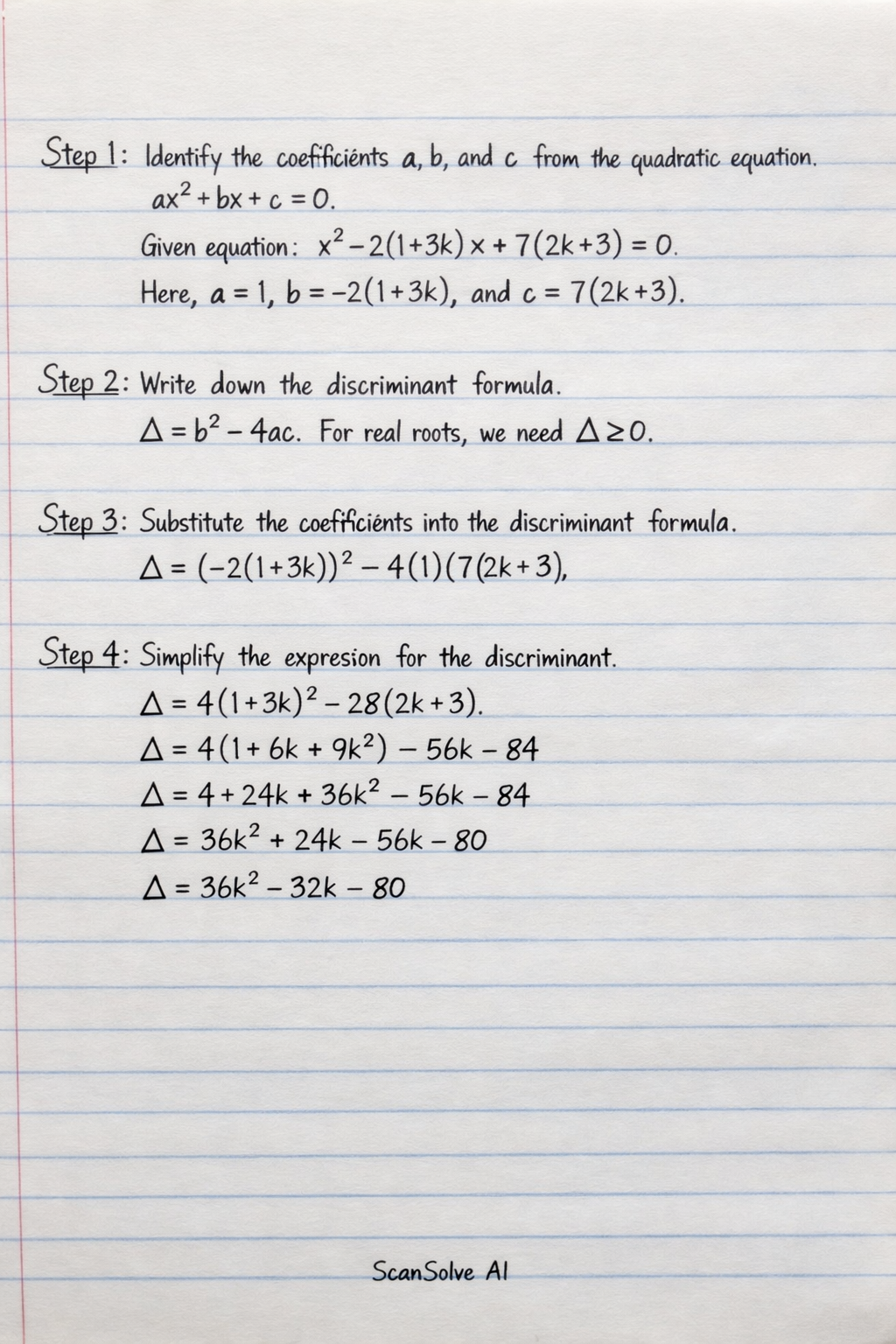
  1. Identify the coefficients aa, bb, and cc from the quadratic equation ax2+bx+c=0ax^2+bx+c=0.

    Given equation: x2−2(1+3k)x+7(2k+3)=0x^2-2(1+3k)x+7(2k+3)=0
    Here, a=1a=1, b=−2(1+3k)b=-2(1+3k), and c=7(2k+3)c=7(2k+3).

  2. Write down the discriminant formula.

    The discriminant Δ\Delta is given by Δ=b2−4ac\Delta = b^2 - 4ac. For real roots, we must have Δ≥0\Delta \ge 0.

  3. Substitute the coefficients into the discriminant formula.

    Δ=(−2(1+3k))2−4(1)(7(2k+3))\Delta = (-2(1+3k))^2 - 4(1)(7(2k+3))
  4. Simplify the expression for the discriminant.

    Δ=4(1+3k)2−28(2k+3)\Delta = 4(1+3k)^2 - 28(2k+3) Δ=4(1+6k+9k2)−(56k+84)\Delta = 4(1 + 6k + 9k^2) - (56k + 84) Δ=4+24k+36k2−56k−84\Delta = 4 + 24k + 36k^2 - 56k - 84 Δ=36k2+(24k−56k)+(4−84)\Delta = 36k^2 + (24k - 56k) + (4 - 84) Δ=36k2−32k−80\Delta = 36k^2 - 32k - 80
  5. Set the discriminant to be greater than or equal to zero and solve the inequality for kk.

    36k2−32k−80≥036k^2 - 32k - 80 \ge 0

    Divide the entire inequality by 4 to simplify:

    9k2−8k−20≥09k^2 - 8k - 20 \ge 0

    To find the roots of the quadratic 9k2−8k−20=09k^2 - 8k - 20 = 0, we can use the quadratic formula k=−b±b2−4ac2ak = \frac{-b \pm \sqrt{b^2-4ac}}{2a}.
    Here, a=9a=9, b=−8b=-8, c=−20c=-20.

    k=−(−8)±(−8)2−4(9)(−20)2(9)k = \frac{-(-8) \pm \sqrt{(-8)^2 - 4(9)(-20)}}{2(9)} k=8±64+72018k = \frac{8 \pm \sqrt{64 + 720}}{18} k=8±78418k = \frac{8 \pm \sqrt{784}}{18} k=8±2818k = \frac{8 \pm 28}{18}

    Two possible values for kk:

    k1=8−2818=−2018=−109k_1 = \frac{8 - 28}{18} = \frac{-20}{18} = -\frac{10}{9} k2=8+2818=3618=2k_2 = \frac{8 + 28}{18} = \frac{36}{18} = 2

    Since the quadratic 9k2−8k−209k^2 - 8k - 20 opens upwards (coefficient of k2k^2 is positive), the inequality 9k2−8k−20≥09k^2 - 8k - 20 \ge 0 is satisfied when kk is less than or equal to the smaller root or greater than or equal to the larger root.

    k≤−109ork≥2k \le -\frac{10}{9} \quad \text{or} \quad k \ge 2 k≤−109 or k≥2\boxed{k \le -\frac{10}{9} \text{ or } k \ge 2}

    Dernière correction gratuite aujourd'hui — reviens demain, ou tape /upgrade pour l'illimité.

Was this helpful?

Try one yourself

A new problem that tests the same skill.

Still stuck on this one?

Ask a follow-up, and the answer starts from this question.

Got a different question?Ask your own question
Handwritten step-by-step solution preview

Handwritten Step-by-Step Solution

Get this as a handwritten image on WhatsApp — like a tutor wrote it for you.

Try on WhatsApp