
We read your photo as:
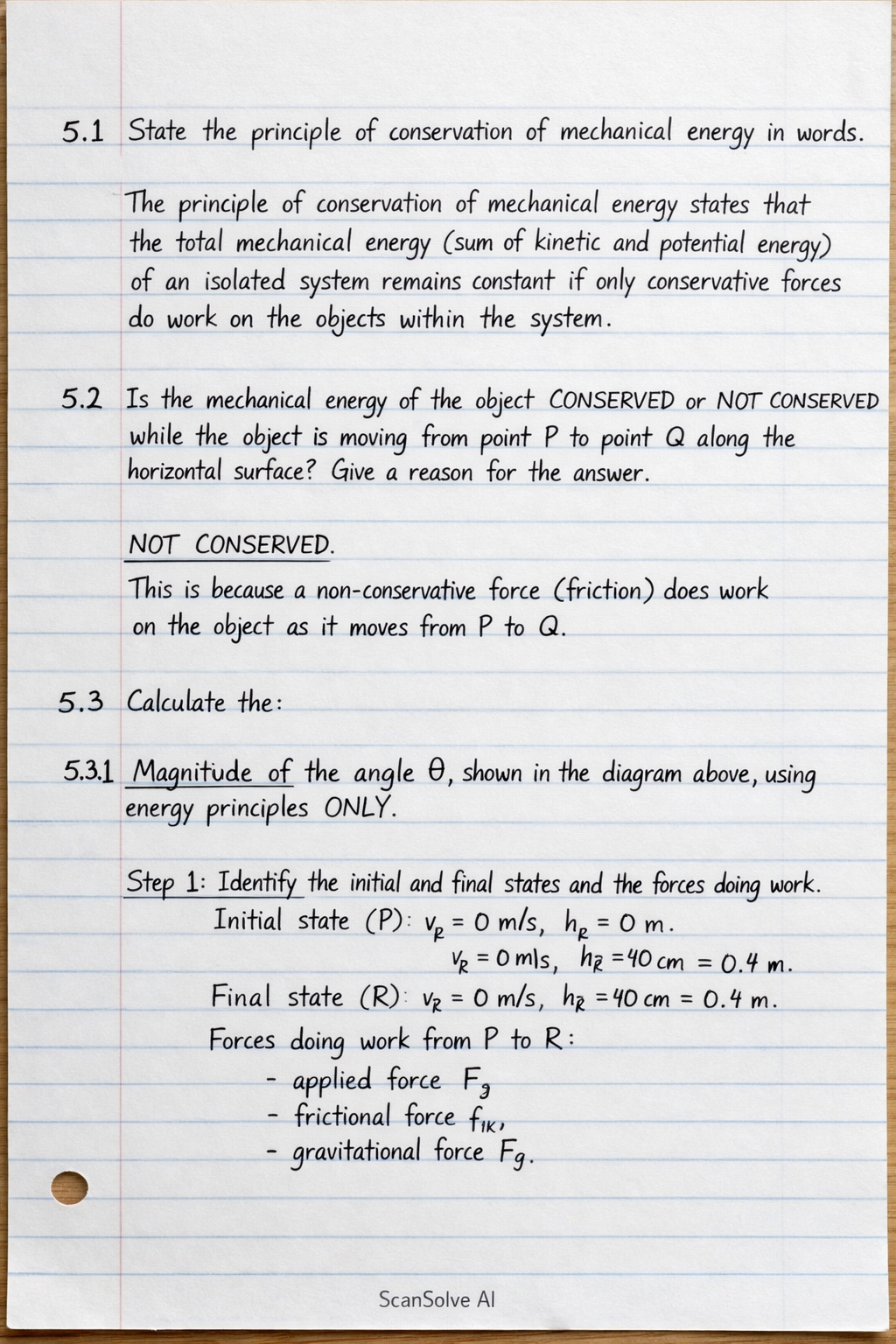
5.1 State the principle of conservation of mechanical energy in words.
ScanSolve AI Answer
Answer
Step-by-step solution
5 steps5.1 State the principle of conservation of mechanical energy in words.
The principle of conservation of mechanical energy states that the total mechanical energy (sum of kinetic and potential energy) of an isolated system remains constant if only conservative forces do work on the objects within the system.
5.2 Is the mechanical energy of the object CONSERVED or NOT CONSERVED while the object is moving from point P to point Q along the horizontal surface? Give a reason for the answer.
NOT CONSERVED.
This is because a non-conservative force (friction) does work on the object as it moves from P to Q.
5.3 Calculate the:
5.3.1 Magnitude of the angle , shown in the diagram above, using energy principles ONLY.
Identify the initial and final states and the forces doing work.
Initial state (P): m/s, m.
Final state (R): m/s, cm m.
Forces doing work from P to R: applied force , frictional force , and gravitational force .Apply the Work-Energy Theorem from point P to point R.
The Work-Energy Theorem states that the net work done on an object equals its change in kinetic energy: .
Since the object starts from rest at P and stops at R, .
Therefore, .The net work is the sum of the work done by all forces:
Note: The applied force and frictional force only act from P to Q. The gravitational force does work over the vertical displacement from Q to R.
Substitute the known values into the Work-Energy Theorem equation.
Given:
N
m (distance from P to Q)
N
kg
m/s
mThe magnitude of the angle is .
5.3.2 Power delivered by force F if the time taken for the object to move from point P to point Q is 2.86 seconds.
Calculate the work done by force F from P to Q.
Using the value of from 5.3.1:
Calculate the power delivered by force F.
Power is defined as the rate at which work is done:
Given s:
The power delivered by force F is .
Try one yourself
A new problem that tests the same skill.
Still stuck on this one?
Ask a follow-up, and the answer starts from this question.
More Physics Questions
Handwritten Step-by-Step Solution
Get this as a handwritten image on WhatsApp — like a tutor wrote it for you.
Try on WhatsApp