
We read your photo as:
Two bodies of masses M1 and M2 are connected to a ceiling as illustrated in the diagram below. The tension T2 in the middle string is given by the expression [Take acceleration due to gravity as g]
ScanSolve AI Answer
This answer stops before the end.
It was cut off when it was first written. Ask ScanSolve this question again for the full working.
Step-by-step solution
12 stepsHere are the solutions to the questions:
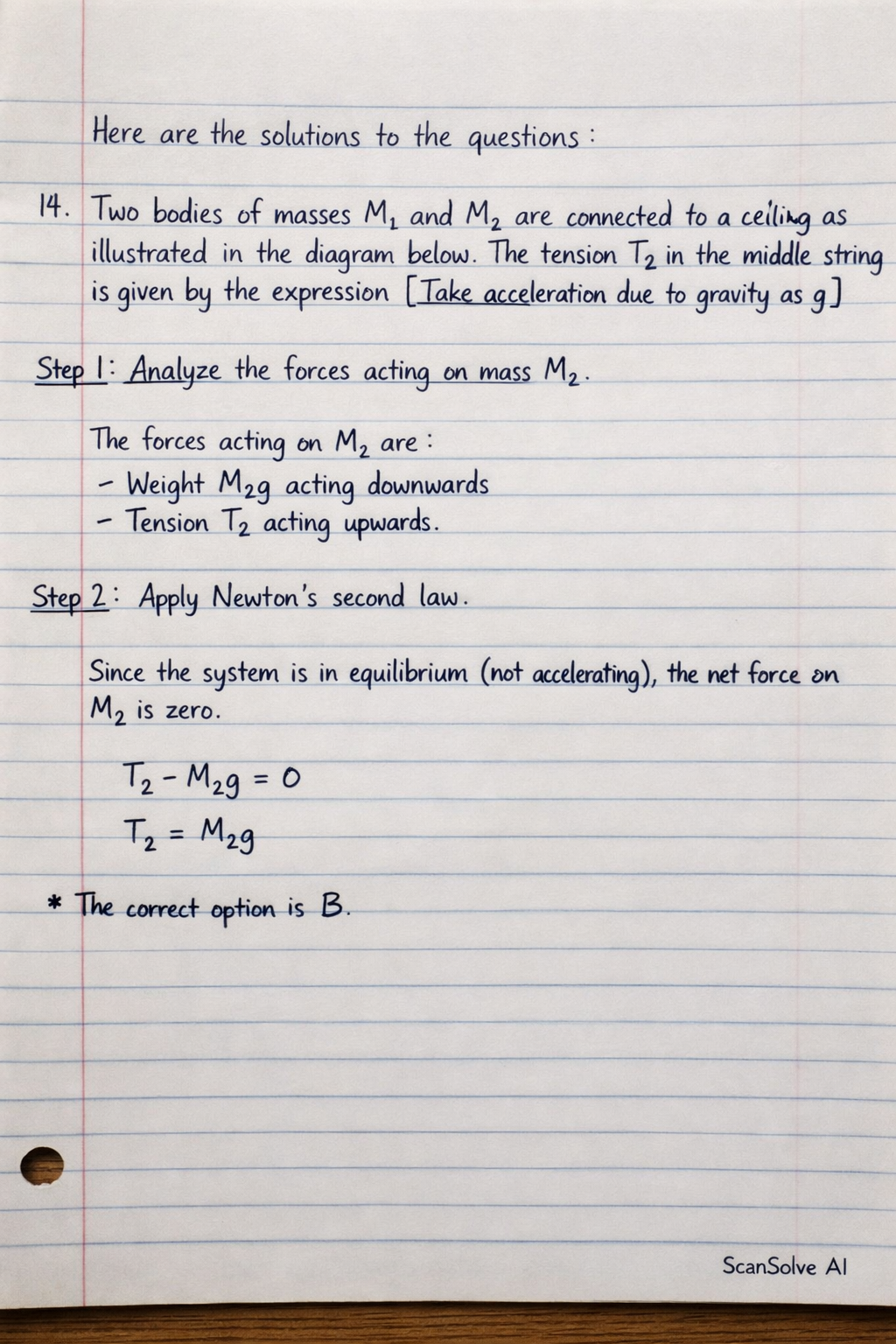
14. Two bodies of masses and are connected to a ceiling as illustrated in the diagram below. The tension in the middle string is given by the expression [Take acceleration due to gravity as ]
Analyze the forces acting on mass .
The forces acting on are its weight acting downwards and the tension acting upwards.
Apply Newton's second law.
Since the system is in equilibrium (not accelerating), the net force on is zero.
- The correct option is B.
15. Two identical cells each of emf and internal resistance are connected in series with a resistor. Calculate the current in the circuit.
Calculate the total electromotive force (emf) of the cells in series.
Calculate the total internal resistance of the cells in series.
Calculate the total resistance in the circuit.
Use Ohm's Law to calculate the current.
- The correct option is C.
16. The first ionization energy of Titanium (Ti) is . Calculate the longest wavelength of electromagnetic radiation that can ionize an atom of Ti. [Planck's constant, , speed of light, , Avogadro's number, ]
Convert the ionization energy from per mole to per atom.
Use the formula for the energy of a photon, , to find the wavelength .
Substitute the given values into the formula.
Convert the wavelength to nanometers (nm).
Rounding to two decimal places, .
- The correct option is B.
A body accelerates uniformly from rest at for . Use the information provided above to answer questions 17 and 18.
Given:
Initial velocity, (from rest)
Acceleration,
Time,17. The speed of the body at the end of is
Use the kinematic equation .
- The correct option is C.
18. How far will the body move in ?
Use the kinematic equation .
- The correct option is C.
19. The magnetized needle of a compass aligns more quickly at the geographical north and south poles than other regions because the poles have the
The Earth's magnetic field lines are most concentrated at the magnetic poles, meaning the magnetic field strength is greatest there. This stronger field exerts a greater torque on the compass needle, causing it to align more quickly.- The correct option is D.
20. When whirling a stone in a horizontal circle, the angular velocity is
Angular velocity is a vector quantity whose direction is along the axis of rotation. For a stone whirled in a horizontal circle, the axis of rotation is vertical, meaning the angular velocity vector is perpendicular to the plane of the circle.- The correct option is B.
**21. Which of the following therm
Still stuck on this one?
Ask a follow-up, and the answer starts from this question.
More Physics Questions
Handwritten Step-by-Step Solution
Get this as a handwritten image on WhatsApp — like a tutor wrote it for you.
Try on WhatsApp