
We read your photo as:
Two masses, 5 kg and 7 kg, are connected by a string over a frictionless pulley. Calculate the acceleration of the masses and the tension in the string.
ScanSolve AI Answer
Answers
3 partsStep-by-step solution
7 stepsHere are the steps to solve the problem:
Part a· 3 steps
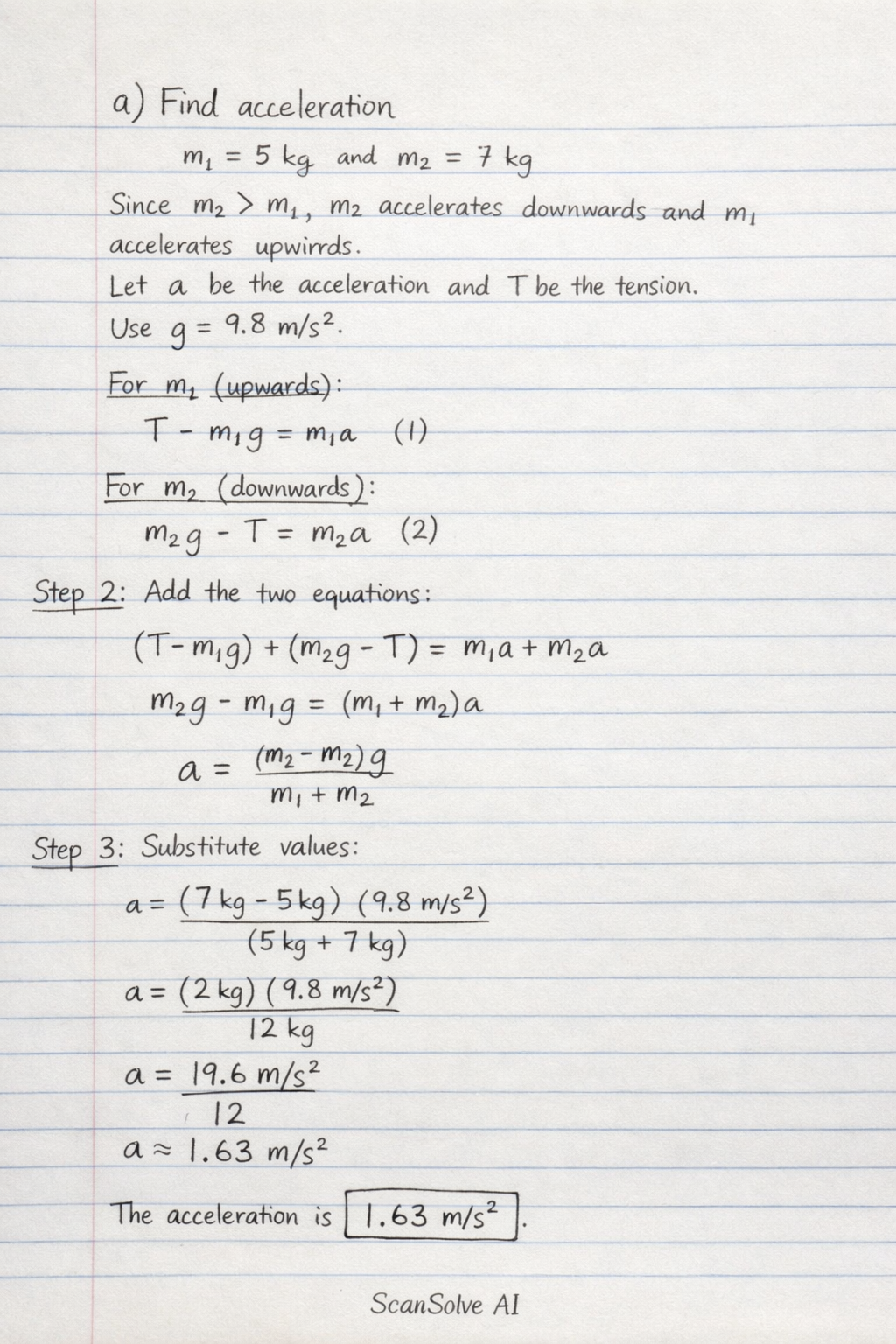
Find acceleration
Identify the masses and set up Newton's second law for each mass.
Let and .
Since , accelerates downwards and accelerates upwards. Let be the magnitude of the acceleration and be the tension in the string. We use .For (moving upwards):
For (moving downwards):
Add the two equations to eliminate and solve for .
Substitute the given values into the acceleration formula.
The acceleration is .
Part b
Find T, the tension in the string
Use one of the original equations (Equation 1 or Equation 2) and the calculated acceleration to find the tension .
Using Equation 1:
Substitute the values for , , and .
The tension in the string is .
Part c
Find force ceiling must exert on pulley
Analyze the forces acting on the pulley.
The string exerts a downward force equal to the tension on each side of the pulley. Therefore, the total downward force exerted by the string on the pulley is .
The ceiling must exert an upward force to support the pulley. Assuming the pulley is massless and in equilibrium (not accelerating vertically), the upward force from the ceiling must balance the total downward force from the string.Substitute the calculated tension .
The force the ceiling must exert on the pulley is .
Try one yourself
A new problem that tests the same skill.
Still stuck on this one?
Ask a follow-up, and the answer starts from this question.
More Physics Questions
Handwritten Step-by-Step Solution
Get this as a handwritten image on WhatsApp — like a tutor wrote it for you.
Try on WhatsApp