

This physics problem tests your understanding of fundamental physical laws and their applications. The step-by-step solution below breaks down the problem using relevant equations and physical reasoning.
ScanSolve AI Answer
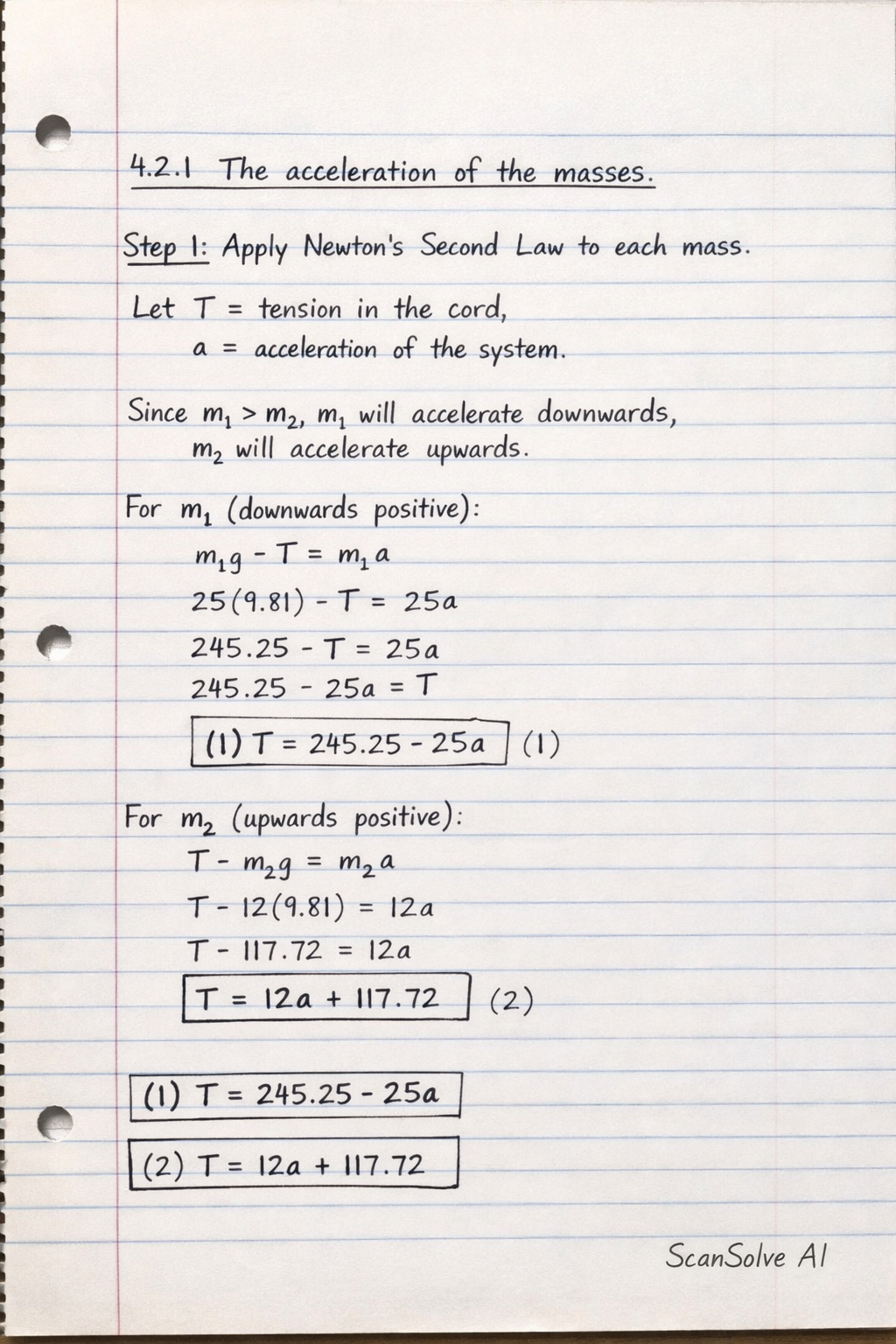
QUESTION 4.2: DYNAMICS A light cord passes over a friction-free pulley. Each end of the cord has a mass attached, one mass of 25 kg, and the other 12 kg. Given: Mass 1: m_1 = 25 kg Mass 2: m_2 = 12 kg Acceleration due to gravity: g = 9.81 m/s^2 4.2.1 The acceleration of the masses. Step 1: Apply Newton's Second Law to each mass. Let T be the tension in the cord and a be the acceleration of the system. Since m_1 > m_2, m_1 will accelerate downwards and m_2 will accelerate upwards. For m_1 (downwards positive): m_1 g - T = m_1 a (1) For m_2 (upwards positive): T - m_2 g = m_2 a (2) Step 2: Solve the system of equations for acceleration (a). Add equation (1) and equation (2): (m_1 g - T) + (T - m_2 g) = m_1 a + m_2 a m_1 g - m_2 g = (m_1 + m_2) a Factor out g on the left and a on the right: g(m_1 - m_2) = a(m_1 + m_2) Solve for a: a = (g(m_1 - m_2))/(m_1 + m_2) Substitute the given values: a = 9.81 m/s^2 (25 kg - 12 kg)25 kg + 12 kg a = 9.81 m/s^2 (13 kg)37 kg a = (127.53)/(37) m/s^2 a ≈ 3.446756 m/s^2 Rounding to three significant figures: 3.45 m/s^2 4.2.2 The tension in the cord. Step 3: Substitute the calculated acceleration into one of the original equations to find the tension (T). Using equation (2): T - m_2 g = m_2 a T = m_2 a + m_2 g T = m_2 (a + g) Substitute the values: T = 12 kg (3.446756 m/s^2 + 9.81 m/s^2) T = 12 kg (13.256756 m/s^2) T ≈ 159.081 N Rounding to three significant figures: 159 N