
A mass of 4kg rests on a horizontal table(coefficient of friction 1/2) and is connected by a light in extensible string passing over smooth pulley at the age of table carrying a mass 6kg. Find the acceleration of each particle.
ScanSolve AI Answer
Answer
Step-by-step solution
4 stepsIdentify the forces acting on each mass.
For the mass on the horizontal table:
- The normal force acts upwards, balancing its weight .
- The tension acts horizontally, pulling it towards the pulley.
- The kinetic friction force acts horizontally, opposing the motion. For the hanging mass :
- Its weight acts downwards.
- The tension acts upwards.
Apply Newton's Second Law to each mass.
For :
In the vertical direction, the mass is in equilibrium, so .The kinetic friction force is . Given .
In the horizontal direction, applying Newton's Second Law ():
For :
Applying Newton's Second Law in the vertical direction (assuming moves downwards):Solve the system of equations for acceleration .
Add equation (1) and equation (2) to eliminate :
Substitute the value of and calculate the acceleration.
Using the standard value for acceleration due to gravity, :
Since the string is inextensible, both particles will have the same magnitude of acceleration.
The acceleration of each particle is .
Try one yourself
A new problem that tests the same skill.
Still stuck on this one?
Ask a follow-up, and the answer starts from this question.
More Physics Questions
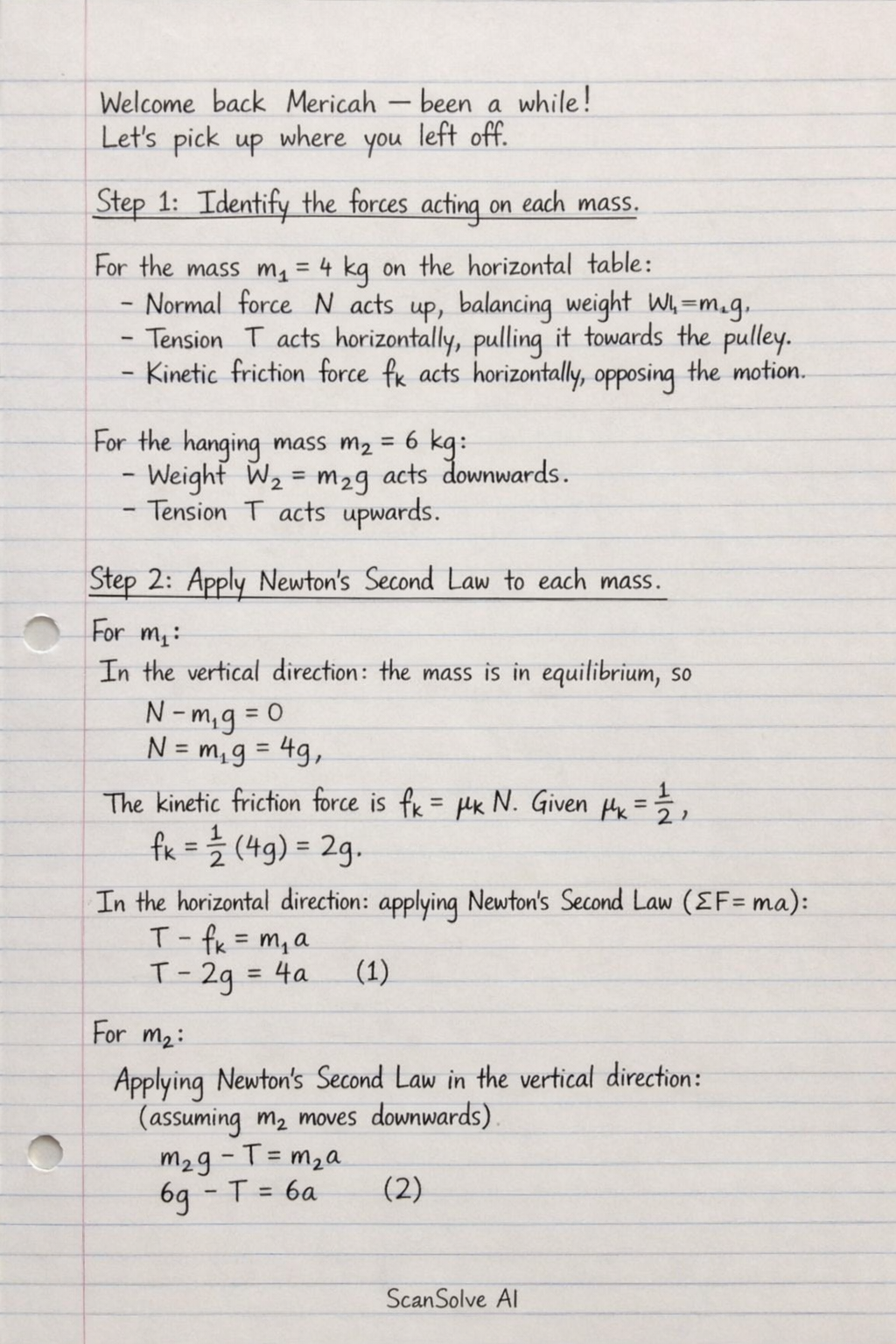
Handwritten Step-by-Step Solution
Get this as a handwritten image on WhatsApp — like a tutor wrote it for you.
Try on WhatsApp