
We read your photo as:
State Newton's second law of motion. Two particles of mass 15 kg and 20 kg are connected by a taunt light inextensible string which passes over a smooth light pulley. The system shown in fig below is released from rest. Find: i. The common acceleration of the particles ii. The tension of the string
ScanSolve AI Answer
Answers
5 partsStep-by-step solution
12 stepsHere's the solution to your physics problem:
Part a
State Newton's second law of motion
Newton's second law of motion states that the acceleration of an object is directly proportional to the net force acting on it and inversely proportional to its mass. It is commonly expressed as , where is the net force, is the mass, and is the acceleration.
Part b(i)
The common acceleration of the particles
Two particles of mass 15 kg and 20 kg are connected by a string over a smooth light pulley.
Identify the forces acting on each mass.
Let and . Let be the tension in the string and be the acceleration due to gravity. Since , will accelerate downwards and will accelerate upwards.
For (15 kg, moving up):
For (20 kg, moving down):
Add the two equations to eliminate and solve for .
Substitute the given values into the equation for .
The common acceleration of the particles is .
Part b(ii)
The tension of the string
Substitute the calculated acceleration into equation (1).
Substitute the values for , , and .
The tension in the string is .
Part c(i)
What angle does the strap make with the horizontal?
A woman pulling her 20 kg suitcase at a constant speed.
Given: Mass , pulling force , frictional force . The suitcase moves at a constant speed, so the net acceleration is 0.
Analyze the horizontal forces.
Since the suitcase moves at a constant speed, the net horizontal force is zero. The horizontal component of the pulling force balances the frictional force.
Solve for .
The angle the strap makes with the horizontal is .
Part c(ii)
What normal force does the ground exert on the suitcase?
Analyze the vertical forces.
Since there is no vertical acceleration, the net vertical force is zero. The normal force () and the vertical component of the pulling force () balance the gravitational force ().
Substitute the values for , , , and .
The normal force exerted by the ground is .
Part c(iii)
If the strap breaks, what would be the magnitude and direction of the acceleration of the suitcase?
Identify the forces acting on the suitcase after the strap breaks.
When the strap breaks, the pulling force becomes zero. The suitcase is still moving, so the frictional force will act opposite to the direction of motion.
Apply Newton's second law in the horizontal direction.
The net force is the frictional force, acting opposite to the direction of motion.
Calculate the acceleration.
The magnitude of the acceleration is . The negative sign indicates that the acceleration is in the direction opposite to the initial motion.
The magnitude and direction of the acceleration are .
Try one yourself
A new problem that tests the same skill.
Still stuck on this one?
Ask a follow-up, and the answer starts from this question.
More Physics Questions
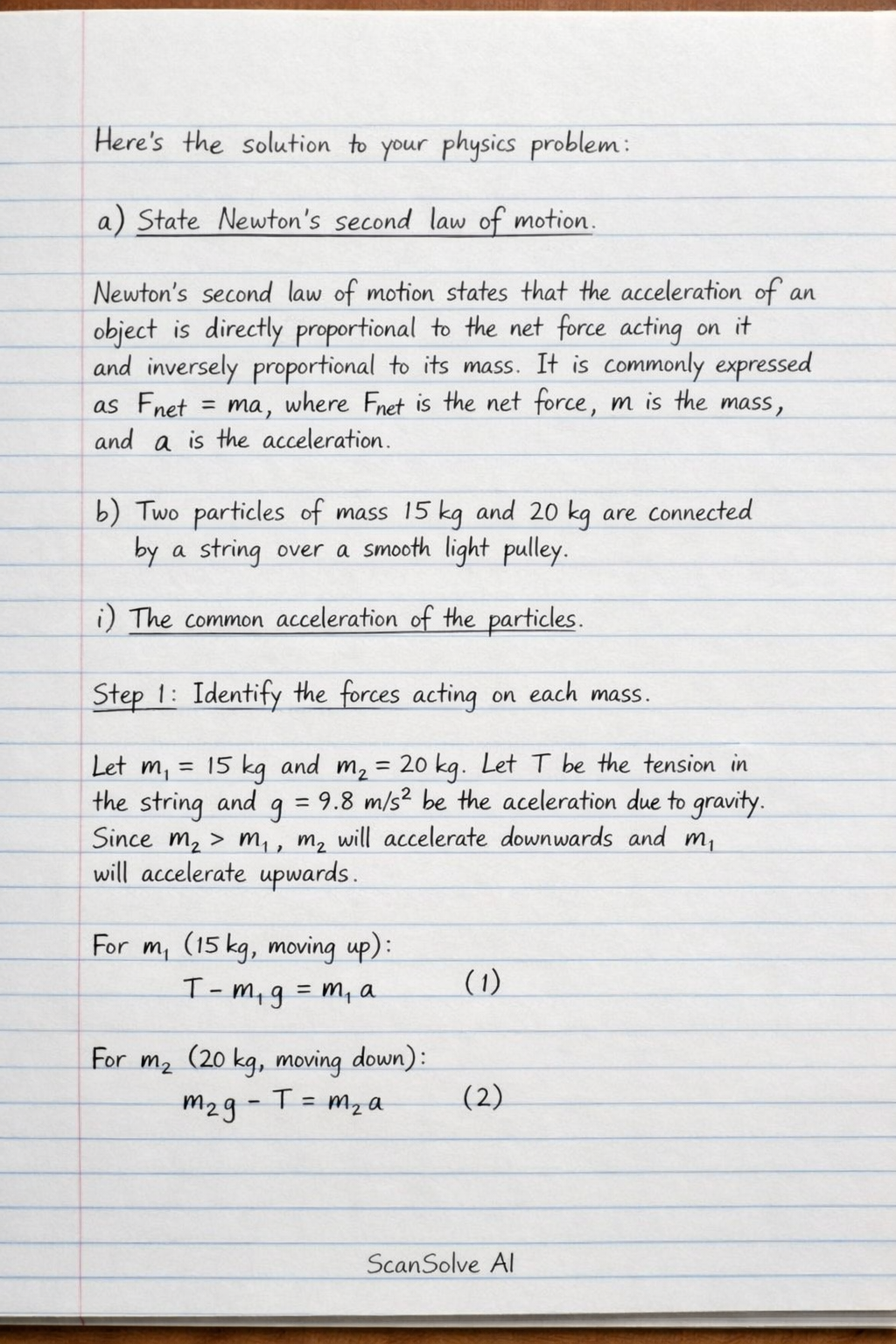
Handwritten Step-by-Step Solution
Get this as a handwritten image on WhatsApp — like a tutor wrote it for you.
Try on WhatsApp