We read your photo as:

6- Analise o oscilograma referente a oscilação de uma particula. a) Determine a Amplitude e o periodo da oscilação. b) Calcula a frequência da oscilação. c) Calcula a frequência angular. d) Quantas oscilações a partícula réuliza por minuto?

Physics

ScanSolve AI Answer

Step-by-step solution

15 steps

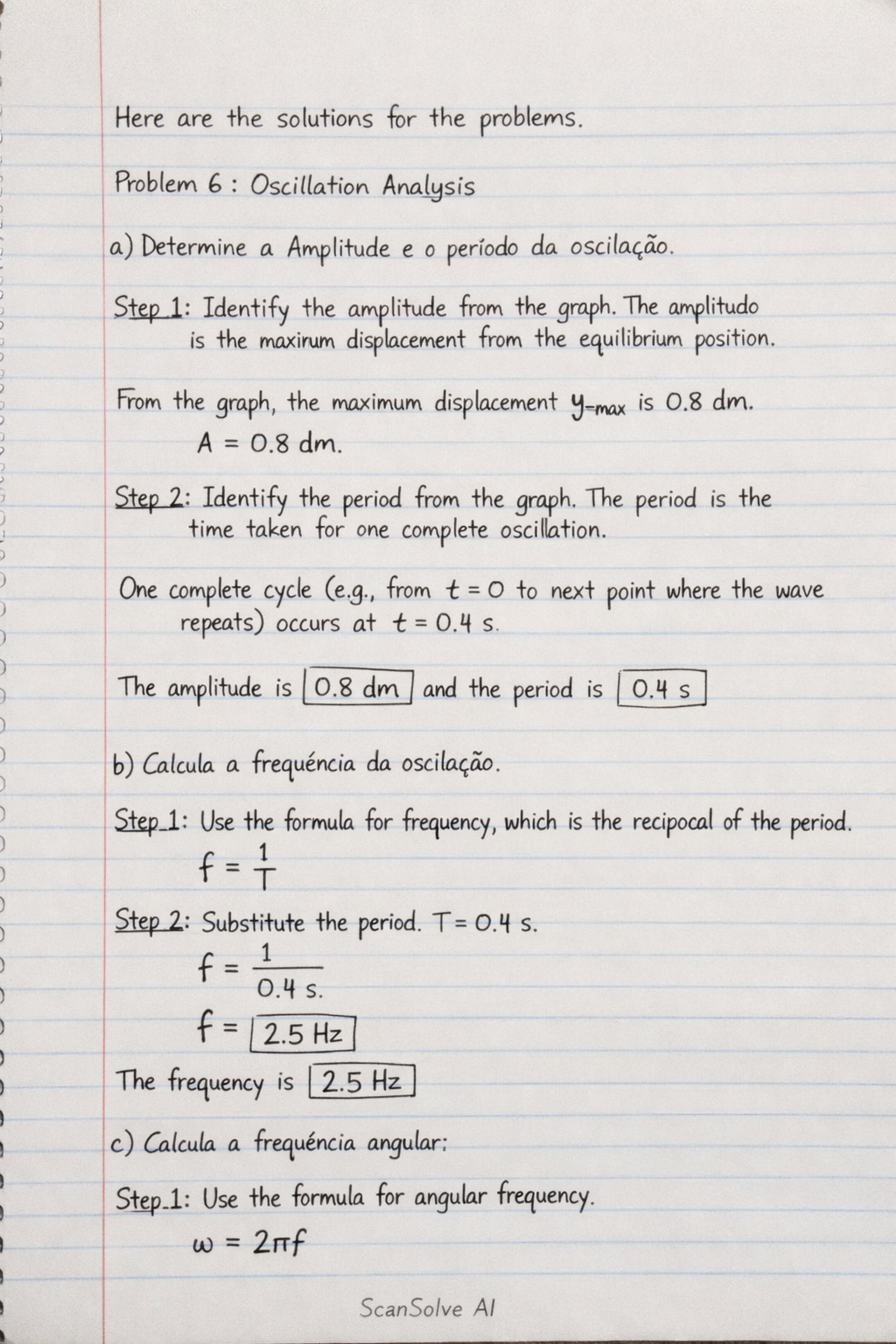
Here are the solutions for the problems.

: Oscillation Analysis

a) Determine a Amplitude e o período da oscilação.

  1. Identify the amplitude from the graph.

    The amplitude is the maximum displacement from the equilibrium position.
    From the graph, the maximum displacement ymaxy_{max} is 0.8 dm0.8 \text{ dm}.

    A=0.8 dmA = 0.8 \text{ dm}
  2. Identify the period from the graph.

    The period is the time taken for one complete oscillation.
    One complete cycle (e.g., from t=0t=0 to the next point where the wave repeats its pattern) occurs at t=0.4 st = 0.4 \text{ s}.

    T=0.4 sT = 0.4 \text{ s}

    The amplitude is 0.8 dm\boxed{0.8 \text{ dm}} and the period is 0.4 s\boxed{0.4 \text{ s}}.

    b) Calcula a frequência da oscilação.

  3. Use the formula for frequency, which is the reciprocal of the period.

    f=1Tf = \frac{1}{T}
  4. Substitute the period T=0.4 sT = 0.4 \text{ s}.

    f=10.4 sf = \frac{1}{0.4 \text{ s}} f=2.5 Hzf = 2.5 \text{ Hz}

    The frequency is 2.5 Hz\boxed{2.5 \text{ Hz}}.

    c) Calcula a frequência angular.

  5. Use the formula for angular frequency.

    ω=2πf\omega = 2\pi f
  6. Substitute the frequency f=2.5 Hzf = 2.5 \text{ Hz}.

    ω=2π(2.5 Hz)\omega = 2\pi (2.5 \text{ Hz}) ω=5π rad/s\omega = 5\pi \text{ rad/s} ω≈5×3.14159 rad/s\omega \approx 5 \times 3.14159 \text{ rad/s} ω≈15.71 rad/s\omega \approx 15.71 \text{ rad/s}

    The angular frequency is 5π rad/s\boxed{5\pi \text{ rad/s}} or approximately 15.71 rad/s\boxed{15.71 \text{ rad/s}}.

    d) Quantas oscilações a partícula realiza por minuto?

  7. Multiply the frequency (oscillations per second) by the number of seconds in a minute.

    Oscillations per minute=f×60 s/min\text{Oscillations per minute} = f \times 60 \text{ s/min}
  8. Substitute the frequency f=2.5 Hzf = 2.5 \text{ Hz}.

    Oscillations per minute=2.5 oscillations/s×60 s/min\text{Oscillations per minute} = 2.5 \text{ oscillations/s} \times 60 \text{ s/min} Oscillations per minute=150 oscillations/min\text{Oscillations per minute} = 150 \text{ oscillations/min}

    The particle performs 150 oscillations per minute\boxed{150 \text{ oscillations per minute}}.

    : Electrical Circuit Analysis

    a) A resistência total.

  9. Calculate the equivalent resistance of R2R_2 and R3R_3, which are connected in parallel.

    R2=6ΩR_2 = 6 \Omega R3=3ΩR_3 = 3 \Omega 1R23=1R2+1R3\frac{1}{R_{23}} = \frac{1}{R_2} + \frac{1}{R_3} 1R23=16Ω+13Ω\frac{1}{R_{23}} = \frac{1}{6 \Omega} + \frac{1}{3 \Omega} 1R23=16Ω+26Ω\frac{1}{R_{23}} = \frac{1}{6 \Omega} + \frac{2}{6 \Omega} 1R23=36Ω\frac{1}{R_{23}} = \frac{3}{6 \Omega} 1R23=12Ω\frac{1}{R_{23}} = \frac{1}{2 \Omega} R23=2ΩR_{23} = 2 \Omega
  10. Calculate the total resistance by adding R1R_1 (in series with R23R_{23}).

    R1=3ΩR_1 = 3 \Omega Rtotal=R1+R23R_{total} = R_1 + R_{23} Rtotal=3Ω+2ΩR_{total} = 3 \Omega + 2 \Omega Rtotal=5ΩR_{total} = 5 \Omega

    The total resistance is 5Ω\boxed{5 \Omega}.

    b) A intensidade da corrente que percorre o circuito.

  11. Use Ohm's Law to find the total current (ItotalI_{total}) flowing through the circuit.

    Vtotal=15 VV_{total} = 15 \text{ V} Itotal=VtotalRtotalI_{total} = \frac{V_{total}}{R_{total}}
  12. Substitute the total voltage and total resistance.

    Itotal=15 V5ΩI_{total} = \frac{15 \text{ V}}{5 \Omega} Itotal=3 AI_{total} = 3 \text{ A}

    The total current is 3 A\boxed{3 \text{ A}}.

    c) As correntes que percorrem as resistências R2 e R3.

  13. Calculate the voltage across the parallel combination (R23R_{23}).

    This voltage is the same for R2R_2 and R3R_3.

    V23=Itotal×R23V_{23} = I_{total} \times R_{23} V23=3 A×2ΩV_{23} = 3 \text{ A} \times 2 \Omega V23=6 VV_{23} = 6 \text{ V}
  14. Calculate the current through R2R_2 using Ohm's Law.

    I2=V23R2I_2 = \frac{V_{23}}{R_2} I2=6 V6ΩI_2 = \frac{6 \text{ V}}{6 \Omega} I2=1 AI_2 = 1 \text{ A}
  15. Calculate the current through R3R_3 using Ohm's Law.

    I3=V23R3I_3 = \frac{V_{23}}{R_3} I3=6 V3ΩI_3 = \frac{6 \text{ V}}{3 \Omega} I3=2 AI_3 = 2 \text{ A}

    The current through R2R_2 is 1 A\boxed{1 \text{ A}} and the current through R3R_3 is 2 A\boxed{2 \text{ A}}.

Was this helpful?

Still stuck on this one?

Ask a follow-up, and the answer starts from this question.

Got a different question?Ask your own question
Handwritten step-by-step solution preview

Handwritten Step-by-Step Solution

Get this as a handwritten image on WhatsApp — like a tutor wrote it for you.

Try on WhatsApp