
We read your photo as:
7.6 How does the magnitude and direction of the horizontal force of the lawn that counters the movement of the roller in Question 7.5 differs to when the man pulls the roller with the same force?
ScanSolve AI Answer
Here are the solutions to the problems:
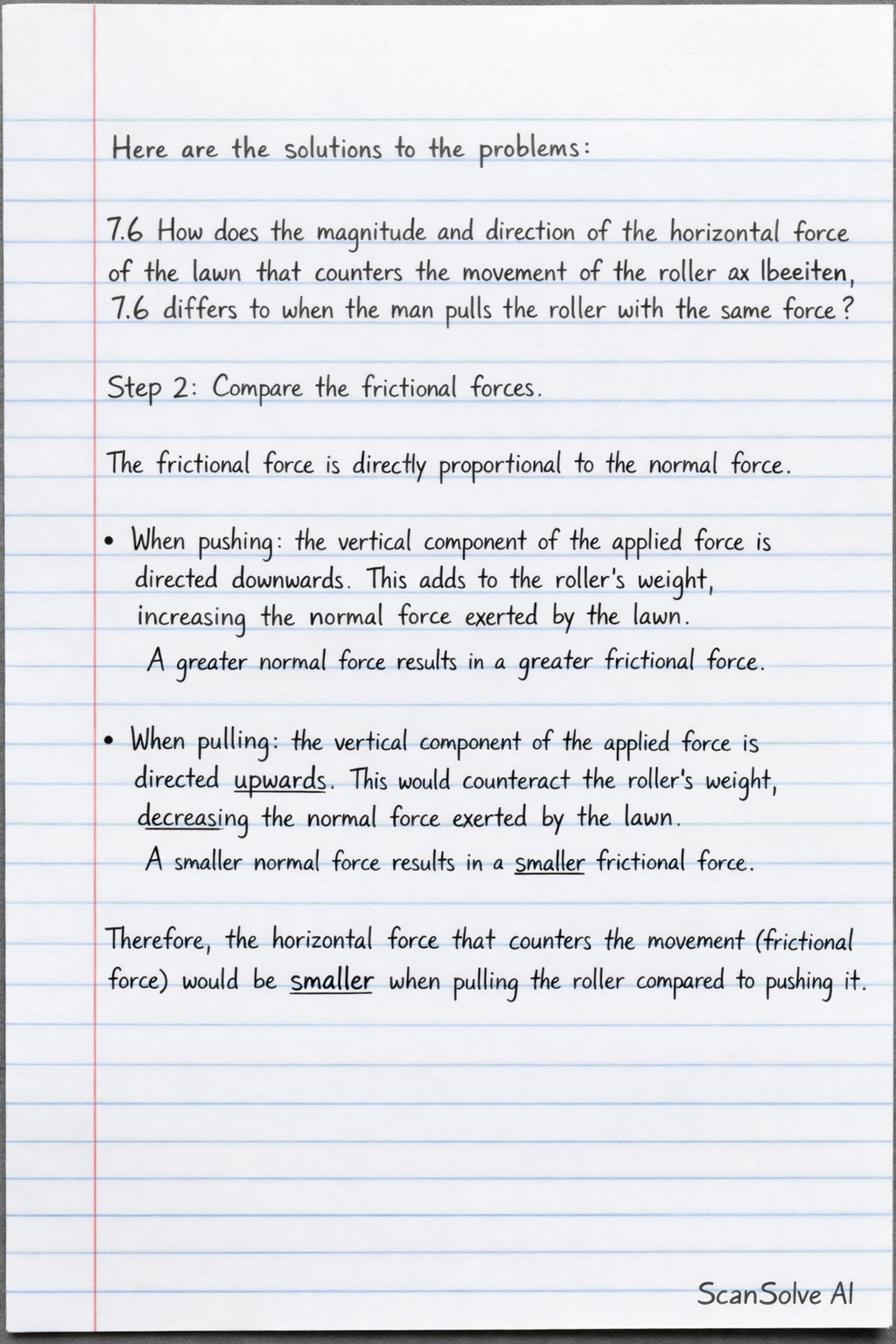
7.6 How does the magnitude and direction of the horizontal force of the lawn that counters the movement of the roller in Question 7.5 differs to when the man pulls the roller with the same force?
Step 2: Compare the frictional forces.
The frictional force is directly proportional to the normal force.
- When pushing, the vertical component of the applied force is directed downwards. This adds to the roller's weight, increasing the normal force exerted by the lawn. A greater normal force results in a greater frictional force.
- When pulling, the vertical component of the applied force would be directed upwards. This would counteract the roller's weight, decreasing the normal force exerted by the lawn. A smaller normal force results in a smaller frictional force. Therefore, the horizontal force that counters the movement (frictional force) would be smaller when pulling the roller compared to pushing it.
7.7 Would it be easier for the man to rather pull the roller than to push it with the same force and the magnitude of the angle? Briefly explain (without any calculations) by making use of sketch diagrams (vector diagrams not according to scale).
Yes, it would be easier for the man to rather pull the roller.
Explanation:
When pulling the roller, the applied force has an upward vertical component. This component reduces the total downward force on the lawn, thereby decreasing the normal force. Since frictional force is proportional to the normal force, a reduced normal force leads to a smaller frictional force opposing the roller's motion.
When pushing, the applied force has a downward vertical component, which increases the normal force and thus increases the frictional force. Therefore, pulling requires less effort to overcome friction.
Vector Diagrams (Sketches):
Pushing the roller:
Imagine the applied force vector pointing from the handle downwards and forwards.
- The vertical component of this force points downwards, adding to the roller's weight.
- This results in a larger normal force from the ground.
- The frictional force, which opposes motion, is proportional to this larger normal force.
Pulling the roller:
Imagine the applied force vector pointing from the handle upwards and forwards.
- The vertical component of this force points upwards, partially lifting the roller.
- This results in a smaller normal force from the ground.
- The frictional force, which opposes motion, is proportional to this smaller normal force.
Still stuck on this one?
Ask a follow-up, and the answer starts from this question.
More Physics Questions
Handwritten Step-by-Step Solution
Get this as a handwritten image on WhatsApp — like a tutor wrote it for you.
Try on WhatsApp