
We read your photo as:
A ball is dropped from a height and bounces off the floor. Using the provided position-time graph, determine: (1) the time of contact with the floor during the first bounce, (2) the time to reach maxi
ScanSolve AI Answer
Step-by-step solution
5 stepsDefine free fall (3.1).
Free fall is the motion of an object solely under the influence of gravity, neglecting any other forces such as air resistance.
Determine the time the ball is in contact with the floor before the first bounce (3.2.1).
From the graph, the ball first hits the floor (position = 0 m) at approximately s.
The ball leaves the floor after the first bounce (position starts increasing from 0 m) at approximately s.
The time in contact with the floor is the difference between these two times.Determine the time it takes the ball to reach its maximum height after the first bounce (3.2.2).
The ball leaves the floor after the first bounce at s.
The maximum height after the first bounce occurs at the peak of the first arc, which is at s.
The time taken to reach maximum height is the difference between these two times.Determine the speed at which the ball leaves the floor at the first bounce (3.2.3).
We use the kinematic equation .
At the maximum height, the final velocity m/s.
The acceleration due to gravity m/s (taking upwards as positive).
The time taken to reach maximum height s (from Step 3).Rounding to two decimal places, the speed is 3.53 m/s.
Determine the time t indicated on the graph (3.2.4).
The time 't' indicated on the graph corresponds to the moment the ball hits the floor for the second time (where its position is 0 m after the first bounce).
From the graph, this occurs at s.- 3.1: Free fall is the motion of an object solely under the influence of gravity, neglecting air resistance.
- 3.2.1: The time that the ball is in contact with the floor before the first bounce is .
- 3.2.2: The time it takes the ball to reach its maximum height after the first bounce is .
- 3.2.3: The speed at which the ball leaves the floor at the first bounce is .
- 3.2.4: Time t indicated on the graph is .
Still stuck on this one?
Ask a follow-up, and the answer starts from this question.
More Physics Questions
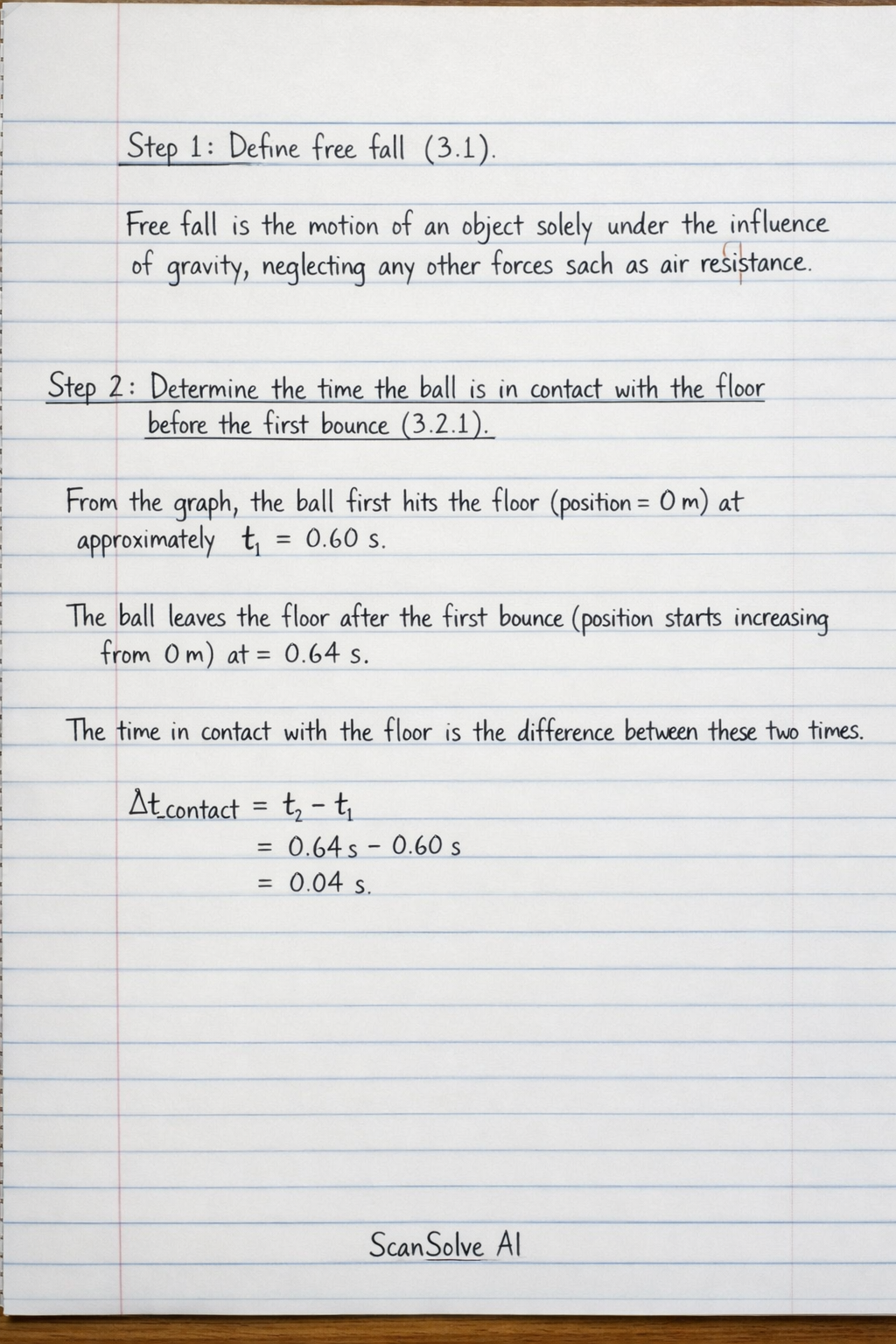
Handwritten Step-by-Step Solution
Get this as a handwritten image on WhatsApp — like a tutor wrote it for you.
Try on WhatsApp