
We read your photo as:
A block and tackle system of pulleys consisting of 6 pulleys is used to raise a load of 600 N through a height of 15 cm. The work done against friction in the pulley is 900 J. Calculate the: (i) total work done by the effort; (ii) efficiency of the system; (iii) effort applied.
ScanSolve AI Answer
Step-by-step solution
7 stepsHere's the solution for part (a):
a) A block and tackle system of pulleys consisting of 6 pulleys is used to raise a load of through a height of . The work done against friction in the pulley is .
First, convert the height from cm to m:
Part i· 2 steps
total work done by the effort;
Calculate the useful work done on the load ().
The work done on the load is the product of the load and the height it is raised.
Calculate the total work done by the effort ().
The total work done by the effort is the sum of the useful work done on the load and the work done against friction.
The total work done by the effort is .
Part ii· 2 steps
efficiency of the system;
Use the formula for efficiency.
Efficiency () is the ratio of work output () to work input (), expressed as a percentage.
Calculate the efficiency.
The efficiency of the system is approximately .
Part iii· 3 steps
effort applied.
Determine the velocity ratio (VR) of the pulley system.
For a block and tackle system, the velocity ratio is equal to the number of pulleys.
Calculate the distance moved by the effort ().
The velocity ratio is also the ratio of the distance moved by the effort to the distance moved by the load.
Calculate the effort applied ().
The total work done by the effort is the product of the effort and the distance it moves.
The effort applied is .
Still stuck on this one?
Ask a follow-up, and the answer starts from this question.
More Physics Questions
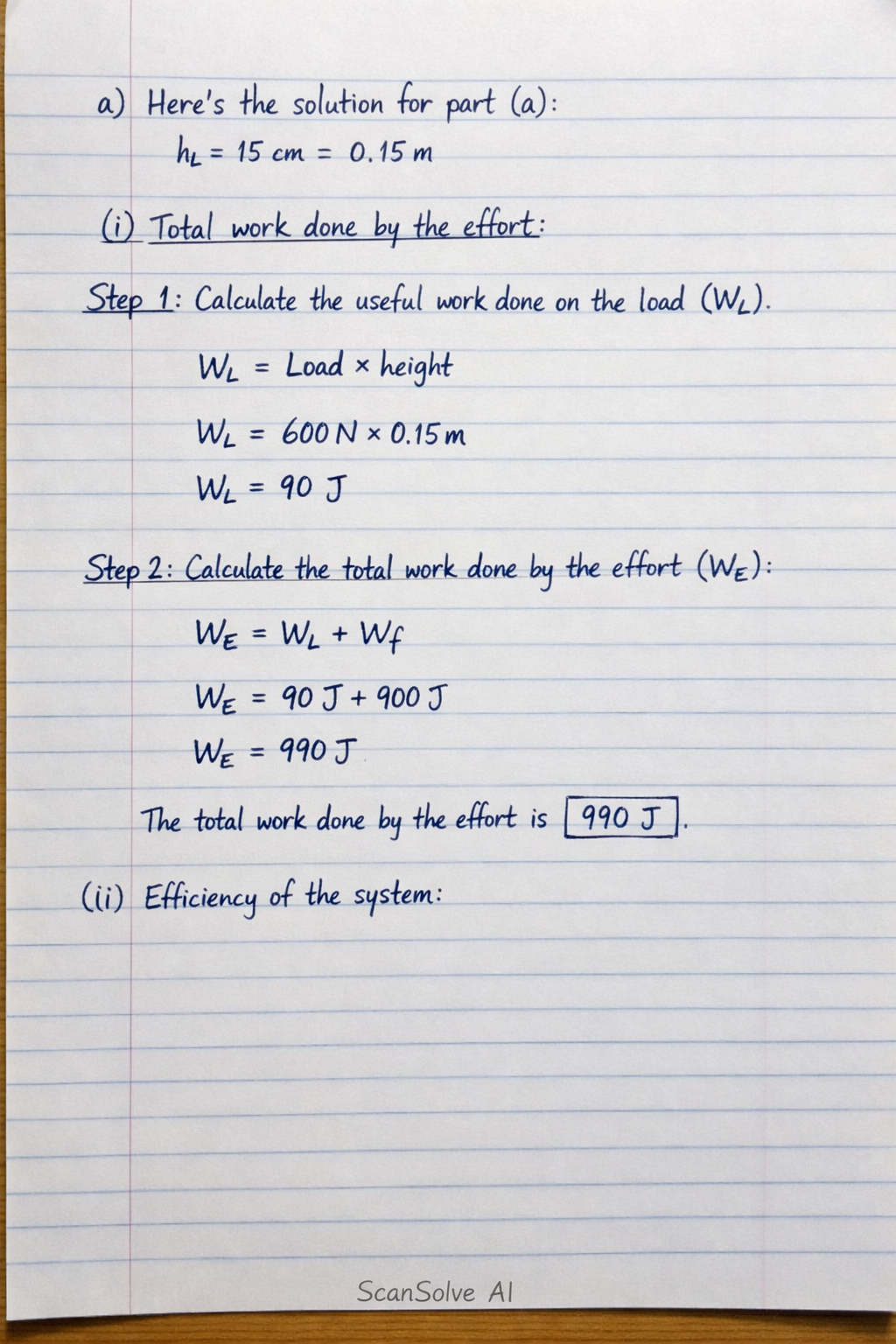
Handwritten Step-by-Step Solution
Get this as a handwritten image on WhatsApp — like a tutor wrote it for you.
Try on WhatsApp