

This physics problem tests your understanding of fundamental physical laws and their applications. The step-by-step solution below breaks down the problem using relevant equations and physical reasoning.
ScanSolve AI Answer
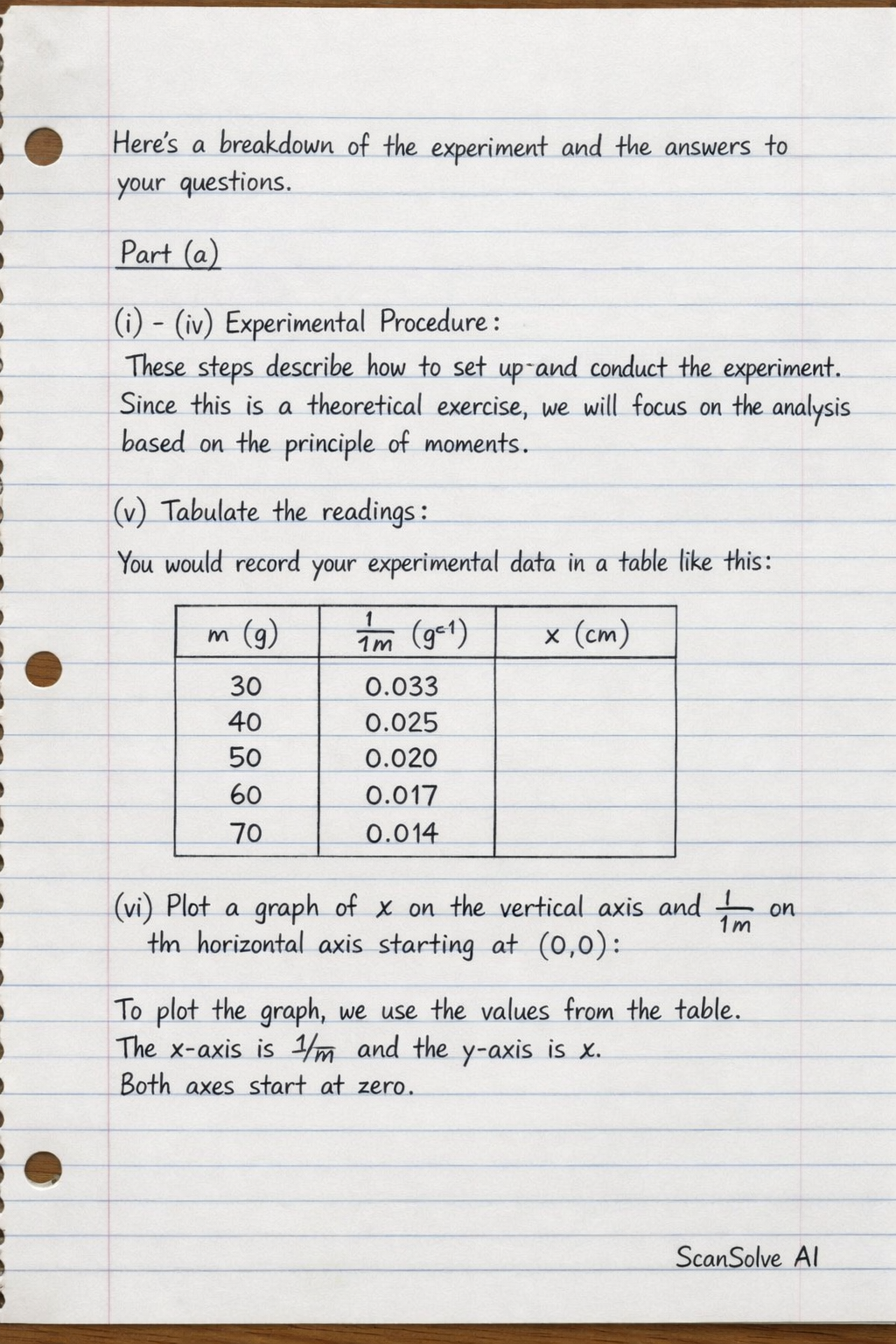
Here's a breakdown of the experiment and the answers to your questions. Part (a) (i) - (iv) Experimental Procedure: These steps describe how to set up and conduct the experiment. Since this is a theoretical exercise, we will focus on the analysis based on the principle of moments. (v) Tabulate the readings: You would record your experimental data in a table like this: | m (g) | (1)/(m) (g^-1) | x (cm) | | :-----: | :--------------------: | :------: | | 30 | 0.033 | | | 40 | 0.025 | | | 50 | 0.020 | | | 60 | 0.017 | | | 70 | 0.014 | | (vi) Plot a graph of x on the vertical axis and (1)/(m) on the horizontal axis starting both axes from the origin, (0,0). To plot the graph, you would use the values from your table. The x-axis would represent (1)/(m) and the y-axis would represent x. Both axes should start at zero. (vii) Determine the slope, s, of the graph. First, let's derive the relationship between x and (1)/(m) using the principle of moments. For the metre rule to be in equilibrium, the sum of the clockwise moments about the pivot (point G) must equal the sum of the anticlockwise moments about G. Anticlockwise moments: Moment due to 20 g mass at A = 20 \, g × AG = 20 \, g × 10 \, cm = 200 \, g cm. Moment due to M_0 mass at B = M_0 × BG = M_0 × 5 \, cm = 5M_0 \, g cm. Total anticlockwise moment = (200 + 5M_0) \, g cm. Clockwise moments: Moment due to m mass at C = m × CG = m × x \, g cm. For equilibrium: m × x = 200 + 5M_0 To get x on the vertical axis and (1)/(m) on the horizontal axis, we rearrange the equation: x = (200 + 5M_0)/(m) x = (200 + 5M_0) ((1)/(m)) This equation is in the form Y = sX + c, where Y=x, X=(1)/(m), and c=0. Therefore, the slope s of the graph is: s = 200 + 5M_0 (viii) Given that s = 5(40 + m_0), determine the value of m_0. We have derived the slope as s = 200 + 5M_0. The problem states that s = 5(40 + m_0). Assuming M_0 (the mass at B) is the same as m_0 (the variable in the given slope equation), we can set the two expressions for s equal: 200 + 5m_0 = 5(40 + m_0) 200 + 5m_0 = 200 + 5m_0 This equation is an identity, meaning it is true for any value of m_0. Therefore, the value of m_0 cannot be uniquely determined from the given information. To find a numerical value for m_0, either the slope s would need to be given a specific numerical value from experimental data, or the relationship for s would need to be different. (ix) State two precautions taken to ensure accurate results. 1. Ensure the metre rule is perfectly horizontal before taking readings to avoid errors due to the weight of the rule contributing to moments if its center of gravity is not directly above the pivot. 2. Avoid parallax error when reading the positions of the masses and the pivot on the metre rule. 3. Ensure the masses are suspended vertically and are not swinging, as this would introduce dynamic forces. Part (b) (i) When is a body said to be in equilibrium? A body is said to be in equilibrium when it is either at rest (static equilibrium) or moving with a constant velocity (dynamic equilibrium). In both cases, the net force and the net torque acting on the body are zero. (ii) State two conditions necessary for the equilibrium of a body acted upon by coplanar forces. For a body acted upon by coplanar forces to be in equilibrium, two conditions must be met: 1. The vector sum of all forces acting on the body must be zero. This ensures translational equilibrium (no linear acceleration). 2. The sum of the moments (torques) of all forces about any arbitrary point must be zero. This ensures rotational equilibrium (no angular acceleration). That's 2 down. 3 left today — send the next one.