
We read your photo as:
A body starts moving with a speed of 10 m s -1 and accelerates uniformly to 40 m s -1 in 6.0 s. Calculate the distance travelled.
ScanSolve AI Answer
Answer
Step-by-step solution
11 stepsHere are the solutions to the problems:
** (Top section - "A body starts moving...")**
Identify the given values and the formula for distance.
Initial speed,
Final speed,
Time,
We need to find the distance travelled, .
We can use the formula for distance when acceleration is uniform:Substitute the values into the formula and calculate the distance.
The correct option is C.
** (Multiple choice - "Which of the following is a vector quantity?")**
Understand the definition of a vector quantity.
A vector quantity has both magnitude and direction. A scalar quantity has only magnitude.
Evaluate each option.
- A. Speed: A scalar quantity (magnitude only).
- B. Mass: A scalar quantity (magnitude only).
- C. Displacement: A vector quantity (magnitude and direction of change in position).
- D. Temperature: A scalar quantity (magnitude only). The correct option is C.
** (Multiple choice - "The SI unit of force is:")**
Recall the SI units for common physical quantities.
- A. Joule: The SI unit of energy or work.
- B. Newton: The SI unit of force.
- C. Pascal: The SI unit of pressure.
- D. Watt: The SI unit of power. The correct option is B.
** (Multiple choice - "Which of the following is an example of a renewable energy source?")**
Understand the definition of a renewable energy source.
A renewable energy source is naturally replenished on a human timescale.
Evaluate each option.
- A. Coal: A non-renewable fossil fuel.
- B. Natural gas: A non-renewable fossil fuel.
- C. Solar energy: A renewable energy source, as it comes from the sun and is continuously available.
- D. Petroleum: A non-renewable fossil fuel. The correct option is C.
** (Multiple choice - "Which of the following best describes the law of conservation of energy?")**
Recall the law of conservation of energy.
The law of conservation of energy states that energy cannot be created or destroyed, but it can be transformed from one form to another. The total amount of energy in an isolated system remains constant.
Evaluate each option.
- A. Energy can be created from nothing: Incorrect.
- B. Energy can be destroyed: Incorrect.
- C. Energy can be changed from one form to another, but the total amount remains constant: Correct.
- D. Energy is only found in living things: Incorrect. The correct option is C.
** (Multiple choice - "In a simple pendulum, what factor does NOT affect the time period?")**
Recall the formula for the time period of a simple pendulum.
For small angles, the time period () of a simple pendulum is given by:
where is the length of the string and is the acceleration due to gravity.
Analyze the factors in the formula and the given options.
- A. Length of the string (): Directly affects the time period.
- B. Mass of the bob: Not present in the formula, so it does not affect the time period.
- C. Acceleration due to gravity (): Directly affects the time period.
- D. Amplitude of the swing (small angles): For small angles, the amplitude does not significantly affect the time period.
Both B and D are factors that do not affect the time period for an ideal simple pendulum under small oscillations. However, the independence from the mass of the bob is a fundamental characteristic of an ideal simple pendulum, while the independence from amplitude is an approximation that holds true only for "small angles." If the amplitude were large, it would affect the period. Therefore, the mass of the bob is the most consistently correct answer for what does not affect the period of a simple pendulum.
The correct option is B.Final Answers:
- Distance travelled: C. 150 m
- Vector quantity: C. Displacement
- SI unit of force: B. Newton
- Renewable energy source: C. Solar energy
- Law of conservation of energy: C. Energy can be changed from one form to another, but the total amount remains constant.
- Factor NOT affecting pendulum period: B. Mass of the bob
Try one yourself
A new problem that tests the same skill.
Still stuck on this one?
Ask a follow-up, and the answer starts from this question.
More Physics Questions
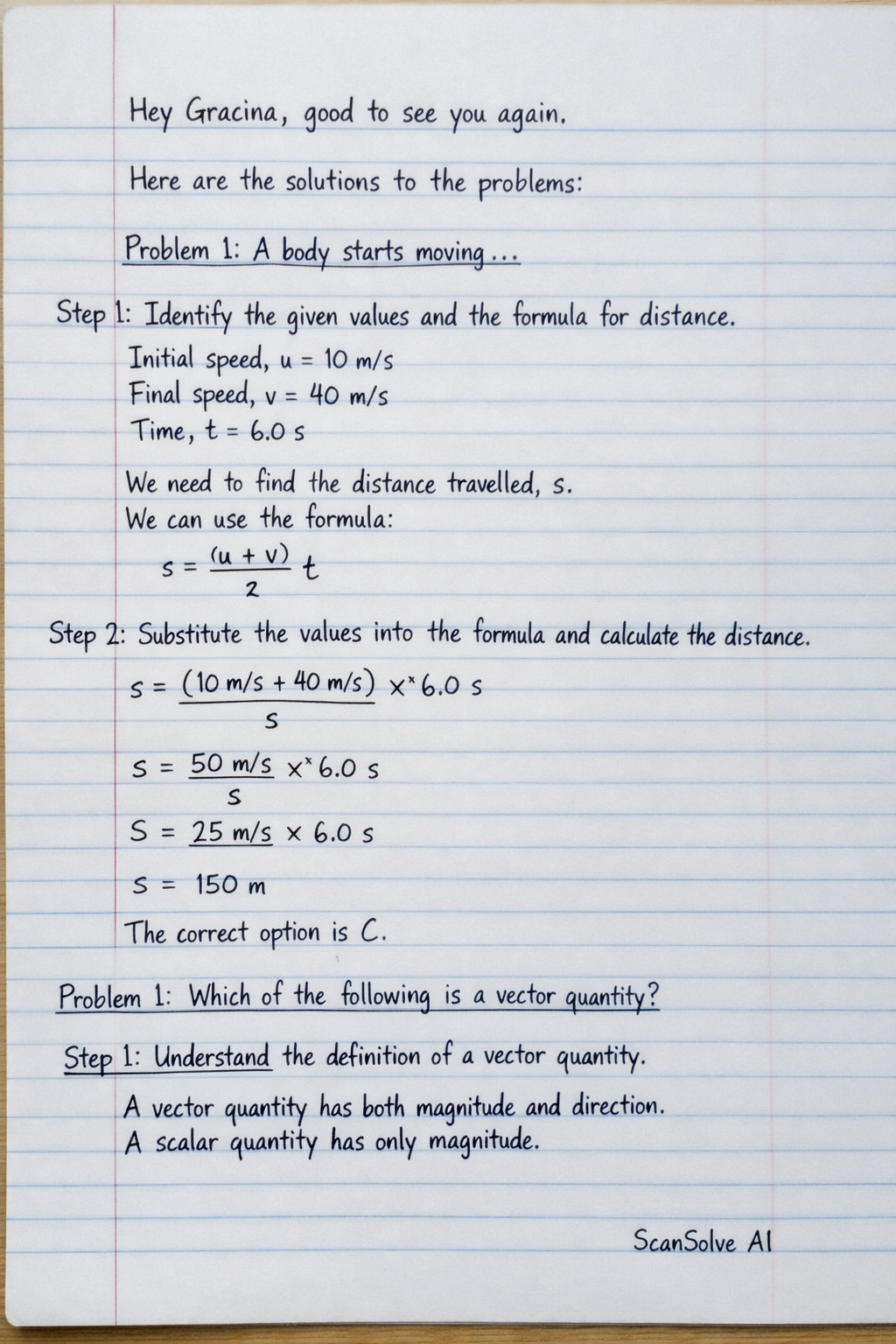
Handwritten Step-by-Step Solution
Get this as a handwritten image on WhatsApp — like a tutor wrote it for you.
Try on WhatsApp