
We read your photo as:
A boy shouts towards a high wall and hears the echo 0.25 s later. The distance between the boy and the wall is 200 m. Calculate the speed of sound.
ScanSolve AI Answer
Answer
Step-by-step solution
3 stepsHere are the solutions for the questions:
8.
Part a
Sketch, on the diagram, the path followed by the second sound.
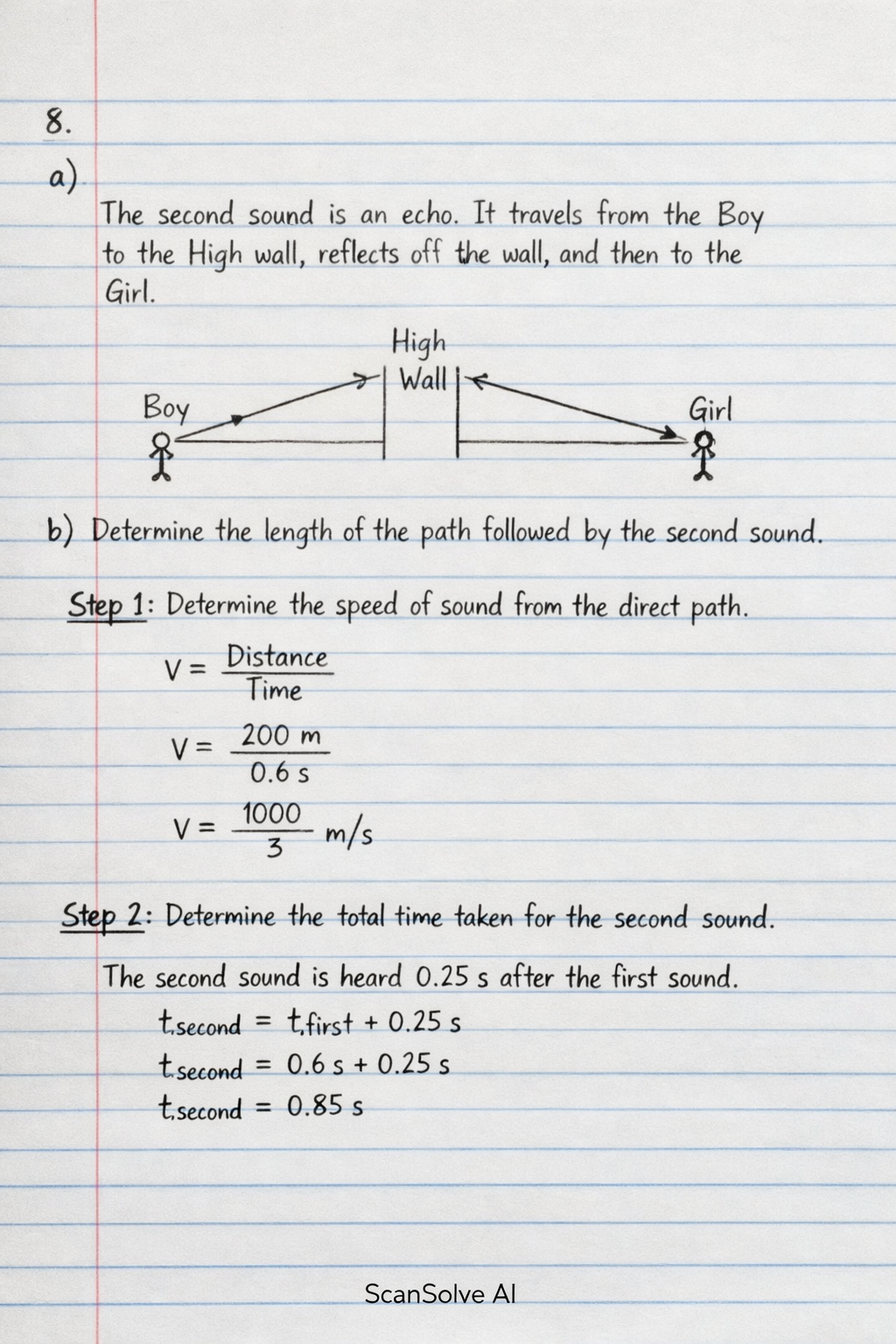
The second sound is an echo. It travels from the boy to the high wall, reflects off the wall, and then travels from the wall to the girl. The path would be a line from the Boy to a point on the High wall, and then another line from that point on the High wall to the Girl.
Part b
Determine the length of the path followed by the second sound.
Determine the speed of sound from the direct path.
The first sound travels directly from the boy to the girl, a distance of , in .
Determine the total time taken for the second sound.
The second sound is heard after the first sound.
Calculate the length of the path followed by the second sound.
The length of the path followed by the second sound is .
9. A person standing out in an illuminated garden at night is observed to have two shadows of different sharpness. Explain this observation.
This observation occurs because there are at least two different light sources illuminating the person. Each light source casts its own shadow. The sharpness of a shadow depends on the size and distance of the light source. A smaller or more distant light source produces a sharper shadow (umbra), while a larger or closer light source produces a less sharp, fuzzy shadow (penumbra). Therefore, the two shadows of different sharpness indicate that the light sources are of different sizes, intensities, or positions.
10. Identify the type of charge induced at X and Y.
When a positively charged metal sphere is brought near an uncharged metallic object, electrostatic induction occurs. The free electrons in the uncharged metallic object are attracted towards the positively charged sphere.
- At point X (closer to the positive sphere), negative charges will accumulate due to the attraction of electrons.
- At point Y (further from the positive sphere), there will be a deficiency of electrons, resulting in an accumulation of positive charges.
Charge at X:
Charge at Y:
Try one yourself
A new problem that tests the same skill.
Still stuck on this one?
Ask a follow-up, and the answer starts from this question.
More Physics Questions
Handwritten Step-by-Step Solution
Get this as a handwritten image on WhatsApp — like a tutor wrote it for you.
Try on WhatsApp