
We read your photo as:
A car starts from rest and accelerates uniformly to a speed of 40 m/s in 1 min 40 s. It then travels at a constant speed for 5 minutes before decelerating uniformly to rest in 2 minutes. a) Draw a vel
ScanSolve AI Answer
Answers
3 partsHere's the solution to question 9:
The car's journey can be broken down into three phases:
Phase 1: Acceleration
- Starts from rest ().
- Reaches .
- Time taken: .
- End of phase 1: .
Phase 2: Constant speed
- Speed: .
- Time taken: .
- This phase starts at and ends at .
- End of phase 2: .
Phase 3: Deceleration
- Starts at .
- Comes to a halt ().
- Time taken: .
- This phase starts at and ends at .
- End of phase 3: .
a) Draw a velocity-time graph to represent the information above.
To draw the graph:
- Draw a horizontal axis for time (in seconds) and a vertical axis for velocity (in m/s).
- Plot the following points:
- (start from rest)
- (end of acceleration)
- (end of constant speed)
- (car comes to a halt)
- Connect to with a straight line (acceleration).
- Connect to with a horizontal line (constant velocity).
- Connect to with a straight line (deceleration). The resulting graph will be a trapezium.
b) Use your graph to find:
(i) The initial acceleration.
The initial acceleration is the gradient of the first segment of the graph (from to ).
The initial acceleration is .
(ii) The deceleration when the car is brought to a halt.
The deceleration is the magnitude of the gradient of the last segment of the graph (from to ).
The deceleration is the positive value of this acceleration.
The deceleration is (to 3 significant figures).
(iii) The distance traveled in km.
The total distance traveled is the area under the entire velocity-time graph (a trapezium).
The formula for the area of a trapezium is .
- Height of the trapezium (maximum velocity) = .
- Length of the top parallel side (duration of constant velocity) = .
- Length of the bottom parallel side (total time) = .
To convert meters to kilometers:
The total distance traveled is .
Try one yourself
A new problem that tests the same skill.
Still stuck on this one?
Ask a follow-up, and the answer starts from this question.
More Physics Questions
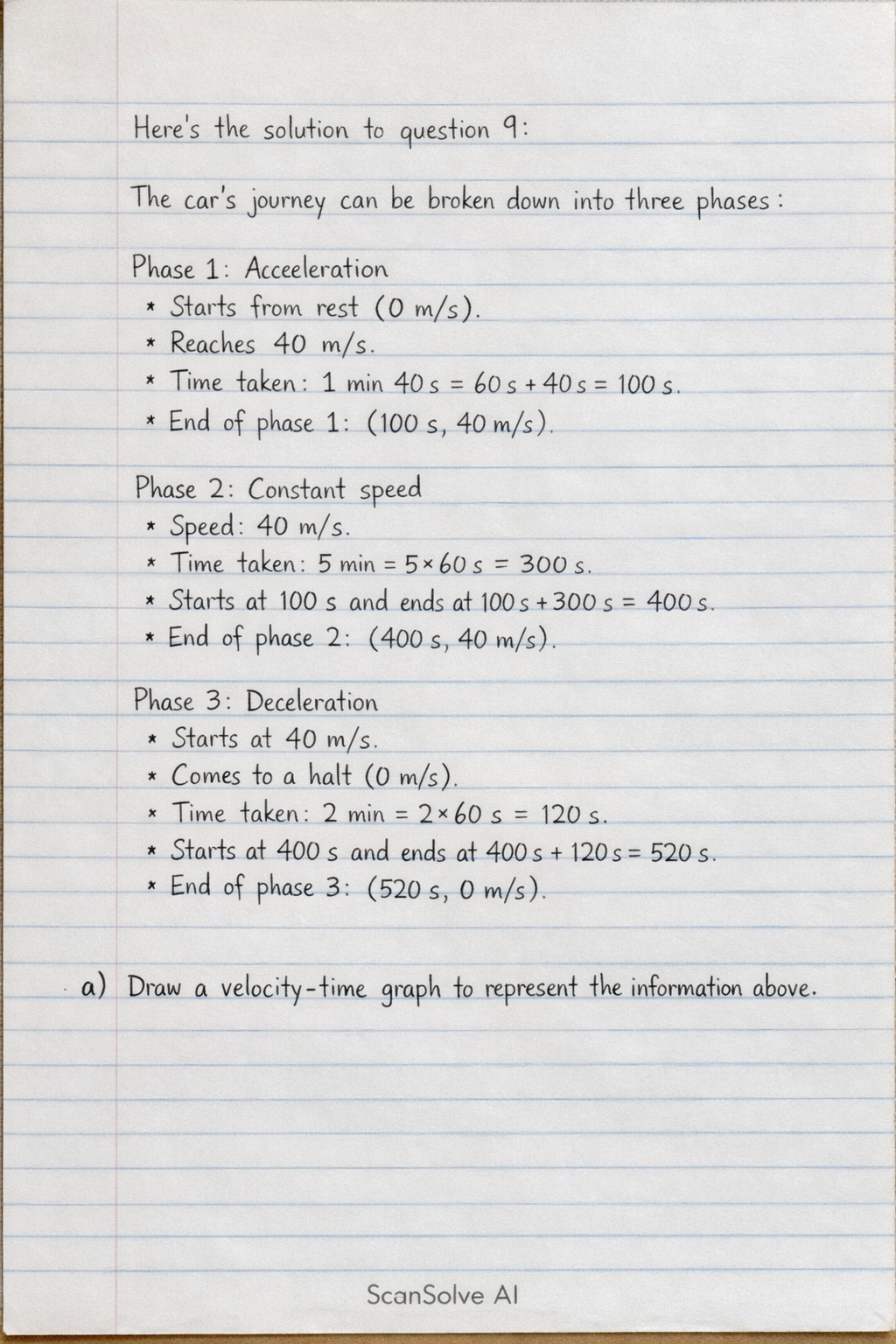
Handwritten Step-by-Step Solution
Get this as a handwritten image on WhatsApp — like a tutor wrote it for you.
Try on WhatsApp