
We read your photo as:
A car starts from rest and reaches a velocity of 72 km/h in 10 s. What is its acceleration? Also, explain why two identical bodies with different velocities have different kinetic energies, and analyz
ScanSolve AI Answer
Answer
Step-by-step solution
8 stepsSolve Question 1.
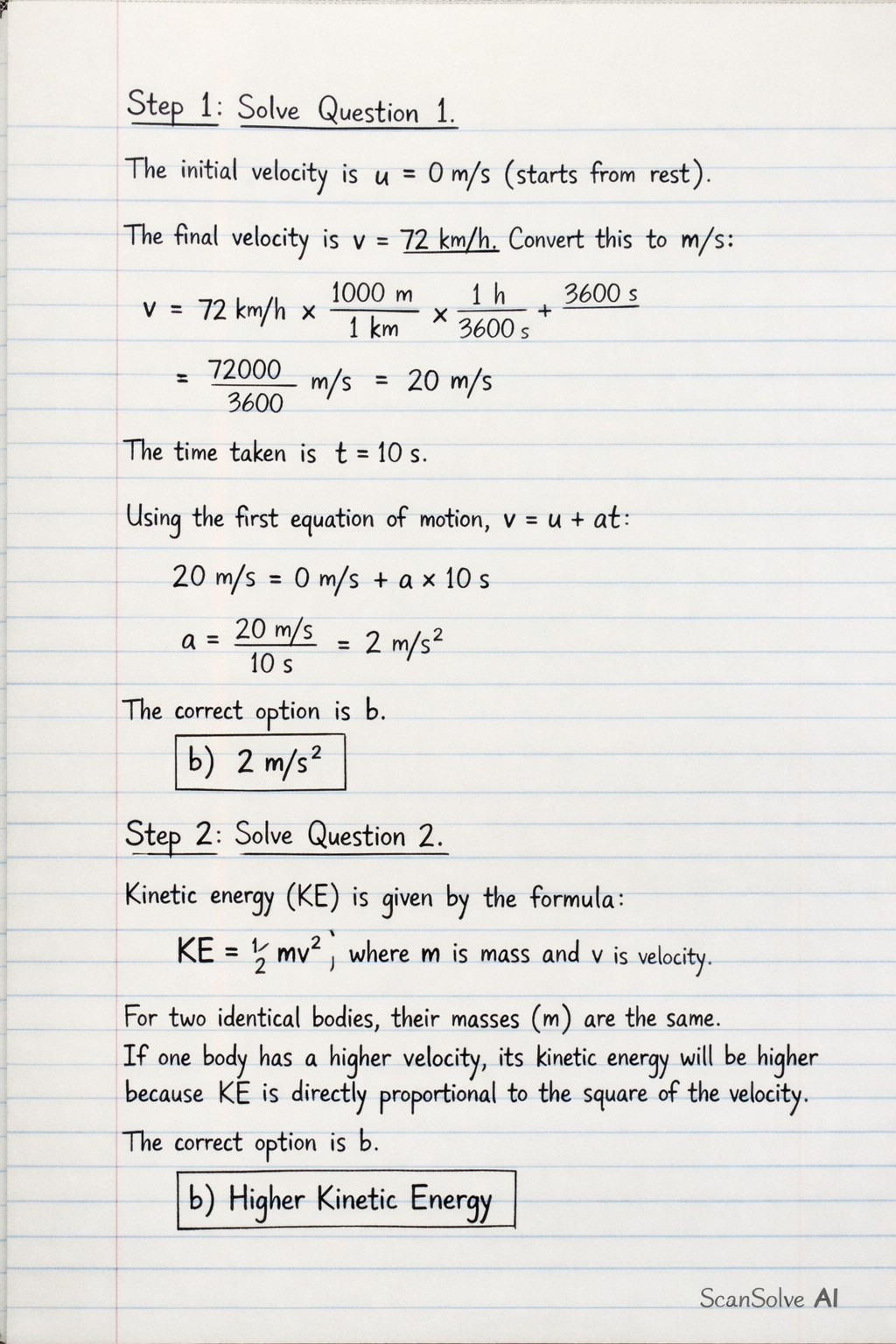
The initial velocity is (starts from rest).
The final velocity is . Convert this to :The time taken is .
Using the first equation of motion, :The correct option is b.
Solve Question 2.
Kinetic energy () is given by the formula , where is mass and is velocity.
For two identical bodies, their masses () are the same. If one body has a higher velocity, its kinetic energy will be higher because is directly proportional to the square of the velocity.
The correct option is b.Solve Question 3.
Assertion: A table cloth cannot be pulled from a table without dislodging the dishes. This assertion is generally false. The "tablecloth trick" works because the dishes, due to their inertia, tend to resist the change in motion when the cloth is pulled quickly.
Reason: Newton's second law of motion gives definition of inertia. This reason is false. Newton's first law of motion defines inertia.
Since both the assertion and the reason are false, the correct evaluation would be that both are incorrect.Solve Question 4.
The electrical energy consumed is .
The time taken is .
Power () is defined as energy consumed per unit time:Solve Question 5.
The distance to the wall is .
The speed of sound is .
For an echo to be heard, the sound travels to the wall and then reflects back to the listener. So, the total distance covered by the sound is .
Total distance .
The time () taken for the echo is:Solve Question 5 (OR part).
What is the work done by the force of gravity on a satellite moving round the Earth? Justify your answer.
A satellite moving in a circular orbit around the Earth experiences a gravitational force that is always directed towards the center of the Earth. The displacement of the satellite at any instant is tangential to its circular path.
The angle () between the force of gravity and the direction of displacement is .
The work done () by a force is given by the formula .
Since , .
Therefore, the work done by the force of gravity on a satellite moving in a circular orbit is zero.Justification: The force of gravity acts perpendicular to the displacement of the satellite at every point in its circular orbit.
Solve Question 6.
Define the characteristic of sound. (also write unit).
i) Amplitude: The maximum displacement or distance moved by a point on a vibrating body or wave measured from its equilibrium position. It determines the loudness or intensity of the sound.
Unit: meter (m) for displacement, or Pascal (Pa) for sound pressure.ii) Pitch: The perception of the frequency of a sound. A higher frequency corresponds to a higher pitch, and a lower frequency corresponds to a lower pitch.
Unit: Hertz (Hz) (as it is directly related to frequency).iii) Frequency: The number of complete oscillations or cycles of a wave that occur per unit of time. It determines the pitch of the sound.
Unit: Hertz (Hz).Solve Question 7.
Give reason for the following.
i) Some of the leaves may get detached from a tree if we vigorously shake its branch.
This phenomenon is due to inertia of rest. When the branch is shaken vigorously, it moves suddenly. However, the leaves, due to their inertia, tend to remain in their original state of rest. This resistance to change in motion causes the leaves to detach from the moving branch.ii) While catching a fast moving cricket ball, a fielder in the ground gradually pulls his hands backwards with the moving ball.
This action is performed to increase the time interval () over which the momentum of the ball changes. According to the impulse-momentum theorem (), if the change in momentum () is constant, increasing the time interval () over which the force acts will decrease the magnitude of the force () exerted on the fielder's hands. This reduces the impact force and prevents injury.
Try one yourself
A new problem that tests the same skill.
Still stuck on this one?
Ask a follow-up, and the answer starts from this question.
More Physics Questions
Handwritten Step-by-Step Solution
Get this as a handwritten image on WhatsApp — like a tutor wrote it for you.
Try on WhatsApp