
We read your photo as:
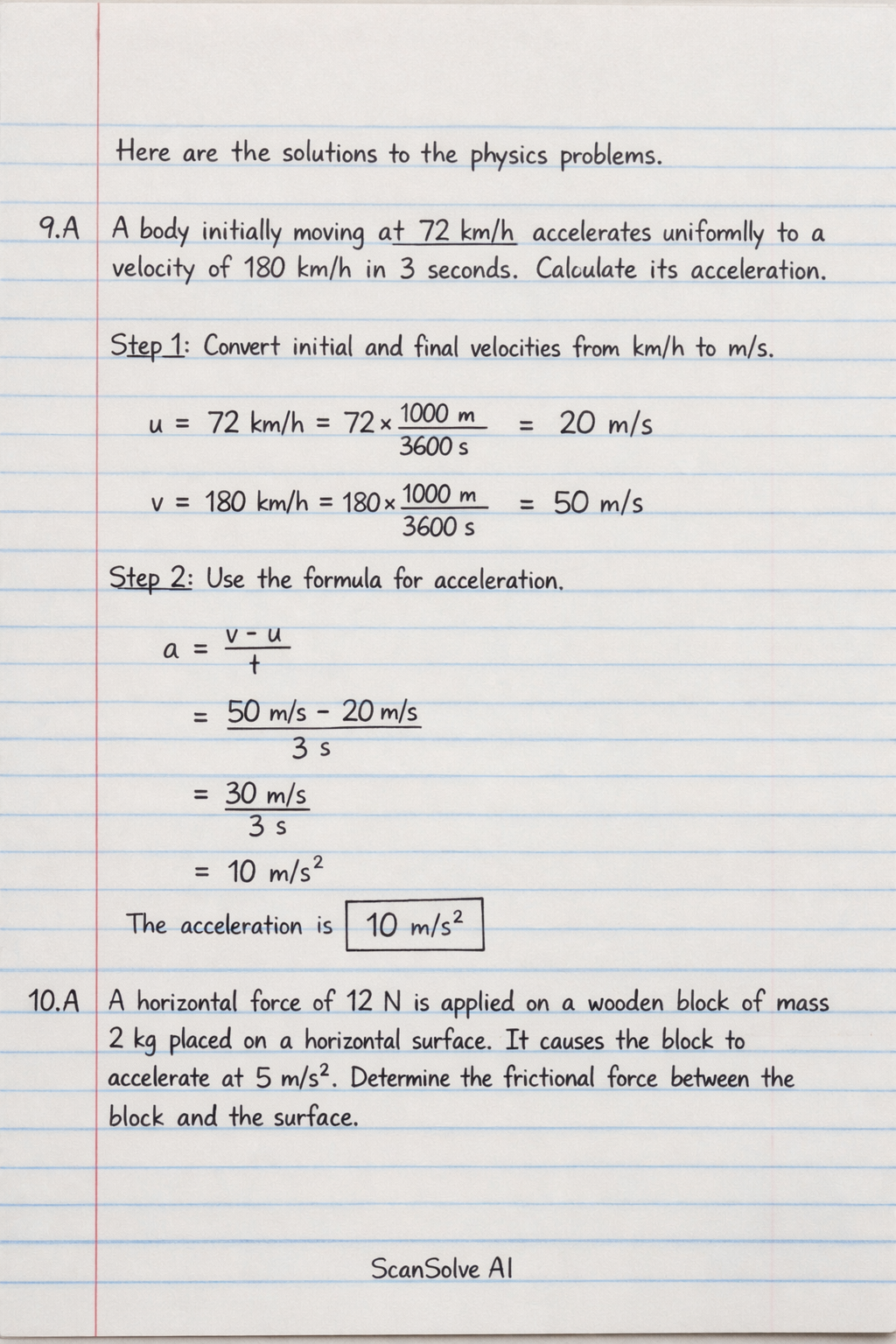
Here are the solutions to the physics problems. 9.A A body initially moving at 72 km/h accelerates uniformly to a velocity of 180 km/h in 3 seconds. Calculate its acceleration. 10.A A horizontal force
ScanSolve AI Answer
Answers
2 partsStep-by-step solution
7 stepsHere are the solutions to the physics problems.
9.A A body initially moving at accelerates uniformly to a velocity of in . Calculate its acceleration.
Step 1: Convert initial and final velocities from to .
Step 2: Use the formula for acceleration.
Substitute the values:
The acceleration is .
10.A A horizontal force of is applied on a wooden block of mass placed on a horizontal surface. It causes the block to accelerate at . Determine the frictional force between the block and the surface.
Step 1: Apply Newton's Second Law of Motion.
The net force () acting on the block is the applied force () minus the frictional force ().
Also, .
So,
Step 2: Substitute the given values and solve for .
Given: , , .
The frictional force is .
11.A A car can be brought to rest from a speed of in a time of .
Part i· 2 steps
Calculate the average deceleration.
Identify the given values.
Initial velocity () =
Final velocity () = (brought to rest)
Time () =Use the formula for acceleration.
Substitute the values:
The average deceleration is . (Deceleration is the magnitude of negative acceleration).
Part ii
If the driver reaction time is , Determine the shortest stopping Distance.
Calculate the distance covered during the reaction time.
During reaction time, the car travels at a constant initial velocity.
Calculate the distance covered during braking.
Using the deceleration calculated in part (i), .
Initial velocity () =
Final velocity () =Calculate the total shortest stopping distance.
The shortest stopping distance is .
12.A A small iron ball is dropped from the top of a vertical cliff and takes to reach the sandy beach. Find the velocity with which it strikes the sand.
Identify the given values.
Initial velocity () = (since it is dropped)
Time () =
Acceleration due to gravity () = (assuming standard gravity)Use the formula for final velocity under constant acceleration.
Substitute the values:
The velocity with which it strikes the sand is .
Try one yourself
A new problem that tests the same skill.
Still stuck on this one?
Ask a follow-up, and the answer starts from this question.
More Physics Questions
Handwritten Step-by-Step Solution
Get this as a handwritten image on WhatsApp — like a tutor wrote it for you.
Try on WhatsApp