
We read your photo as:
A Cathode Ray Oscilloscope (CRO) is used to display an AC signal. (i) Calculate the frequency of the signal. (ii) Calculate the peak voltage of the signal. (b) State two advantages of a CRO as a voltm
ScanSolve AI Answer
Answers
2 partsStep-by-step solution
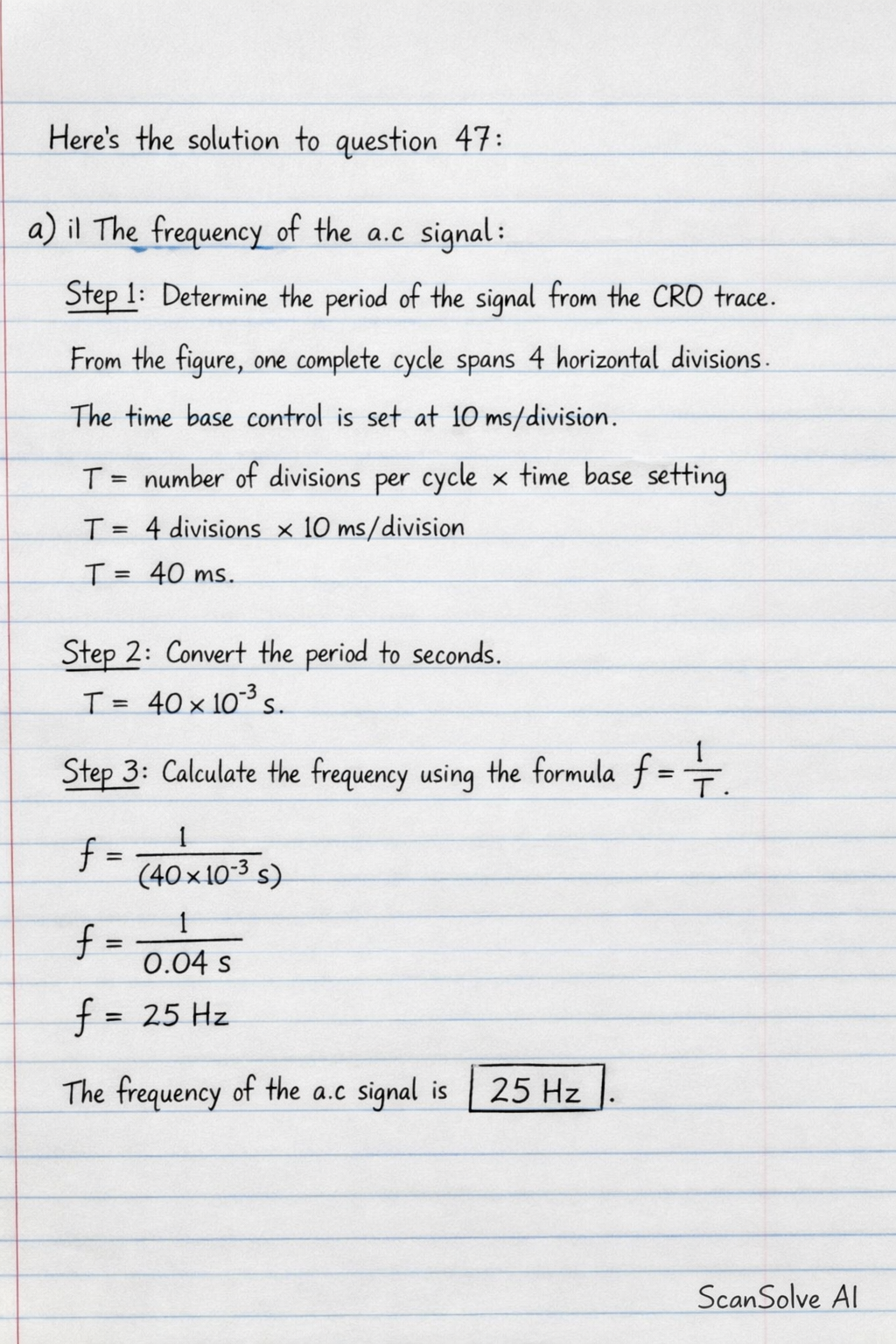
5 stepsHere's the solution to question 47:
Part a(i)· 3 steps
The frequency of the a.c signal
Determine the period of the signal from the CRO trace.
From the figure, one complete cycle of the waveform spans 4 horizontal divisions.
The time base control is set at 10 ms/division.Convert the period to seconds.
Calculate the frequency using the formula .
The frequency of the a.c signal is .
Part a(ii)
The peak voltage of the input signal
Determine the peak amplitude in divisions from the CRO trace.
From the figure, the peak amplitude (from the center line to the peak) is 2 vertical divisions.
The y-gain sensitivity is set at 120 V/division.Calculate the peak voltage.
The peak voltage of the input signal is .
Part b
State two advantages of a CRO as a voltmeter.
- A CRO has a very high input impedance, meaning it draws negligible current from the circuit under test, thus not affecting the circuit's operation.
- It can display the waveform of the voltage, allowing for observation of its shape, period, and peak values, which a conventional voltmeter cannot do.
Try one yourself
A new problem that tests the same skill.
Still stuck on this one?
Ask a follow-up, and the answer starts from this question.
More Physics Questions
Handwritten Step-by-Step Solution
Get this as a handwritten image on WhatsApp — like a tutor wrote it for you.
Try on WhatsApp