
We read your photo as:
A sinusoidal alternating voltage is displayed on a Cathode Ray Oscilloscope (C.R.O.). The y-sensitivity is 10 V/cm and the time base is 0.2 ms/cm. (a) Determine the peak voltage. (b) Determine the fre
ScanSolve AI Answer
Answers
2 partsStep-by-step solution
5 stepsHere are the solutions to your questions:
Part a· 2 steps
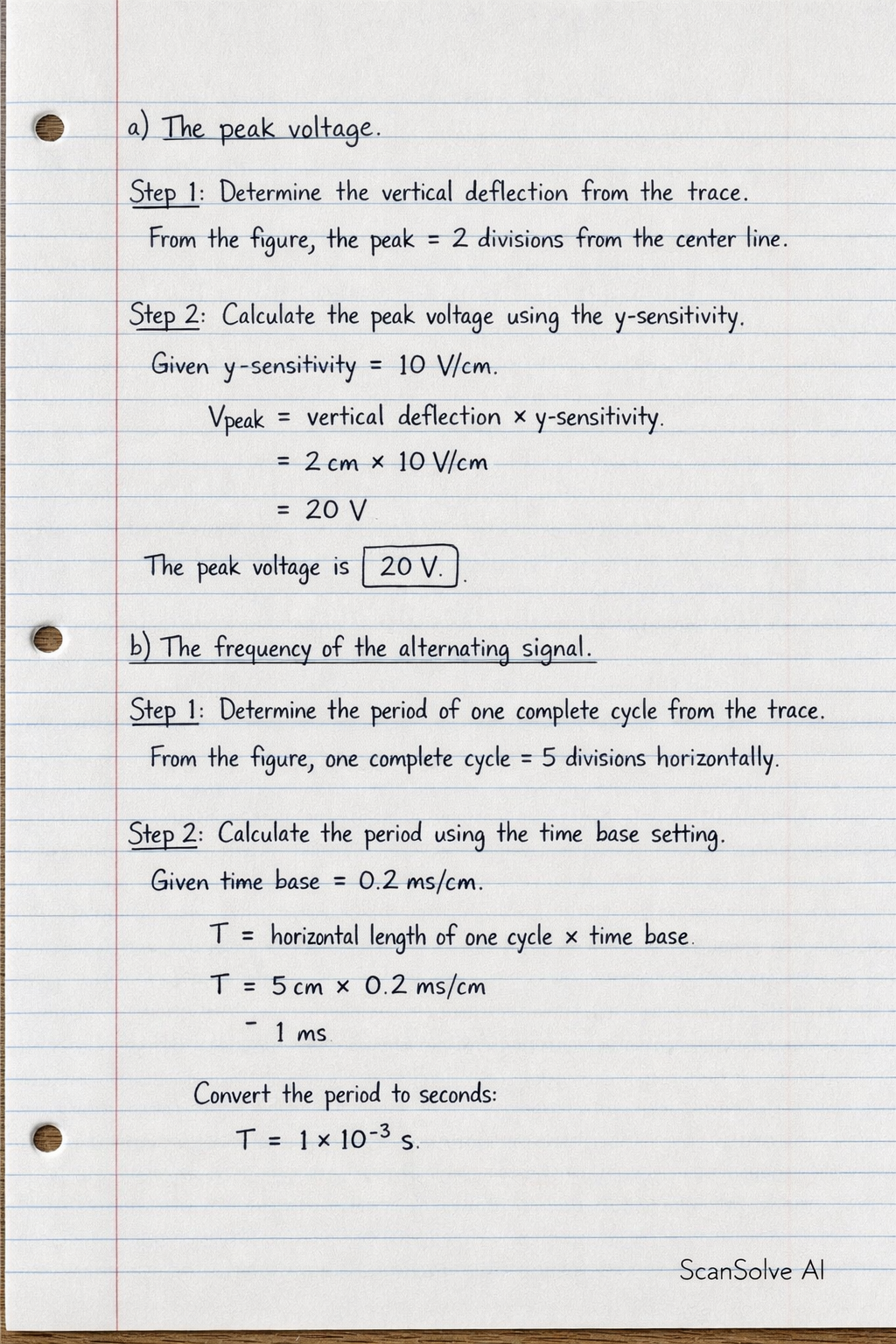
The peak voltage.
Determine the vertical deflection from the trace.
From the figure, the peak of the waveform is 2 divisions (cm) from the center line.
Calculate the peak voltage using the y-sensitivity.
Given y-sensitivity = .
The peak voltage is .
Part b
The frequency of the alternating signal.
Determine the period of one complete cycle from the trace.
From the figure, one complete cycle spans 5 divisions (cm) horizontally.
Calculate the period using the time base setting.
Given time base = .
Convert the period to seconds:
Calculate the frequency.
The frequency of the alternating signal is .
Part c
State two reasons why a C.R.O. is advantageous to use as a voltmeter over ordinary meters.
- A CRO has a very high input impedance, meaning it draws negligible current from the circuit under test, thus not altering the circuit's operating conditions.
- It can display the waveform of the voltage, allowing for the measurement of peak voltage, peak-to-peak voltage, period, and frequency, which ordinary voltmeters cannot do. (It can also measure very high frequencies and has a fast response time).
Part d
List two uses of the graphite used in the T.V. set.
- As an Aquadag coating on the inner surface of the Cathode Ray Tube (CRT) to collect secondary electrons and maintain a uniform electric field.
- As a conductive path or shield within the CRT to prevent unwanted electrostatic interference.
Try one yourself
A new problem that tests the same skill.
Still stuck on this one?
Ask a follow-up, and the answer starts from this question.
More Physics Questions
Handwritten Step-by-Step Solution
Get this as a handwritten image on WhatsApp — like a tutor wrote it for you.
Try on WhatsApp