

This physics problem tests your understanding of fundamental physical laws and their applications. The step-by-step solution below breaks down the problem using relevant equations and physical reasoning.
ScanSolve AI Answer
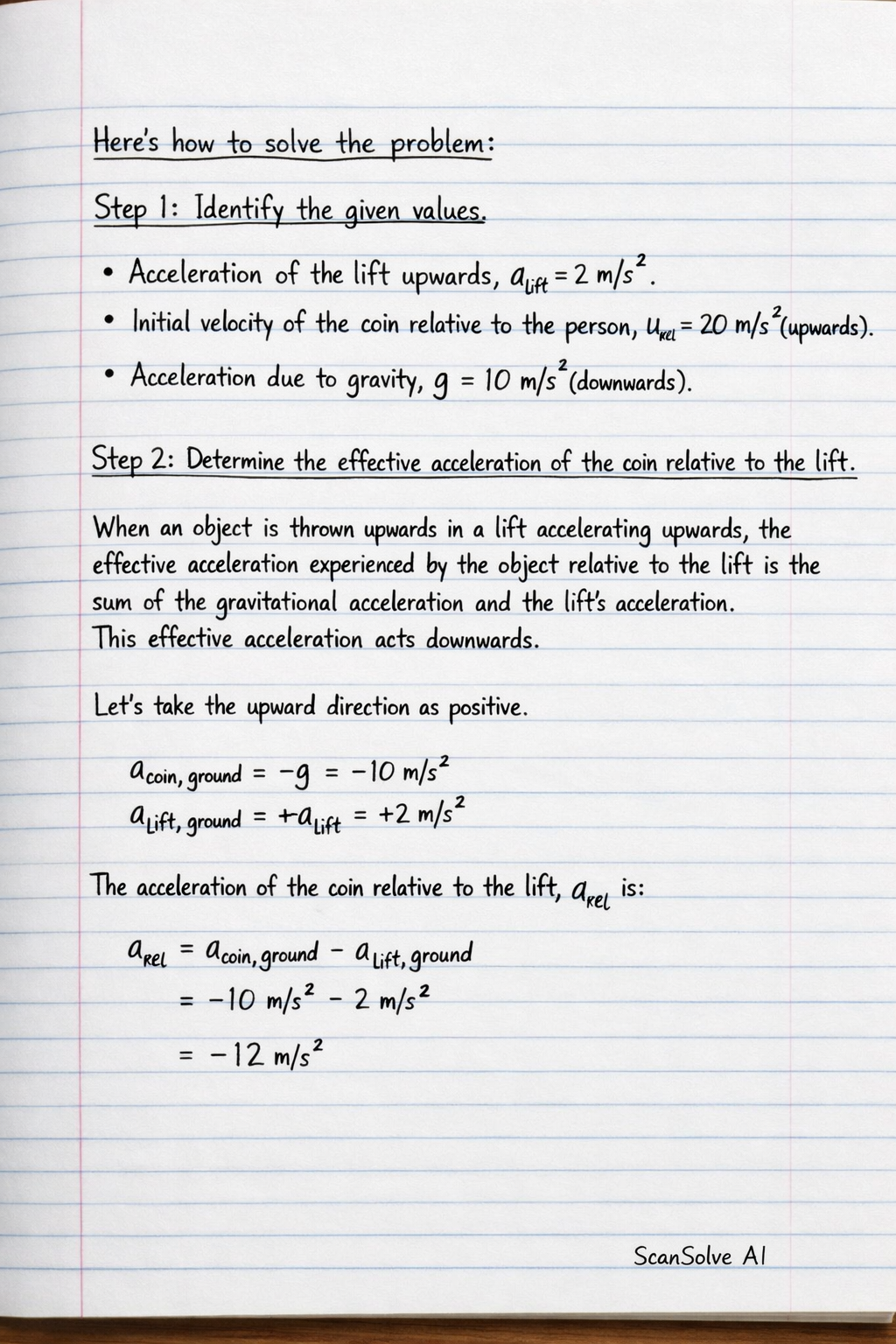
Here's how to solve the problem: Step 1: Identify the given values. Acceleration of the lift upwards, a_lift = 2 m s^-2. Initial velocity of the coin relative to the person, u_rel = 20 m s^-1 (upwards). Acceleration due to gravity, g = 10 m s^-2 (downwards). Step 2: Determine the effective acceleration of the coin relative to the lift. When an object is thrown upwards in a lift accelerating upwards, the effective acceleration experienced by the object relative to the lift is the sum of the gravitational acceleration and the lift's acceleration. This effective acceleration acts downwards. Let's take the upward direction as positive. The acceleration of the coin relative to the ground is a_coin, ground = -g = -10 m s^-2. The acceleration of the lift relative to the ground is a_lift, ground = +a_lift = +2 m s^-2. The acceleration of the coin relative to the lift, a_rel, is: a_rel = a_coin, ground - a_lift, ground a_rel = -10 m s^-2 - 2 m s^-2 a_rel = -12 m s^-2 So, the effective acceleration acting on the coin relative to the lift is 12 m s^-2 downwards. Step 3: Use the kinematic equation for displacement. We want to find the time t when the coin returns to the person's hand. This means the net displacement of the coin relative to the person is zero (s_rel = 0). Using the kinematic equation: s_rel = u_relt + (1)/(2)a_relt^2 Substitute the known values: 0 = (20 m s^-1)t + (1)/(2)(-12 m s^-2)t^2 0 = 20t - 6t^2 Step 4: Solve for time t. Factor out t from the equation: 0 = t(20 - 6t) This gives two possible solutions: 1. t = 0 (This is the initial moment when the coin is tossed). 2. 20 - 6t = 0 6t = 20 t = (20)/(6) s t = (10)/(3) s The time after which the coin returns to the person's hand is (10)/(3) s. Comparing this with the given options, it matches option (c). The final answer is (c).