
We read your photo as:
A convex mirror has an object distance of 2 m and a magnification of 1/3. Calculate the focal length of the mirror.
ScanSolve AI Answer
Answer
Step-by-step solution
3 stepsIdentify the given values and apply sign conventions.
The object is placed in front of a convex mirror.
Object distance, m. According to the Cartesian sign convention, for a real object, is negative.
So, m.
Magnification, . For a convex mirror, the image is always virtual and erect, so the magnification is positive.
We need to find the focal length, . For a convex mirror, the focal length is positive.Calculate the image distance () using the magnification formula.
The magnification formula for mirrors is:
Substitute the known values:
Multiply both sides by 2 to solve for :
The positive value of indicates that the image is virtual and formed behind the mirror, which is consistent with a convex mirror.
Calculate the focal length () using the mirror formula.
The mirror formula is:
Substitute the values of and :
Combine the fractions:
The positive value of is consistent with the focal length of a convex mirror.
The focal length of the mirror is .
Try one yourself
A new problem that tests the same skill.
Still stuck on this one?
Ask a follow-up, and the answer starts from this question.
More Physics Questions
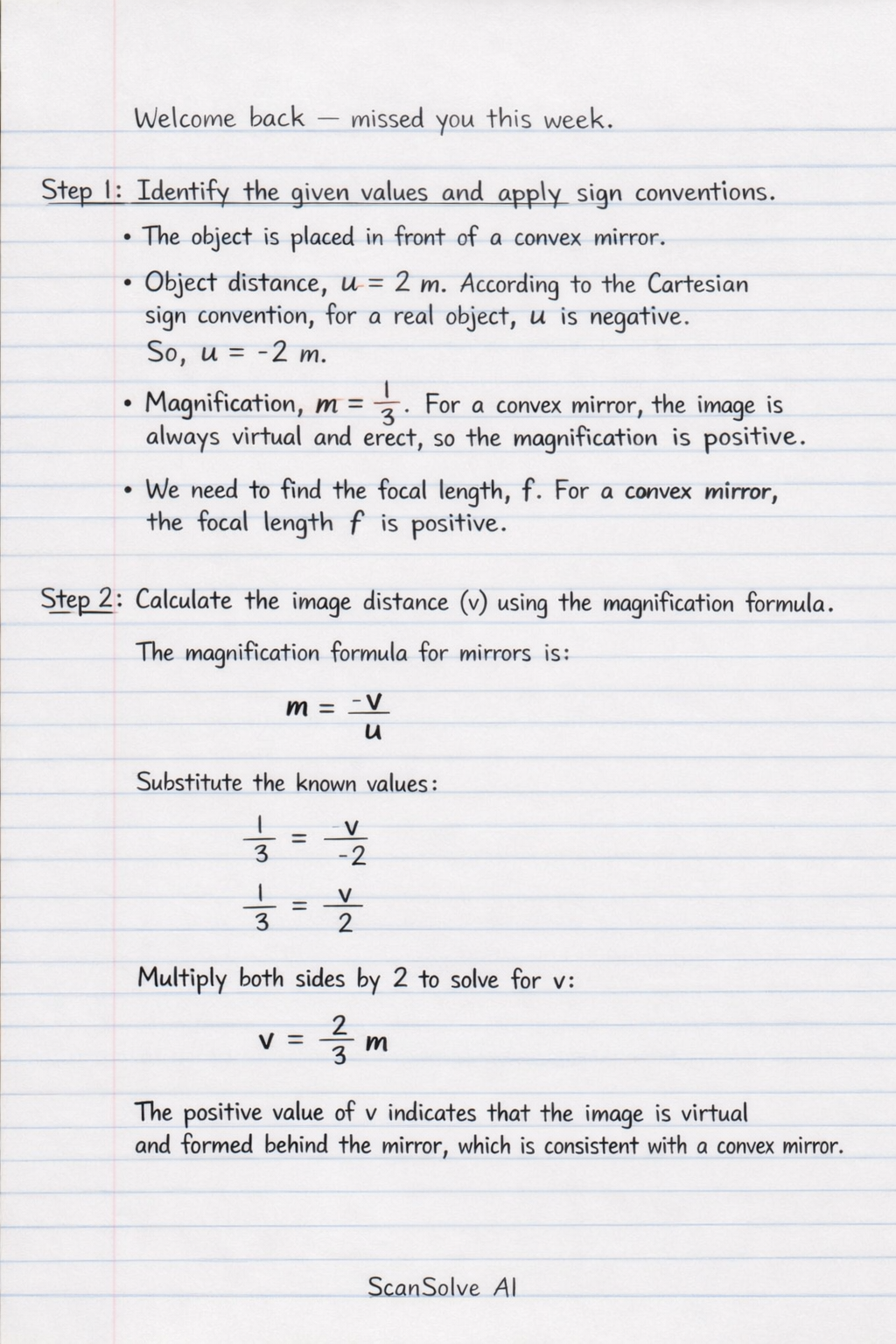
Handwritten Step-by-Step Solution
Get this as a handwritten image on WhatsApp — like a tutor wrote it for you.
Try on WhatsApp