
We read your photo as:
A cylinder contains a gas. Given: Molar mass of gas M = 0.024 kg/mol, Pressure P = 1.40 × 10⁵ N/m2, Temperature Tc = 78 °C, Cylinder height h = 7.2 cm, Cylinder diameter d = 2.5 cm. What mass of gas i
ScanSolve AI Answer
Answer
Step-by-step solution
5 stepsHere's how to solve the problem:
Given:
- Molar mass of gas
- Pressure
- Temperature
- Cylinder height
- Cylinder diameter
Constants:
- Ideal gas constant
- Avogadro's number
- Boltzmann constant
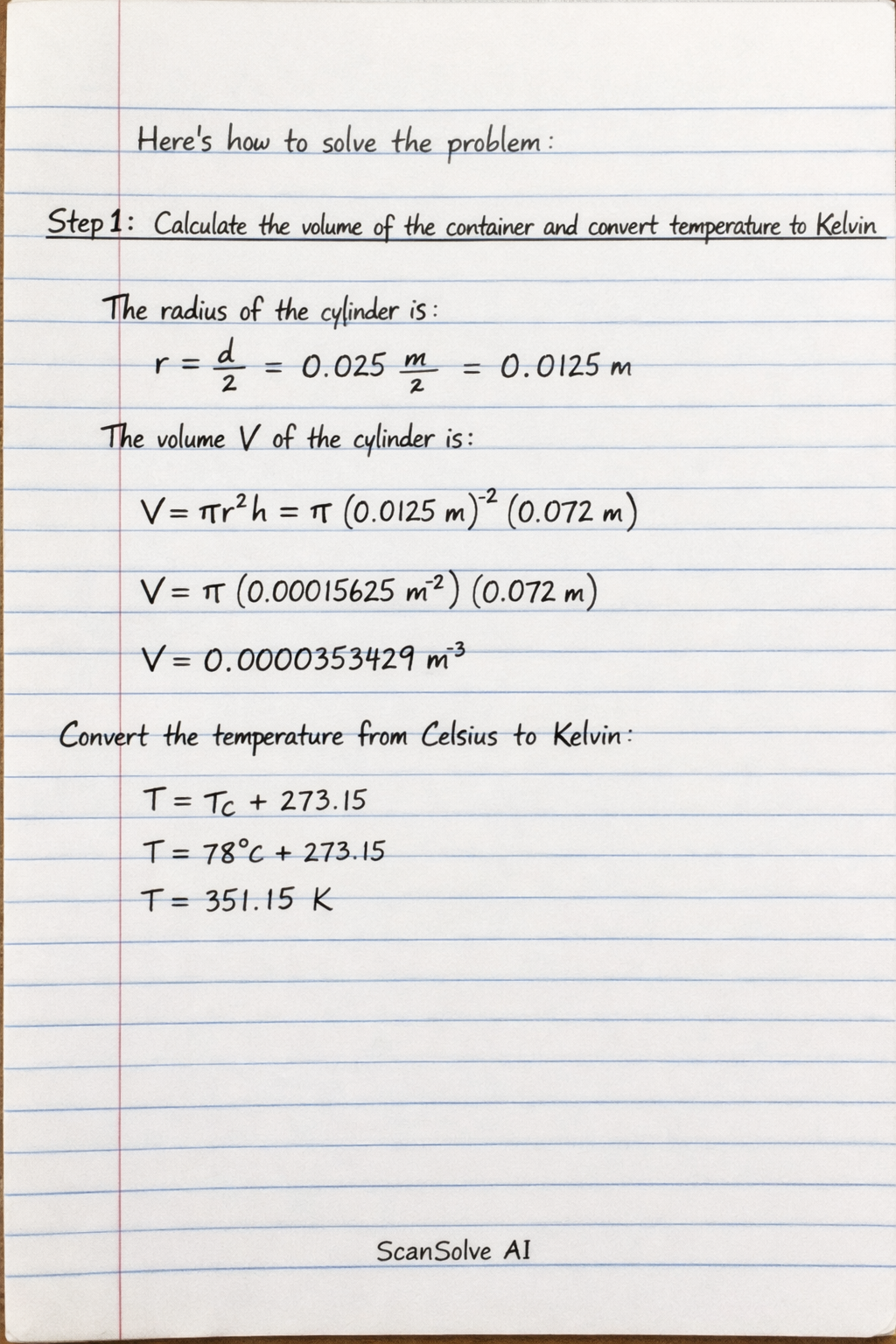
Calculate the volume of the container and convert temperature to Kelvin.
The radius of the cylinder is .
The volume of the cylinder is:Convert the temperature from Celsius to Kelvin:
Part (a) i) What mass of gas is present in the container?
Calculate the number of moles () of gas using the ideal gas law.
The ideal gas law is . Rearranging for :
Calculate the mass () of the gas.
The mass of the gas is the number of moles multiplied by the molar mass:
Rounding to three significant figures:
Part (a) ii) How many molecules of the gas are present in the container?
Calculate the number of molecules ().
The number of molecules is the number of moles multiplied by Avogadro's number:
Rounding to three significant figures:
Part (b) Calculate the average kinetic energy of the gas molecules.
Calculate the average kinetic energy () of the gas molecules.
For an ideal gas, the average translational kinetic energy per molecule is given by:
Rounding to three significant figures:
Try one yourself
A new problem that tests the same skill.
Still stuck on this one?
Ask a follow-up, and the answer starts from this question.
More Physics Questions
Handwritten Step-by-Step Solution
Get this as a handwritten image on WhatsApp — like a tutor wrote it for you.
Try on WhatsApp