
We read your photo as:
A force F acts on an object that moves to the right on a rough, horizontal surface. The velocity of the object decreases. The directions of the resultant force and the acceleration are:
ScanSolve AI Answer
Step-by-step solution
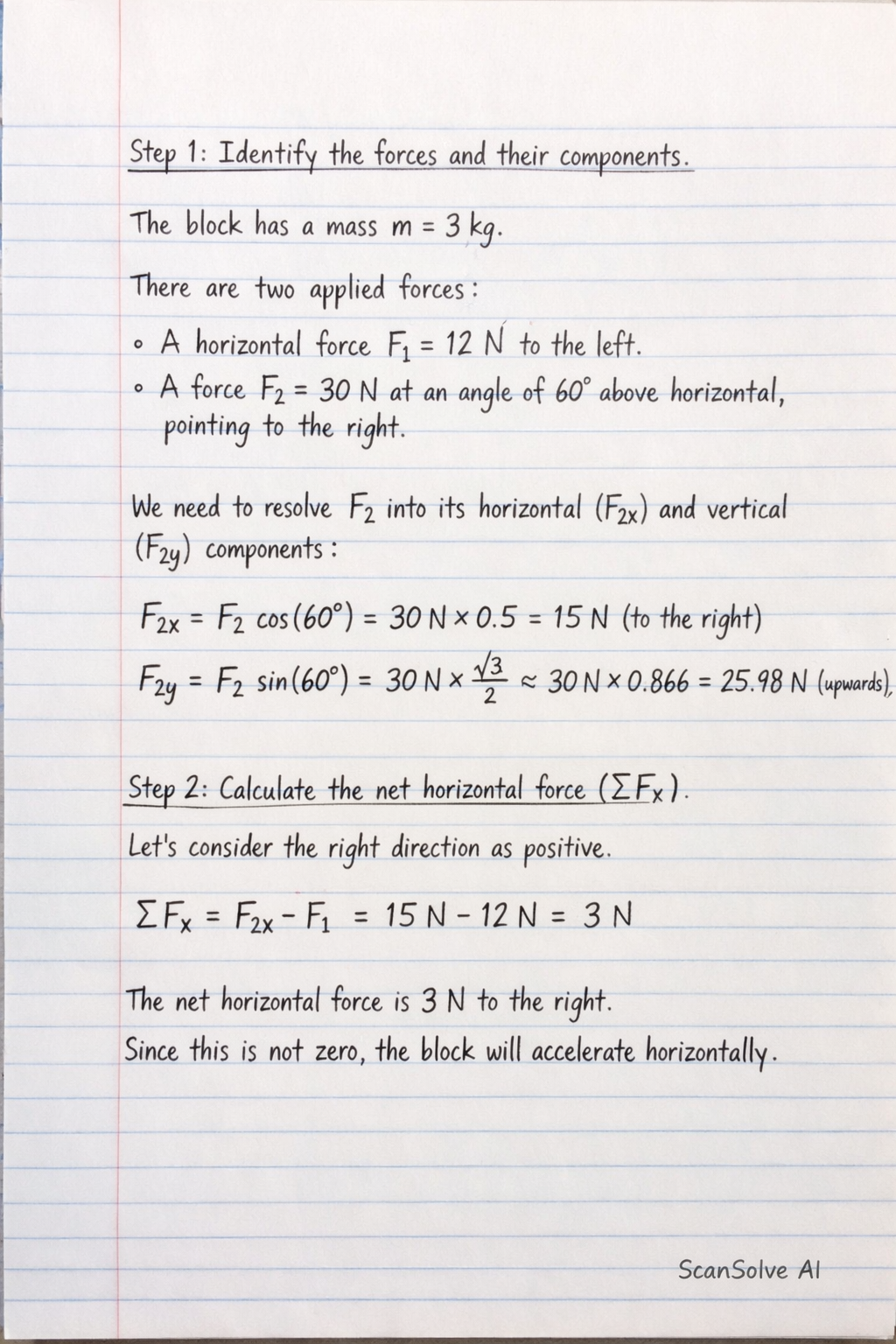
4 stepsIdentify the forces and their components.
The block has a mass .
There are two applied forces:- A horizontal force to the left.
- A force at an angle of above the horizontal, pointing to the right.
We need to resolve into its horizontal () and vertical () components:
Calculate the net horizontal force ().
Let's consider the right direction as positive.
The net horizontal force is to the right. Since this is not zero, the block will accelerate horizontally.
Calculate the net vertical force () to check if the block lifts off.
The gravitational force acting on the block is .
The upward component of the applied force is .
To lift off the floor, the total upward force must be greater than the gravitational force.
In this case, ().
Therefore, the block will not lift off the floor. There will be a normal force from the surface supporting the block.Determine the block's motion.
Since there is a net horizontal force of to the right, and the block does not lift off the floor, the block will accelerate to the right.
The final answer is
Still stuck on this one?
Ask a follow-up, and the answer starts from this question.
More Physics Questions
Handwritten Step-by-Step Solution
Get this as a handwritten image on WhatsApp — like a tutor wrote it for you.
Try on WhatsApp